By Staff Reporter
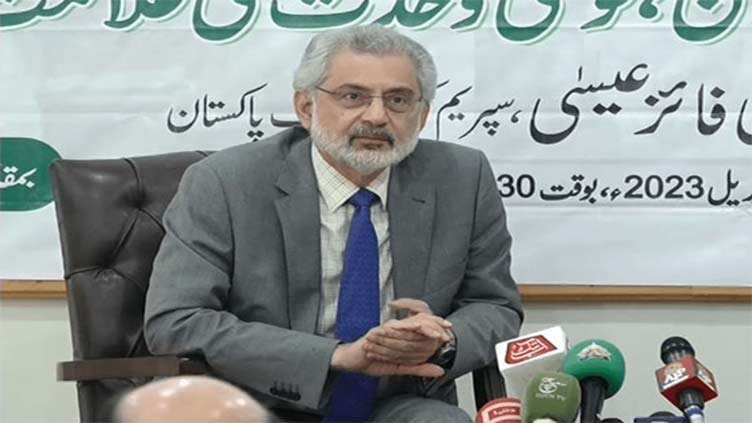
ISLAMABAD: The senior puisne judge of the Supreme Court, Justice Qazi Faez Isa, said the Constitution gave the top court the power to take suo motu notice, and this power was not exclusively for the Chief Justice of Pakistan (CJP).
Justice Isa made these remarks during an event that celebrated the golden jubilee of the Constitution. Justice Isa, who is expected to become the next CJP in September, was asked about the difference in opinion regarding the top judge’s suo motu powers.
On March 29, Justice Isa and Justice Aminuddin Khan ruled that the CJP did not have the power to make special benches or decide its members, and all hearings based on suo motu notices and cases of constitutional significance should be postponed until they were legislated upon.
However, the order was eventually recalled by a six-member larger bench earlier this month.
Justice Isa’s remarks come amid a growing debate about the CJP’s suo motu powers, and a bill aimed at depriving the office of the CJP of powers to take suo motu notice in an individual capacity has also been passed by the Parliament.
However, the implementation of the bill, which is yet to become law, has been curbed by a bench headed by CJP Umar Ata Bandial.
Justice Isa said some of his colleagues believed only the CJP could exercise the right to take suo motu notice, but he believed that only the Supreme Court had this right.
Article 184(3) of the Constitution sets out the Supreme Court’s original jurisdiction and enables it to assume jurisdiction in matters involving a question of “public importance” with reference to the “enforcement of any of the fundamental rights” of Pakistan’s citizens, Justice Isa said.
Justice Isa also spoke about the circumstances when Article 184(3) should be invoked, saying it could not be used to benefit a specific person and should instead be used in matters that affected society as a whole and concerned fundamental rights.
“Where these two things are not applicable simultaneously, this article cannot be used,” he added.
The judge said the term “suo motu” is a Latin phrase that is not even mentioned in the Constitution. There are specific requirements that must be met for a suo motu notice to be taken under Article 184(3), such as if the matter is of public importance or if enforcement of fundamental rights is necessary.”
Justice Esa said his understanding of Article 184(3) is that it is meant to protect those who have been treated unjustly, such as “brick kiln workers, bonded laborers, women who are being deprived of education, forced child labor,” and others who do not have access to legal representation.
He emphasized that the article is intended to protect such citizens, and it has been used “abundantly” in Pakistan.
On the matter of him having differing views from some of the apex court justices, Justice Isa said that having differences did not mean having a huge ego.
“When you are in [an important] role, you should not have any ego. If you possess an ego, you would frown upon him. This is wrong,” Justice Isa said.
The senior apex judge also brought up Article 58(2b) and termed it “another seed of hatred and bitterness.”
The article was inserted by General Zia-ul-Haq, the former dictator of Pakistan, and allowed him to dismiss an elected government when he wished.
Justice Isa criticized the Supreme Court for supporting these steps and said, “It also brings some shame to me that the Supreme Court kept on supporting these steps.”
Copyright © 2021 Independent Pakistan | All rights reserved