By Staff Reporter
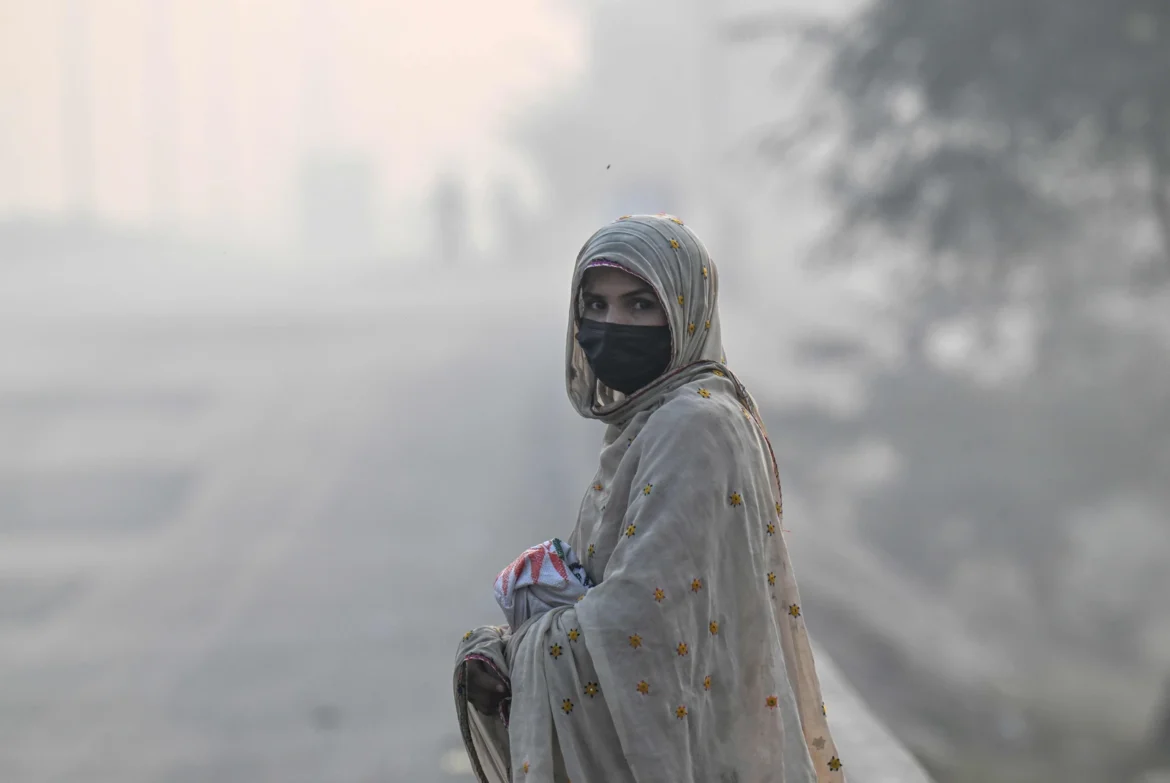
LAHORE: Thick smog smothered Lahore this weekend, pushing one monitoring station to the top of the air quality scale while forecasters held out little hope of rain.
The Punjab Environmental Protection Agency (EPA) said the Wagha border recorded an air quality index (AQI) score of 500 on Saturday evening, a “hazardous” reading. Barki Road, in the same city, logged 288, which is “unhealthy”.
Elsewhere in the provincial capital, Egerton Road registered 175, Shahdara 173, Multan Road 167, Kahna Nau 165, Safari Park 160 and DHA Phase 6 159, all classed as unhealthy for sensitive groups. Punjab University and GT Road, at 149 and 148, were rated “moderate”.
Particulate readings were also high. PM2.5 concentrations reached 108.3µg/m³ at Shahdara, 105.5µg/m³ at Egerton Road, 99.9µg/m³ at Multan Road and 97µg/m³ at Kahna Nau. Wagha border recorded a PM10 level of 683.5µg/m³.
The Swiss monitoring service IQAir put Lahore’s US AQI at 275 on Saturday morning, improving to 172 by the evening. By 10pm the city stood fifth on its live ranking of the world’s most polluted major cities at 204, behind Kuwait City (287), Kolkata (264), Delhi (219) and Kabul (213). Its station readings included 322 in Allama Iqbal Town, 312 in Cantonment and 298 on Burki Road near Paragon City.
The two systems often differ because they use different monitoring networks, station locations, calculation methods and reporting periods. Both pointed the same way.
Lahore did not appear in the EPA’s latest provincial ranking of the 10 worst-affected cities, which was led by Vehari at 369, followed by Multan at 354 and Sahiwal at 329. Gujranwala recorded 323, Sheikhupura 284, Kot Addu 271, Dera Ghazi Khan 270, Pakpattan 247, Nankana Sahib 238 and Wazirabad 233.
The smog has been felt in the city’s hospitals. On Thursday, when the EPA put Lahore’s overall AQI at 312, or “very unhealthy”, at 11am, patients arrived at one hospital with breathing difficulties, eye irritation and other smog-related complaints. Readings that day ranged from 212 near the Wagha border to 449 in Kahna Nau, while IQAir recorded between 195 and 364.
Ahmed Abubakar, who has had heart bypass surgery and is also diabetic, said he had come for a check-up.
“In the smog we get this problem with our breathing and our eyes get infected, which is why we come here for a check-up,” he told Reuters.
A doctor at the hospital said smog-related illness was rising with pollution levels. Lahore’s daily AQI usually falls between 200 and 300, he said, but can occasionally pass 1,000, a threshold the city crossed last November, when IQAir recorded 1,067. He warned of growing risks for residents with existing medical conditions.
Mohammad Niaz Butt, another resident, said the polluted air had left him with nasal congestion, throat problems and burning eyes. He urged the government to ban vehicles that emit smoke, and accused the authorities of going through the motions.
“Here they just go through formalities, a few vehicles are shown for the camera, but the smoke keeps increasing,” he said. “Now the crops have been harvested. They [authorities] say crop residue must not be burned, but they are burning it, and nothing is being done about it.”
The Pakistan Meteorological Department (PMD) forecast dry weather across most of Punjab, with smog likely at isolated places in Narowal, Sialkot, Gujranwala, Lahore, Faisalabad, Kot Addu, Multan, Bahawalpur and surrounding areas. It expected a high of 31C in Lahore. Sunday was forecast to be similarly dry, with fog or smog possible in the morning.
Its weekly outlook warned of smog at isolated places in north-eastern and southern Punjab over the weekend. Rain and thunderstorms were forecast for parts of the country, including the Potohar region, Murree and Galiyat, but the outlook did not suggest widespread rainfall over Punjab.
The Punjab government says its measures are working. A report from the provincial Environment Protection and Climate Change Department found that Lahore’s peak AQI fell by 28 per cent in October compared with the same month last year, and that the city had no hazardous days in October, against four in October 2025.
Local Government Minister Zeeshan Rafique said on Tuesday that anti-smog measures over the past two years had produced encouraging results, and that smog levels this November were noticeably lower than two years ago. He was speaking at the launch of “Chamkta Lahore”, a campaign under which the government plans to wash about 648km of roads each week and deploy rickshaw-mounted mist guns to suppress dust.
The authorities have also stepped up enforcement against smoke-emitting vehicles, brick kilns, industrial units, plastic burning and construction dust, using AI-powered cameras to spot violations, and have put 67 quick response units into farming areas to deal with crop-residue burning.
Independent analysts have urged caution. The Pakistan Air Quality Initiative said weather accounted for most of October’s improvement, and that Lahore’s air exceeded the legal PM2.5 limit of 35µg/m³ on all 31 days of the month. Marriyum Aurangzeb, the senior minister for Punjab, has warned that Lahore could again rank as the world’s most polluted city, blaming polluted air from neighbouring countries in part.
The Punjab AQI dashboard advises residents to avoid prolonged or strenuous outdoor activity when pollution is high, to check air quality before going out, to wear masks and to keep children indoors. Older people and those with respiratory or cardiovascular conditions are urged to take particular care, and people with chronic obstructive pulmonary disease or heart disease are advised to ask their doctors about mask use.
Copyright © 2021 Independent Pakistan | All rights reserved