By Staff Reporter
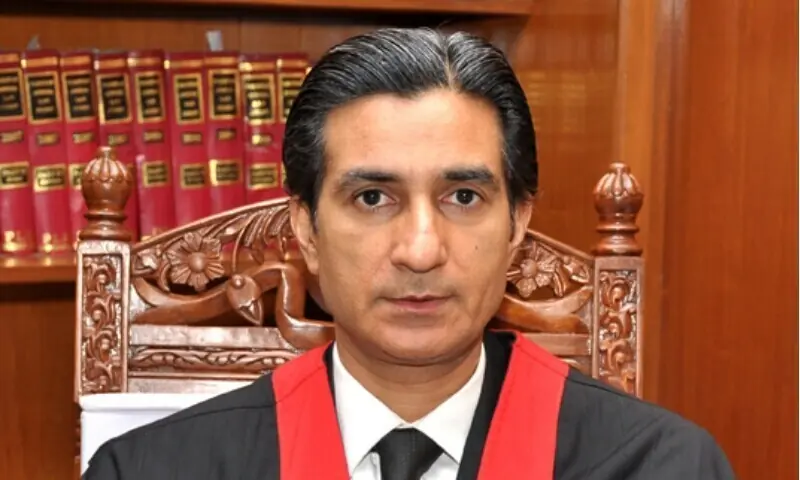
LAHORE: A judge of the Lahore High Court resigned on Saturday, saying he could no longer serve “in good conscience” after the passage of the 27th Constitutional Amendment, in the first departure from a provincial high court since the sweeping changes to the judicial system took effect a day earlier.
Justice Shams Mehmood Mirza, who was appointed as an additional judge in March 2014 and was due to reach superannuation on March 6, 2028, submitted his resignation to the court’s registrar.
The letter cited the recent amendment as the reason he felt unable to continue. The resignation is the latest in a series of protests by senior members of judiciary against legislation that critics, including the International Commission of Jurists, have branded a “flagrant attack” on judicial independence.
On Thursday, two senior Supreme Court judges, Justice Mansoor Ali Shah, the senior puisne judge, and Justice Athar Minallah, tendered strongly worded resignations that directly condemned the amendment.
Speculation has also swirled about possible forced transfers of high court judges, prompting Justices Mohsin Akhtar Kayani and Saman Rafat Imtiaz of the Islamabad High Court to signal they may not be available to hear cases in the federal capital next month.
In a press release issued Saturday evening, the Lahore High Court Bar Association paid tribute to Justice Mirza and urged every judge who had taken oath under the Constitution to follow his example. The amendment, the association said, had “divided the higher judiciary into pieces” and was responsible for the “burial of the Constitution.” It announced a complete boycott of court proceedings on Monday after the disposal of urgent matters.
The 27th Amendment, rushed through Parliament this week by the ruling coalition, makes two profound changes to the judicial architecture. It creates a new Federal Constitutional Court that will assume jurisdiction over all constitutional matters previously handled by the Supreme Court, effectively stripping the country’s highest court of its status as the final arbiter of the Constitution.
Decisions of the new court will be binding on all other courts, including the Supreme Court itself, which under the amended Article 189 will now serve only as the apex forum for ordinary civil and criminal appeals.
Separately, the amendment grants the Judicial Commission of Pakistan the power to transfer high court judges without their consent, a provision that has fueled fears of political interference in judicial postings.
Justice Mirza is the son of the late Justice Zia Mehmood Mirza, a former Supreme Court judge who wrote the sole dissenting opinion in the 1996 case that upheld President Farooq Ahmad Khan Leghari’s dismissal of Prime Minister Benazir Bhutto’s government. In his dissent, Justice Zia Mehmood Mirza argued that there was no evidence of a breakdown of constitutional machinery that could justify the president’s use of Article 58(2)(b), the now-repealed provision that once allowed the head of state to dissolve an elected government.
Copyright © 2021 Independent Pakistan | All rights reserved