By Staff Reporter
ISLAMABAD: The Archbishop of Canterbury’s office on Thursday withdrew an interfaith award it had presented to a prominent Pakistani cleric six days earlier, after remarks he made about Osama bin Laden in 2007 resurfaced and drew condemnation on the 25th anniversary of the Sept. 11 attacks.
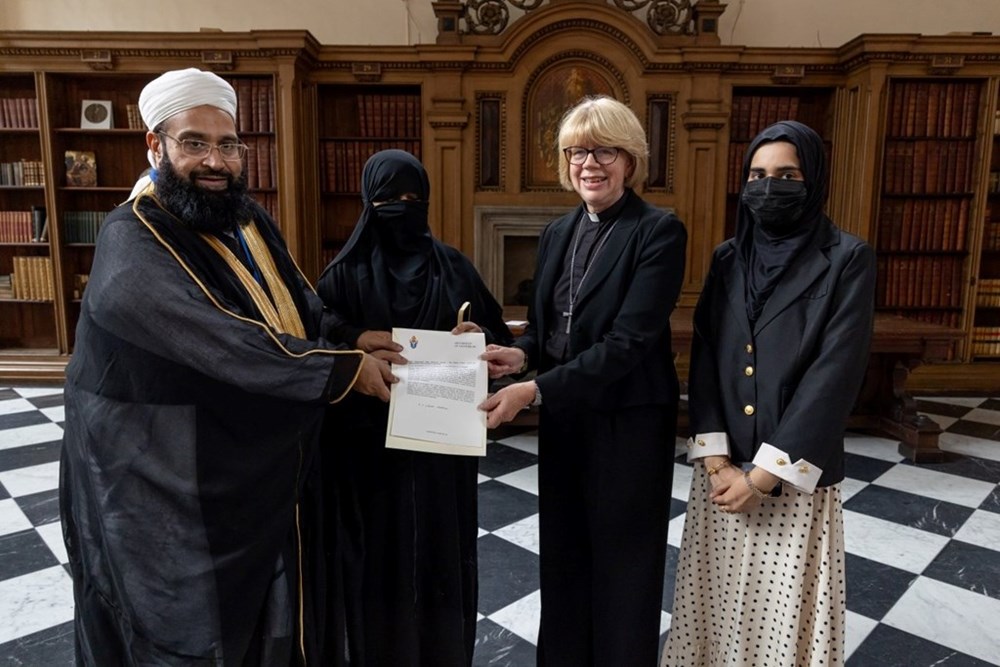
Hafiz Muhammad Tahir Mehmood Ashrafi, chairman of the Pakistan Ulema Council, an umbrella group of Islamic scholars, had received the Hubert Walter Award for Reconciliation and Interfaith Cooperation from Dame Sarah Mullally, the archbishop, at Lambeth Palace on Friday, Sept. 11. He was one of 27 people honoured that day with a Lambeth Award, given for what the church describes as “extraordinary contributions to the Church of England, the Anglican Communion and wider society.”
Lambeth Palace, the archbishop’s London residence and office, said in a statement that “previous comments made by Imam Ashrafi have come to light that have led Lambeth Palace to reconsider this award and we can now confirm today that the award has been withdrawn.”
“We have contacted Imam Ashrafi to make him aware of this decision,” the statement continued.
The palace did not identify the remarks. But the criticism that preceded its announcement centred on comments Ashrafi made in 2007, during protests in Pakistan over Britain’s decision to knight Salman Rushdie, author of “The Satanic Verses,” a novel many Muslims consider blasphemous. Then leading the Pakistan Ulema Council, Ashrafi said he would confer the title “Saifullah,” or “Sword of God,” on bin Laden, the mastermind of the Sept. 11 attacks, for “serving Muslims by waging jihad against infidels,” according to accounts of the remarks. The BBC also reported that he described bin Laden as someone who had “been fighting for Islam against the Russians, Americans and British.”
Ashrafi has said his words were distorted. He told the BBC his remarks had been “totally taken out of context” and called the backlash “an unfair campaign.” He has said he was speaking in response to “the hurt felt by many Muslims” over the Rushdie knighthood, and that he was “giving an example” of the offence it caused. The title, he insisted, was never actually given to bin Laden.
A spokesman for Ashrafi said the remarks had been reported: “without their proper context.”
“His comparison was not an endorsement of bin Laden; it was made in the context of explaining the hurt felt by many Muslims over the British honour given to Salman Rushdie,” the spokesman said. “His longstanding record against terrorism and violent extremism should be considered when assessing such remarks.”
Ashrafi, in a video statement posted on X, went further, alleging that an “Indian and Ahmadi lobby” had played a role in the decision. He did not offer evidence for the claim, and none appears in the reporting reviewed. Ahmadis are a religious minority that has faced persecution in Pakistan. He said the archbishop’s office had asked him to clarify several matters before withdrawing the award, including Pakistan’s blasphemy law, Rushdie, bin Laden and his wife’s hijab. He said he told the office that he supports keeping the blasphemy law but opposes its misuse, and that he would not retract his remarks about Rushdie.
The award had been announced with warm words. A caption on a Lambeth Palace photograph of the ceremony said Ashrafi was being recognised “for his outstanding work as an ambassador of interfaith harmony in Pakistan, known for his commitment to promoting religious tolerance.” The palace later said the honour reflected his “longstanding support for religious minorities in Pakistan, particularly the Christian community — support that is valued by many Christians in Pakistan including its Anglican Church.”
Its withdrawal statement struck a defensive note about the principle at stake. “It is a longstanding principle of interfaith dialogue and co-operation that we must engage with one another across deeply-held differences, and that remains the case,” the palace said. It added that it continues “to pray for the Christian community in Pakistan, and for all those working for interfaith dialogue and harmony in Pakistan and around the world.”
The timing of the ceremony drew the sharpest rebuke. The National Secular Society, a British group that campaigns for the separation of church and state, called the award “obscene, and almost beyond parody,” noting that it was given on the anniversary of attacks that killed nearly 3,000 people, 67 of them British citizens.
“It is obscene, and almost beyond parody, that the Archbishop of Canterbury has awarded an Osama Bin Laden apologist an interfaith award on the anniversary of 9/11,” Alejandro Sanchez, a spokesman for the society, said before the withdrawal. He said the award showed “appallingly poor judgement” and called on the archbishop to explain “what due diligence was undertaken.”
After the announcement, Stephen Evans, the society’s chief executive, said the group welcomed the decision but found it “astonishing that it was given in the first place — on the anniversary of 9/11, no less.” He said the episode revealed “a dangerous naivety about the religious figures legitimised through interfaith engagement,” and used it to renew the society’s call to disestablish the Church of England. “A Church capable of such a serious failure of judgement should not enjoy constitutional privilege, including 26 bishops making our laws,” he said.
Ashrafi’s record on religious minorities has drawn scrutiny apart from the bin Laden remarks. Lambeth Palace had cited his intervention in the 2012 case of Rimsha Masih, a young Christian girl in Pakistan falsely accused of blasphemy. But he has also defended the country’s blasphemy laws, which have led to an estimated 2,000 prosecutions since the late 1980s. Those charged include a disproportionate number of Christians and Ahmadis, though many Sunni Muslims, who make up Pakistan’s majority, have also been prosecuted. Ashrafi has argued the laws “save lives” by stopping people from taking matters into their own hands.
Human Rights Watch said last year that “the laws perpetuate religious discrimination and are used to target the poor and minorities in unlawful evictions and land grabs,” and urged Pakistan’s government to reform them so they are not “weaponised to […] attack marginalised communities.”
The fallout has raised concerns beyond London. Michael Nazir-Ali, the former Anglican bishop of Rochester, said on The Spectator’s Holy Smoke podcast that Pakistani Christians now fear a backlash and that the question remained “why there was not due diligence.” He said “some signal needs to be given that Christians in Pakistan are not responsible for whatever has happened,” and that in his view this would require action from Britain’s Foreign Office.
A separate controversy touched on the photograph from the ceremony, which showed Ashrafi with his wife and daughter, who wore face coverings. After online criticism, his spokesman said the women’s decision “to observe hijab is their personal and religious right,” adding that Ashrafi had dedicated the award to his wife, “acknowledging her support and contribution throughout his work.”
Even as Lambeth Palace was distancing itself from him, another church honored Ashrafi. On Friday, the Church of Pakistan presented him with a Global Peace Award at a ceremony in Lahore, according to the church, recognising his work on peace, interfaith harmony and religious tolerance. Bishop Azad Marshall, the church’s president, presented it and said Ashrafi had continued to promote dialogue among followers of different faiths in Pakistan.
Ashrafi thanked the church and Marshall, saying the Church of Pakistan was working with leaders of other religions and Muslim schools of thought toward peace, national security, and stability. He said joint efforts through the National Paigham-e-Peace Committee would further strengthen interfaith and sectarian harmony and national unity, and pledged to keep working for the protection of the legitimate rights of all Pakistanis.
Copyright © 2021 Independent Pakistan | All rights reserved