By Staff Reporter
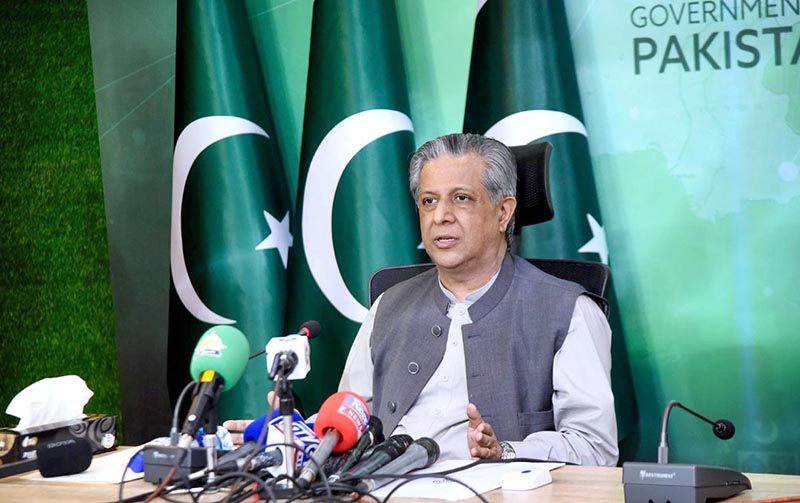
ISLAMABAD: Law Minister Azam Nazeer Tarar said on Saturday that he sees “no indications” of a proposed 28th constitutional amendment, even as his government continues quiet consultations with coalition partners on a range of contentious national issues that could eventually require broad political agreement to resolve.
Speaking to journalists after a conference on minority rights in Lahore, Tarar made clear that any move to amend the constitution would proceed only after exhaustive consultations with allies in the ruling coalition. “We are a coalition government; how can we proceed with constitutional amendments without consultation?” he asked. Meetings with stakeholders are underway, he said, but “several issues remain unresolved” and consensus must first be reached. “Legislation is an ongoing process,” Tarar added.
The minister noted that the contours of any amendment would become visible only once a draft is prepared, and that the government would take all coalition partners into confidence before moving forward. “The constitutional changes can be introduced, [but] only if an agreement is reached,” he said, recalling that the landmark 18th Amendment in 2010 was itself the product of painstaking consensus among political parties.
The minister’s remarks came amid persistent speculation in political circles about a possible 28th Amendment, fueled in part by comments last November from Rana Sanaullah, adviser to the prime minister on political affairs. Sanaullah had said such an amendment, dealing with “public issues,” could be introduced if political consensus existed.
Tarar listed several longstanding demands now under discussion, including population control, the proposed creation of new provinces in Hazara and Saraiki regions, and reforms to strengthen local government systems. He noted that the Muttahida Qaumi Movement-Pakistan (MQM-P) has long pushed for constitutional changes to bolster local governance, and that Prime Minister Shehbaz Sharif had tasked him with building consensus around the party’s suggestions. The coalition has also grappled with broader governance challenges, including disputes over the National Finance Commission award, which determines the distribution of federal resources to provinces.
Tarar’s cautious tone aligned with statements made two days earlier by Pakistan Peoples Party Chairman Bilawal Bhutto-Zardari. At a parliamentary party meeting in Islamabad on Thursday, Bilawal said the government had not contacted him or his father, President Asif Ali Zardari, about any constitutional amendment. “President Zardari and I remain in contact with Prime Minister Shehbaz Sharif, but the government has not contacted the PPP regarding any constitutional amendment,” Bilawal told reporters after the meeting.
He pointedly highlighted his party’s record on previous amendments, saying the PPP had helped pass the 26th and 27th amendments without diminishing provincial rights. “We did not allow the rights of the provinces to be reduced; instead, we expanded them,” he said. “Through our amendments, Balochistan’s representation in the Senate increased.” Bilawal added that while “no talks have taken place yet on the 28th Amendment,” he could not speak for the future. “I do not know about tomorrow.”
State Minister for Law Barrister Aqeel Malik sought to tamp down another line of speculation, rejecting suggestions that any new amendment would amount to a rollback of the 18th Amendment, which significantly devolved power from the center to the provinces. “This impression being created that if the 28th Amendment is introduced, it is a rollback of the 18th Amendment — I believe an extremely false impression is being created,” Malik said during an appearance on a local television.
The ruling coalition, led by the Pakistan Muslim League-Nawaz and including the PPP and MQM-P, has governed for several years through often-fragile alliances. Tarar emphasized on Saturday that the only path forward on major constitutional questions — or on the many governance challenges the government faces — lies in the same model of consensus that guided earlier reforms, including those reached in 2009. “Nothing is clear yet,” he said. “The contours of any amendment become visible once a draft is prepared.”
Copyright © 2021 Independent Pakistan | All rights reserved