By Staff Reporter
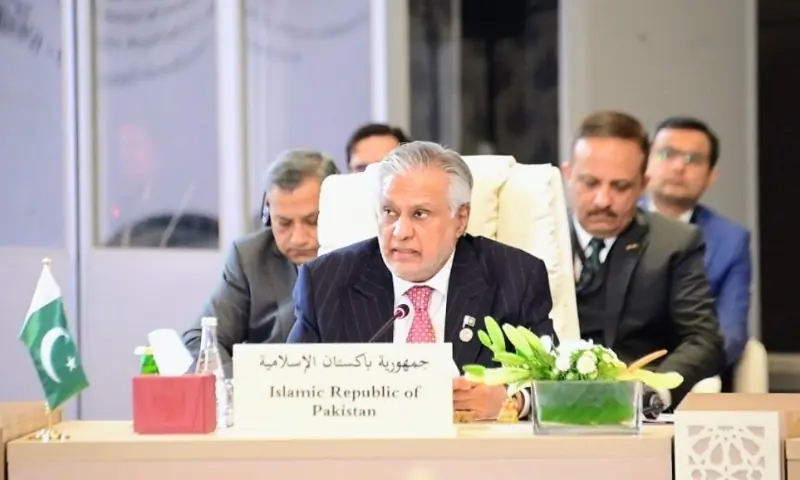
ISLAMABAD: Pakistan’s deputy prime minister has said the newly signed defence pact between Islamabad, Riyadh and Ankara is open to any country in the region prepared to uphold its founding principles, as he moved to clarify the scope of an agreement struck at a moment of acute regional tension.
Ishaq Dar, who also serves as foreign minister, said on Sunday that the Makkah Joint Defence Agreement was “purely defensive” and not aimed at any particular state. His remarks came a day after Turkiye’s foreign minister suggested Egypt was likely to join the pact once a number of technical questions had been settled.
The agreement was signed in the Saudi holy city on Friday by Prime Minister Shehbaz Sharif, Saudi Crown Prince and Prime Minister Mohammed bin Salman, and Turkish President Recep Tayyip Erdogan, at a ceremony held at the Makkah Al-Mukarramah Summit for Joint Defence. It commits the three countries to treat an armed attack on any one of them as an attack on all three, and is intended to deepen collective deterrence at a time when the wider region remains destabilised by the war between the United States, Israel and Iran.
Writing on X, Dar set out the thinking behind the accord in detail. “The Makkah Joint Defence Agreement […] reflects the depth of the brotherly relations between the leadership and peoples of the three countries,” he said, describing it as the product of “years of discussions and coordination” driven by a shared desire to deepen strategic cooperation on peace and security.
He was careful to stress that the new arrangement left existing commitments untouched. The pact, he said, “does not abrogate or replace any existing bilateral or multilateral agreements” the three countries hold with each other or with outside states and organisations. That distinction matters in practice: Pakistan and Saudi Arabia are already bound by a bilateral Strategic Mutual Defence Agreement signed in September last year, while Turkiye remains a member of Nato.
On the substance of the mutual-defence clause, Dar said the commitment that an attack on one signatory would be treated as an attack on all was rooted in the “inherent right of individual and collective self-defence” recognised under Article 51 of the UN Charter. He repeated that the accord was “purely defensive” and carried no hostile intent toward any state.
“It is not targeted against any country and its sole purpose is to further strengthen our ongoing efforts towards peace, stability and prosperity in the wider region,” he wrote.
Dar went further, indicating the pact was designed with room to grow. “The Makkah Accord remains open to any country in the region willing to uphold its fundamental principles and resolve differences through mutual respect, cooperation and peaceful means,” he said, adding that the agreement sat comfortably within “the fundamental pillars” of Pakistan’s foreign policy.
He closed his remarks with a broader statement of intent. “Pakistan looks forward to continuing to work closely with all brotherly countries in the region towards lasting peace and stability,” he said. “We remain committed to advancing the cause of peaceful resolution of all conflicts and building a more secure, stable and prosperous future for our peoples.”
Later on Sunday, Dar held a call with his Canadian counterpart, Anita Anand, in which the two discussed the regional picture, including the Makkah agreement itself. According to Pakistan’s Foreign Office, Dar briefed Anand on “the essence of the agreement and the joint resolve of the three countries to contribute to regional peace, stability and security”.
Turkiye signals Egypt could follow
Dar’s comments followed remarks the day before from Turkish Foreign Minister Hakan Fidan, who told the state-run Anadolu news agency that he expected Egypt to eventually join the pact once a handful of technical matters had been resolved.
“Egypt is already our natural partner on all issues,” Fidan said. “I believe that at the next stage, Egypt will also be among us in the alliance. We already act toward one another as if we were alliance members. There are a few technical issues. Once these are implemented, there is no reason for Egypt not to be part of it.”
Fidan said other countries had also expressed interest in joining, though the three founding members were still working through how any expansion should be managed. Some of the interested states had asked not to be identified publicly, he said. The preferred approach, he explained, was for Turkiye, Saudi Arabia and Pakistan to remain the three core founders responsible for setting the alliance’s principles, standards and long-term structure, with other countries able to join subject to the founders’ approval.
“Under our president’s vision, we should not remain limited to three countries,” Fidan said. “We should grow.”
He also argued that Pakistan’s involvement meant the initiative already reached beyond the conventional boundaries of the Middle East, giving it what he described as a broader regional character than its geography might first suggest.
A pact modelled on Nato’s Article 5
Fidan drew a direct comparison between the new agreement and Nato’s own mutual-defence clause, describing the Makkah pact as “technically the same” as Article 5 of the North Atlantic Treaty, under which an attack on one member is treated as an attack on all, obliging allies to take whatever action they judge necessary, including military force, to assist.
He said the Makkah agreement’s text set out similarly general commitments, with the practical detail of how support would be delivered left to future discussion among member states. Under the pact, a country under attack would submit a request specifying the type of assistance it needed, which could range from intelligence-sharing and logistics to ammunition or, in more serious cases, military units, depending on the scale of the threat. The nature and extent of any response would then be settled by consultation among the signatories. Fidan added that no country would be regarded as a threat unless it actually attacked a member state.
He was explicit that the alliance was not conceived with Iran, or any other specific country, in mind, describing it instead as a general commitment by the three states to support one another’s security. Talks on the initiative, he noted, had begun before the current war era, at a point when there was no US-Israel military campaign against Iran, and other regional states had also taken part in the discussions that eventually produced the agreement.
Fidan characterised the three founding members as states without expansionist ambitions. “They are countries concerned with their own borders, their own problems and their development, and, if possible, they want to contribute positively to their environment through good relations and good neighbourliness,” he said, adding that while the three brought different styles and capacities to the table, together they had produced something inherently defensive rather than offensive in character.
“It is not an approach of going on the offensive and saying, ‘Let’s do this or that together,'” he said. “Therefore, unless it is attacked by a country, whether from inside or outside the region, this alliance cannot have any dispute with any country. But, of course, the power composition we have put forward will make a constructive contribution to regional stability.” He described the agreement as the “most important step” toward securing lasting stability in the region.
How the alliance will operate
Fidan set out the institutional architecture envisaged for the pact, which he said would function through a political and military committee made up of foreign and defence ministers together with each country’s chief of general staff — a structure he likened to Nato’s own. That committee, he said, would be responsible for turning the leaders’ broad vision into concrete decisions, with a secretariat then established to carry those decisions out.
He suggested that at the committee’s first meeting, ministers were likely to put forward proposals to their leaders covering the secretariat’s establishment, structure, function and initial priorities. The pact’s remit, he said, would extend across a wide span of military cooperation, including interoperability between the three countries’ differing military systems, joint training, mutual support, logistics, threat assessment, intelligence sharing and, he stressed, cooperation across their respective defence industries.
The committee would meet periodically through the year, Fidan said, with a permanent secretariat to be based in Saudi Arabia; further detail on its structure, functions and any additional units would be worked out among the member states. He said joint exercises and training would be essential to establishing genuine interoperability between the three militaries.
“Because after a while you will see that when you find yourselves in a common combat scenario, how your weapons systems and communications systems will communicate with one another and how they will be compatible are important issues,” he said. “These are the things that will be done after the secretariat is established.” Common standards would need to be developed, he added, alongside ongoing analysis and assessment work.
Fidan said the agreement had drawn strong support from across the Muslim world, including from states that were not signatories but had welcomed the pact regardless. He said there were also sympathisers in the West who understood what the initiative was trying to achieve.
“Especially in the Islamic world, there are many who strongly support this issue,” he said. “There are also supporters in the West, among those who understand the essence of the matter. The way for the Middle East to cease being a place that produces problems for humanity and the international community and instead become a place that creates added value with everything it possesses is through implementing constructive alliances of this kind.”
He said the leaders of the three countries had, in signing the agreement, raised significant expectations both regionally and globally, and that it now fell to officials to meet those expectations through careful, professional work. “Our responsibility, in the positions we hold, is to recognise that the political will put forward by the leadership of the three countries has created a very significant regional and global expectation,” he said. “We need to fill that expectation very professionally, move forward step by step and make it work. We have begun doing this, and God willing, we will continue.”
The agreement was signed against a backdrop of significant upheaval across the Middle East, with the ongoing US-Israel war on Iran having disrupted shipping through both the Strait of Hormuz and the Red Sea, and with Pakistan continuing to navigate its ties to both Middle Eastern and Western partners.
Analysts say the pact reflects a broader shift, with several in the region viewing it as part of a wider trend of Gulf states taking on greater responsibility for their own security, rather than relying solely on outside guarantors. Israel’s increasingly assertive military posture in recent years, they add, has become a significant factor shaping how Saudi Arabia, Pakistan and Turkiye each assess the security environment they now face.
Saudi Arabia has for decades anchored its security around its relationship with Washington, and experts are clear that the new pact is not intended as a substitute for that relationship, but rather as an additional layer alongside it. “The regional states are not seeking to sever ties with Washington, but neither do they want to entrust their security exclusively to American guarantees,” one analyst said.
Copyright © 2021 Independent Pakistan | All rights reserved