By Staff Reporter
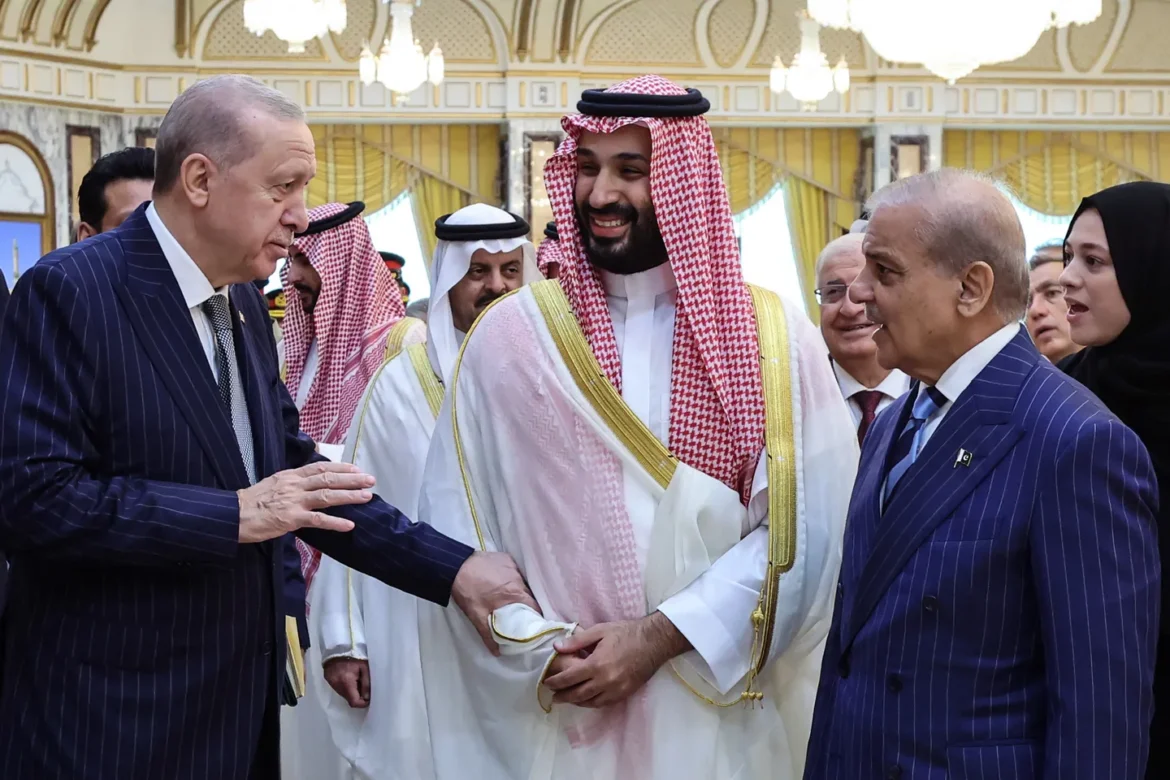
Diplomatic language is designed to bore you into missing what’s actually being said, and Friday’s Mecca Joint Defence Agreement is a case in point. Saudi Arabia, Turkey and Pakistan have promised that an attack on one is an attack on all — words borrowed almost wholesale from Nato’s founding charter — and every official statement that followed insisted, with slightly too much enthusiasm, that this is nothing like Nato at all. No shared command. No standing force. No clarity on what any of the three has actually agreed to send when the phone rings. Saudi Deputy Minister Rayed Krimly went out of his way to say the pact was not a military axis, not a sectarian bloc, and had nothing to do with nuclear ambitions.
There isn’t much in the fine print. The timing tells you more.
Since February, when the US and Israel opened their war on Iran, the old Gulf bargain has been fraying. Washington guarantees security, the oil keeps moving, America keeps its bases — that was the deal, more or less, since the aftermath of Iraq’s invasion of Kuwait. Except Iranian missiles have hit Saudi refineries and a US embassy compound. The Strait of Hormuz has been repeatedly threatened, sometimes closed outright, and Tehran has shown it can restrict traffic through it more or less at will regardless of how hard Washington and Israel have hit back. American air-defence stocks, stretched thin by what Israel needed, left Gulf partners watching munitions go somewhere else while their own skies stayed exposed. That is not the kind of thing an ally forgets quickly, and it isn’t the only grievance sitting underneath this pact — several US partners in the region have made no secret of their frustration that the war on Iran was launched with what looked like very little thought given to how it would land on them.
So a hedge gets built, and three governments bring three different things to it. Pakistan supplies the sort of institutional muscle that comes from decades of training Saudi forces and roughly 8,000 troops already stationed in the kingdom, alongside fighter jets, drones and an air-defence system deployed there under existing arrangements. It also brings something nobody in Riyadh or Islamabad will say out loud, which is that Pakistan happens to be the only nuclear power in the Muslim world, and that fact does not need spelling out to register. Turkey supplies drones, precision munitions, naval platforms and a defence-export machine that has made Ankara one of the fastest-growing arms suppliers anywhere from the Gulf to Central Asia — Riyadh is already a major buyer of Turkish drones. Saudi Arabia supplies the money, the geography and the urgency, being the country with the most exposed energy infrastructure, the deepest financial resources, and the least appetite for finding out the hard way whether Washington shows up next time. It’s worth noting the framework doesn’t replace the bilateral defence agreement Riyadh and Islamabad signed last September — it builds on it, folding a partnership that already existed into something wider rather than starting from nothing.
None of which alters the actual balance of power. Iran still has its missiles, its proxies, its grip on one shore of Hormuz. Israel’s qualitative military edge, backed by American technology and money, isn’t going anywhere. American bases across the Gulf remain, in scale and sophistication, unmatched. What the pact changes is quieter than any of that — it’s the arithmetic in an aggressor’s head. Attack Saudi Arabia now, and you at least have to wonder whether Ankara or Islamabad responds too. Nobody has defined what that response looks like, and the vagueness is doing real work: an adversary planning around a known quantity finds it easier than planning around an unknown one. That’s precisely why the pact’s architects have left so much unsaid — a looser commitment complicates an enemy’s planning without tying the allies’ hands.
Burcu Ozcelik at Rusi has warned against reading this as evidence of “a post-American Middle East,” and she has a point worth taking seriously: this fits, in her words, a broader American preference for regional partners to shoulder more of their own security burden rather than a rejection of Washington’s role altogether. Nobody involved is walking away from the United States — what’s changed is the willingness to admit, in public, that one umbrella might not be enough. — that’s the phrase one King’s College London academic used, and it’s the right one. This is insurance, not divorce.
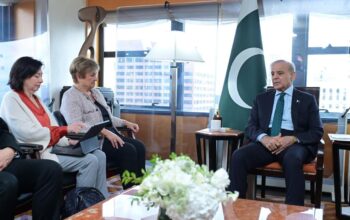
There’s a Pakistani angle worth dwelling on, because it’s easy to miss amid the Saudi and Turkish headlines. Islamabad has spent this year quietly becoming indispensable — helping broker dialogue between Iran and the US during the crisis, launching a four-way diplomatic coordination mechanism with Turkey, Saudi Arabia and Egypt, and now locking in a defence relationship that gives it relevance well past South Asia. Former Pakistani senator Mushahid Hussain went further than most of the region’s diplomats have been willing to on the record, calling the pact a direct counter to Israeli expansionism and framing it partly around what he described as an emerging India-Israel axis. That reading will find more sympathy in Islamabad than in Riyadh or Ankara, and it’s a reminder that a trilateral pact doesn’t mean three identical sets of motives — each capital signed the same document for a different reason. For an economy that leans heavily on Gulf investment and remittances, Pakistan’s gains have a fairly direct exchange rate: joint production, defence exports, the kind of leverage that doesn’t show up in a joint statement but shows up in a budget a year from now.
The one relationship the pact doesn’t settle is with Iran, and that’s by design rather than oversight. Every government involved has said, in one form or another, that this isn’t aimed at Tehran — Munir Akram, Pakistan’s former UN envoy, has pointed out that Iran’s own president welcomed the earlier Saudi-Pakistan bilateral deal and had floated a regional security arrangement himself. Whether that goodwill extends to a trilateral pact built around a nuclear-armed state is a separate question, and one the three governments will have to keep answering rather than settling once.
None of that changes what already makes Friday’s signing worth taking seriously, regardless of whether the pact is ever tested. Three governments looked at a security guarantee they’d relied on for decades and decided, in public, that it wasn’t enough on its own. That’s the actual news. Whatever this framework becomes — a template other Gulf states join, or a document that mostly just exists — the decision to write it down at all marks a region no longer content to wait and see whether Washington shows up.
Copyright © 2021 Independent Pakistan | All rights reserved