By Staff Reporter
ISLAMABAD: A wave of militant attacks across Pakistan’s restive southwestern province of Balochistan has killed 42 people over the past four days, including 27 police officers, 11 soldiers, and four civilians, the military said on Wednesday, in one of the deadliest bursts of violence the region has experienced in months.
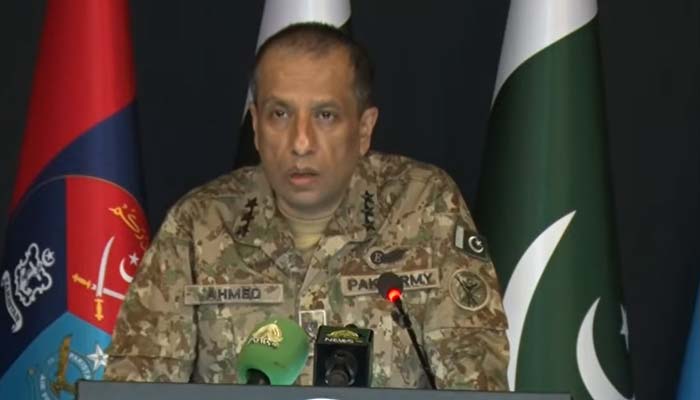
Speaking to reporters at a nationally televised briefing in Rawalpindi, Lieutenant General Ahmed Sharif Chaudhry, the director general of the military’s Inter-Services Public Relations wing, said security forces had killed 54 militants in the fighting, though he cautioned that clashes were continuing in several parts of the province and that the death toll could still rise.
“Forty-two precious lives of this country … they gave their lives while protecting their country,” Lieutenant General Chaudhry told the assembled press, his voice hardening as he ran through the toll. “So, in the three major operations that I told you about, initially four civilians, and then police and army jawaans were martyred, so our total martyrs are 42.”
The bloodshed unfolded in three distinct assaults over four days, each in a different corner of Balochistan, Pakistan’s largest province by area but its least populated, a vast expanse of desert and mountain that shares long, porous borders with both Afghanistan and Iran. It has been the epicenter of a decades-old separatist insurgency and, increasingly, a staging ground for attacks by Pakistani Taliban militants who the government says now operate with near impunity from havens across the Afghan frontier.
The first attack began overnight between July 4 and July 5, when gunmen the military identified as belonging to the banned Tehrik-e-Taliban Pakistan, stormed the Hanna Urak valley on the outskirts of Quetta, the provincial capital, opening fire on local residents. Four civilians were killed and six others wounded, according to the ISPR account, before villagers themselves took up arms and drove the attackers back.
“Fitna al Khawarij terrorists attacked the innocent local population,” Lieutenant General Chaudhry said, using the government’s official designation for the TTP and its affiliated networks, a phrase that translates roughly to “tribulation of the rebels” and that Pakistani officials have adopted in recent years in place of the group’s own name. He said the residents of Hanna Urak “fought back very valiantly” and “forced those terrorists belonging to Indian proxy Fitna Al Khwarij to flee.”
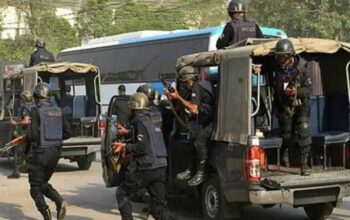
The violence escalated sharply the following night, when militants launched a “multi-directional attack” on a police checkpost guarding the pumping station that feeds the Mangi Dam, a critical water source for the city of Quetta, in the mountainous district of Ziarat. Nine police officers, including two station house officers, were killed in the initial assault late Monday, though the outnumbered force inflicted heavy losses of its own, with 15 militants killed in the firefight.
What followed was described by the military as a tense, days-long standoff in the mountains above Ziarat. Reinforcements from the army and the Frontier Corps, a paramilitary force that polices Pakistan’s western border regions, were dispatched to the scene but arrived too late to prevent militants from seizing roughly 18 police officers who had survived the initial attack and retreating with them into the surrounding terrain.
Lieutenant General Chaudhry said commanders made a deliberate decision to hold off on air power once it became clear the militants were holding captives. “We were very careful because of the collateral damage not to use any aerial assets because they had taken our youth hostage,” he said. Ground forces instead moved to encircle the militants over the following two days, tightening a cordon around the mountainous terrain where the hostages were being held.
That containment effort ended in tragedy Wednesday, when the military said the trapped militants, sensing that they were surrounded, executed the police officers they were holding rather than surrender. “During this time, several khariji were killed as well, and once they knew that the net around them had been absolutely tightened, these cowards, low-lives martyred 18 brave personnel of Balochistan,” Lieutenant General Chaudhry said. “They did that today.”
The general said the operation in the mountains around Ziarat was still active as of Wednesday’s briefing, with 11 additional militants killed in the fighting, bringing the total number of militants killed in connection with the Ziarat attack to 26 — 15 whose bodies were recovered at the checkpost and 11 more confirmed since. Combined with the nine officers killed in the initial assault and the 18 executed later, the toll from Ziarat alone stood at 27 police officers dead, more than the combined toll from the other two attacks.
The third and most recent attack occurred Wednesday morning, when terrorists from the Balochistan Liberation Army, a separatist group that has for years waged an insurgency seeking independence for the province, ambushed a military convoy traveling near the N-25 national highway between the towns of Bela and Winder, roughly 100 miles southwest of Karachi. Eleven soldiers — one junior commissioned officer and 10 enlisted men — were martyred in the engagement, while security forces killed 14 militants, according to the ISPR.
The military attributed the Bela ambush to a faction of “Fitna al Hindustan,” a term Pakistani officials use for militant networks financed and directed by India to destabilise the country. Lieutenant General Chaudhry said security forces killed six additional militants from that network in a separate operation in Kharan, in southern Balochistan, and eight more in Dalbandin, near the Iranian border, bringing the day’s nationwide militant death toll, combined with the ongoing Ziarat operation, to 54.
A REGION UNDER SIEGE
The attacks lay bare the depth of the security crisis gripping Balochistan, a province that is home to significant natural gas reserves and to Gwadar, the deep-water port at the heart of Pakistan’s multibillion-dollar economic partnership with China, but that remains the country’s poorest and most underdeveloped region. Its population has long complained of being denied a fair share of the wealth extracted from its soil, grievances that have fueled the Baloch separatist movement for decades even as the TTP, a separate and largely unrelated insurgency rooted in religious extremism, has increasingly used the same rugged terrain to stage its own attacks.
Pakistani officials have grown increasingly vocal in recent months in accusing the Taliban government in Kabul of tolerating, if not actively enabling, militant sanctuaries just across the Afghan border. Lieutenant General Chaudhry pressed that argument further on Wednesday, asserting that the “majority” of militants killed or captured by Pakistani forces in recent operations have turned out to be Afghan nationals, and that the June 27 attack on a paramilitary Rangers camp in Karachi, in which three of the four attackers were identified as Afghan, had been planned and equipped entirely from across the border. “The whole planning, equipping, everything was done from Afghanistan,” he said.
Relations between the two neighbors, never easy, have deteriorated sharply over the past year. Islamabad has accused Kabul of failing to rein in the TTP despite repeated warnings, tensions that have spilled into border closures, sporadic exchanges of fire between the two countries’ security forces, and Pakistani airstrikes on suspected militant hideouts on Afghan soil. Afghanistan’s Taliban government has dismissed the accusations as unfounded and has accused Pakistan of violating its sovereignty.
Lieutenant General Chaudhry went further Wednesday, casting the violence in Balochistan as a proxy campaign directed by India and aimed specifically at undermining the province’s economic development. “You do not want Balochistan to prosper?” he said, addressing the militants and, implicitly, their backers directly. “Because you know that Balochistan is Pakistan’s lifeline and its pride. Because you know that Balochistan’s prosperity is a reality that no one can change. You cannot digest it? You cannot accept it? You have a problem with the pipeline supplying water to Quetta? You have a problem with everything that is for the people of Balochistan.”
‘WE WILL HUNT YOU’
Lieutenant General Chaudhry’s tone shifted from clinical recitation of the day’s casualties to open defiance as the briefing wore on, delivering a series of warnings aimed squarely at the militant groups and the governments he said were sheltering them. He said the armed forces, operating under the command of Field Marshal Asim Munir, Pakistan’s chief of defence forces, and with the backing of the civilian government, had reached a point of unambiguous resolve. “We will hunt you and we will hurt you everywhere.”
He said that resolve was shared by civilian leaders in Balochistan, noting that the province’s chief minister, Sarfraz Bugti, had traveled by road to Ziarat in the aftermath of the Mangi Dam attack to meet with residents there, rather than waiting for the security situation to stabilize. Lieutenant General Chaudhry argued that a sustained government campaign over the past three years to expel undocumented Afghan migrants and to separate the militants’ cause from mainstream Baloch political grievances — insisting publicly that the violence has “nothing to do with Islam” and that the India-linked networks have “nothing to do with Balochiyat,” or Baloch identity — was beginning to unsettle the militants themselves.
“The government is telling them that we will throw out all these illegal Afghans, then they have a problem with that,” he said. “They think by carrying out such acts, they can deter us. You can only deter someone who knows how to be deterred. Nobody has been born in the world who can deter the Pakistani state.”
He closed with an unqualified rejection of any suggestion that the recent violence might prompt Islamabad toward negotiation. “Don’t expect any sort of rationality and proportionality from us if you are going to touch our kids, our brave policemen, our soldiers and our innocent citizens,” he said. “And then you think we will adopt rationality and proportionality and will hold a dialogue with you?”
The general vowed that security forces would pursue “each and every terrorist, their facilitators, those who harbour them, those who furnish them, those who provide them bases, wherever they are, without any distinction,” and said engagements were continuing in multiple locations across the province as of Wednesday evening, with additional casualties possible on both sides. “We are here and we will remain here,” he said. “Pakistan is here, Balochistan is here and the people of Balochistan are here.”
Copyright © 2021 Independent Pakistan | All rights reserved