By Staff Reporter
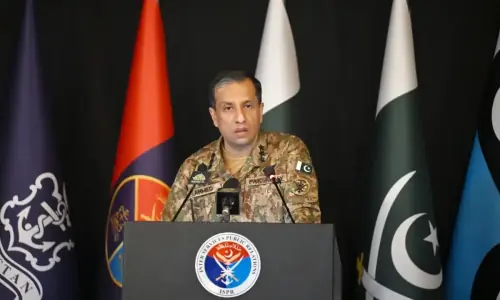
RAWALPINDI: The head of military media wing on Friday sharply rebuked the jailed founder of the country’s main opposition Pakistan Tahreek-e-Insaf party, Imran Khan, accusing him of fomenting an “anti-army” narrative that has escalated into a national security threat, potentially in collusion with foreign adversaries.
In a forceful press conference at military headquarters, Lt. Gen. Ahmed Sharif Chaudhry, director general of the Inter-Services Public Relations, described Khan’s rhetoric as the product of a “delusional mindset” driven by ego and narcissism. He warned that such attacks on the armed forces were no longer mere politics but a danger to the state’s integrity.“
That threat emanates from a delusional mindset of a delusional person who has become captive to his own ego, thinking that his wishes are bigger than those of the state of Pakistan,” General Chaudhry said, in an apparent reference to han, the former prime minister who has been imprisoned since 2023 on corruption and other charges that he denies. “His ego, his wishes, and frustrations have grown to such an extent that he thinks that the world would cease to exist without him.”
Chaudhry’s criticism comes in response to Khan’s latest statement, released by his account on social media platform X on Thursday, in which he blamed Chief of Defense Forces Field Marshal Asim Munir for “the complete collapse of the constitution and rule of law in Pakistan.”
The remarks underscored the deepening rift between Pakistan’s powerful military and Khan’s PTI, which has accused the army of orchestrating his ouster in 2022 and manipulating subsequent elections. General Chaudhry’s comments came amid rising tensions, including PTI demands for access to Khan in Adiala Jail and speculation about potential bans on the party or governor’s rule in Khyber Pakhtunkhwa Province, where PTI holds power.
General Chaudhry emphasised that the military, drawn from diverse ethnic, religious and socioeconomic backgrounds across Pakistan, serves the nation above all else. “We are the armed forces of Pakistan, we don’t represent any ethnicity, don’t represent any language, religious inclination, political thought or school of thought,” he said. “We have people from all areas of Pakistan, all religions, all sects, all languages, and all political views, but we put all that aside once we wear this uniform.”
“That is our pride, that is our honour; we strive, we die daily not for some language, area or political viewpoint. We strive and die on a daily basis for the people of Pakistan, for the integrity of Pakistan. And that we say very clearly, and we also don’t come from the elite class of Pakistan, we belong to the middle, lower-middle, and the poor socio-economic classes; we do not carry the flag of any political actor, class or elitism; This is your armed forces, and we are absolutely clear about the character of the armed forces of Pakistan, starting from a soldier all the way up to his field marshal.”
The general warned that the military would not tolerate efforts to sow division between the armed forces and the public. “No one can be allowed to create fissures between the people and the armed forces of Pakistan,” he said. “Why? Because this is the only armed force that you have. You don’t have a choice; this country doesn’t have any other armed forces.”
He portrayed the army as a bulwark against external threats, including what he called the “Hindutva mindset” in India and terrorist groups operating from Afghanistan. “It is these armed forces that are standing between the khawarij, terrorists, fitna al-khawarij, fitna al-Hindustan operating from Afghanistan and the people,” General Chaudhry said, invoking a famous saying: “Every country has an army. It is a famous saying that there will always be an army in a country, but if it is not yours, it will be your enemy’s. So, the one who attacks their own army and its leadership, is he trying to create space for someone else’s army? What is his design? Why is he trying to do that?”
Without naming Khan, General Chaudhry played a video clip of his anti-army posts on social media to illustrate his points. He accused Khan of building a narrative against the state during meetings with visitors in jail, questioning the legality of such actions. “Tell me, under which law, rules and Constitution can this be allowed? Which politics in Pakistan allows you to go and meet a convict, and a narrative is continuously built from there against their own country’s armed forces? Which constitutional provision allows this?” he asked.
Citing Pakistan’s Constitution, the general noted restrictions on freedom of expression. “You talk about Article 17 of the Constitution and freedom of expression, it clearly says that freedom of expression and political activity are permitted, subject to reasonable restrictions,” he said. “Under reasonable restrictions, nothing can be allowed that will be against the security and integrity of the state. Article 19 says freedom of expression is allowed, it absolutely is, but such freedom of expression cannot be allowed that goes against the security, integrity and defence of Pakistan.”
General Chaudhry listed examples of Khan’s alleged efforts to undermine the state, including calls to halt remittances, a letter to the International Monetary Fund urging it to withhold aid, and advocacy for civil disobedience like refusing to pay electricity bills. “He then resorts to civil disobedience, doesn’t pay electricity bills, so that anarchy is spread in the country,” he said. More recently, the general claimed, Khan had urged followers to target army leadership, despite the military’s sacrifices in operations against superior foes. “Who would actually benefit from such a narrative?” General Chaudhry asked, suggesting it aligned with agendas in New Delhi. “That agenda can only come from someone in Delhi. Someone sitting there and guiding that, who wishes that this army, which is your armour against kharjis and terrorists, sacrificing their lives, stops doing it. This agenda and narrative cannot come from elsewhere.”
He pointed to social media accounts amplifying Khan’s messages, many operated from abroad and linked to Indian media and intelligence. Calling Khan a “mental patient,” the general described a recent tweet from his account that went viral through unnamed troll accounts. “These accounts are being operated from outside Pakistan. They carry forward this narrative, but they originate from this mental patient’s post,” he said. Afghan social media, he added, also spread the rhetoric as “facilitators of the khawarij.” “It is a collusion because they have the same purpose and the same enemy, i.e. the Pakistan Army and its leadership,” General Chaudhry said.
He criticised Khan’s labeling of PTI members who attended an event at the National Defence University as traitors, implying it extended to the military itself. “By that logic, he is also saying that anyone in the ISPR and army is also a traitor, because they too went to NDU, he believes anyone who even is linked [to the army] is a traitor,” the general said.
Quoting Abraham Lincoln, he repeated: “I will again repeat that you can fool some of the people all the time, you can fool all of the people some of the time, but you cannot fool all of the people all the time.” He declared an end to PTI’s “political trickery” and urged the party to focus on governance in Khyber Pakhtunkhwa rather than obsessing over the army. “Please grow up. Talk about real issues,” he said.
General Chaudhry lambasted PTI’s stance on terrorism, questioning calls for talks with militants. “Tell me, can the state’s security be sublet? Is appeasement a security policy?” he asked, warning that such approaches invited aggression, as seen in Libya and Gaza. He alleged a “terror crime nexus” in the province, with political patronage shielding terrorists for economic and political gain. “The only story that comes out of KP is security … there is a narrative of the army being behind terrorism so that no one questions them about governance in the province where they have been in power for the past 12-13 years,” he said.
On speculation about banning PTI or imposing governor’s rule in Khyber Pakhtunkhwa, General Chaudhry deferred to civilian authorities. “The state is above the army. It is all wise. It is their decision,” he said. “We are not politicians … the state has much more vision and clarity.”
Copyright © 2021 Independent Pakistan | All rights reserved