The report, prepared by a fact-finding team formed by the government and presented to the Supreme Court, shreds the Kenyan police version of events to pieces.
By Naveed Naqvi
ISLAMABAD: The fact-finding report regarding the murder of anchor and journalist Arshad Sharif in Kenya that was submitted in the Supreme Court Wednesday makes alarming revelations, indicating the victim was likely murdered in cold blood and the circumstances covered up.
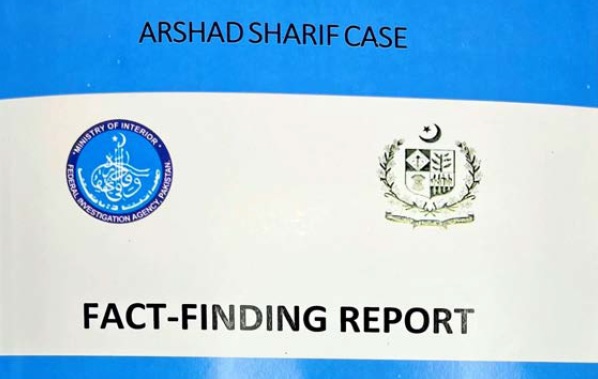
The authorities have not released the report to the public, but a 592-page file that purports to be the Fact-Finding Team (FFT) report is doing the rounds of the social media.
The purported report states that both the members of the FFT are of the considered opinion that Arshad Sharif’s murder it is a planned, targeted assassination involving transnational characters.
The report says there were compelling reasons for Arshad Sharif to leave Pakistan because of criminal cases registered against him in different districts; and that it is most likely that Arshad Sharif was compelled to leave by the UAE authorities.
The investigation team’s operations in Kenya and the United Arab Emirates form part of the fact-finding report, prepared by Director FIA Athar Waheed and Deputy DG IB Umar Shahid.
The role of many foreign characters in the case are important, the role of Arshad Sharif’s host Khurram and Waqar in Kenya is important and requires further research. Waqar Ahmed could not answer the committee’s questions satisfactorily.
The vehicle used in Arshad Sharif’s murder case, maps, crime scene review are included in the report. All events in Kenya from October 23 to Arshad Sharif’s murder are also part of the report.
Also all travel records of Arshad Sharif, review of Arshad Sharif’s mobile phone, devices, WhatsApp and email, motives for forcing Arshad Sharif to leave Pakistan, registered FIRs and arrest of Arshad Sharif in Khyber Pakhtunkhwa CTD and the threat alerts issued by the agency have also been made a part of the report.
The report further states that according to the circumstances, Khurram Ahmed’s version was not correct, that firing was done on the moving vehicle.
The report says Arshad Sharif’s bullet in the back is inconsistent with the position of the police and Khurram. Arshad Sharif was shot in the back at close range or possibly from inside the vehicle.
Weapons used in the crime and ballistic report are also part of the fact finding report that says the Kenyan police provided no assistance in the investigation.
The policeman who allegedly opened fire was not allowed by Kenyan police to meet the Pakistani investigators. Therefore, it cannot be determined whether the person who opened fire is a policeman or not.
Reproduced below verbatim are the key findings of the report.
Key Findings
283. There were compelling reasons for Arshad Sharif to leave Pakistan because of criminal cases registered against him in different districts.
284. It is most likely that Arshad Sharif was compelled to leave by UAE authorities.
285. The four GSU police officials and OC GSU Training camp had been used as instruments in this case under any influence, either financial or some other compulsion.
286. Waqar is connected to National Intelligence Service (NIS) of Kenya and International Intl. agencies and police. The fact that he handed over the personal cell phone and iPad of Arshad Sharif to an NIS officer rather than to the police establishes his links with NIS. His linkage with national and international agencies provides a scope of possibility of transnational characters In this case.
287. The narrations presented by Khuram, who was driving the vehicle on the sequence of crime scene is contrary to logic and facts. There is no penetration mark of a bullet on the seat of Arshad Sharif but he was hit from the back and the bullet exited from the right side of chest. That does not match with his siting position, position of gunners as well as line of fire.
288. The version of the Kenya police to portray the incident as a case of ‘mistaken identity’ is full of contradictions. The statements given by GSU police officials contradict themselves and their version of events is not believable.
289. The post-mortem report in Pakistan identified that nails of four fingers of the left hand of Arshd Sharif were missing, giving rise to speculation that Arshad Sharif had been tortured before his death. But the Kenyan post-mortem does mention “finger nails” taken as DNA sample, however it does not mention how many finger nails were taken. Keeping in view the apparent differences in two post-mortem reports, there is no concrete evidence to establish that Arshad Sharif was tortured before killing.
290. The transnational roles of characters in Kenya, Dubai and Pakistan in this assassination cannot not be ruled out.
291. Both the members of the FFT hove a considered understanding that it is a case of planned targeted assassination with transnational characters rather than a case of mistaken identity.
Copyright © 2021 Independent Pakistan | All rights reserved