By Staff Reporter
ISLAMABAD: Pakistan’s interior minister Mohsin Naqvi said on Wednesday that the coalition government would serve out its full constitutional term, with Prime Minister Shehbaz Sharif remaining in office for the entire five years, days after his own warning that the country’s governance system had “collapsed” triggered a political storm in Islamabad.
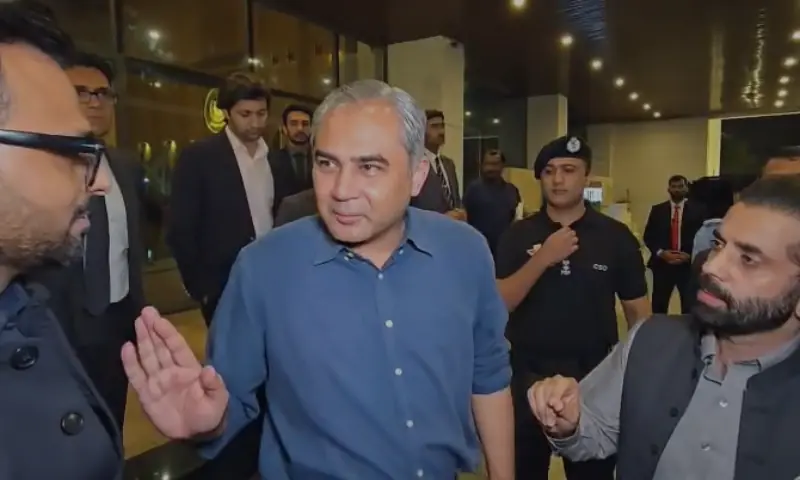
Speaking to reporters outside the interior ministry, Naqvi sought to draw a line under the row he had ignited a week earlier, when he argued that Pakistan needed to create new administrative provinces to fix failures in service delivery, accountability and access to justice. His comments had been followed a day later by the military’s spokesperson, who also urged political parties to consider restructuring the country’s governance system, saying stability depended on adapting institutions to the demands of a modern, growing population.
“The future for the government is the completion of its five-year tenure,” Naqvi told journalists. “Shehbaz sahib will remain the prime minister for five years — the prime minister will complete his five-year term.”
Pressed on whether his earlier warning amounted to a formal indictment of the government he serves in, the interior minister did not retreat from his original assessment. “The system has been destroyed,” he said, standing by the remark but insisting it referred specifically to what he called the country’s “80-year-old administrative system” rather than to the current administration itself.
“Even today, I maintain that the system that has been in place for the last 80 years is destroyed,” he said. “If it had been functioning, Pakistan would have reached new heights.”
Naqvi rejected the idea that he had issued a “charge sheet” against the government, noting pointedly that he was himself a serving member of it. “If you have a prime minister who works 14 to 16 hours a day, and if the current situation improves, the results will be a thousand times better,” he said.
He went on to list what he described as the government’s achievements under Sharif, citing a sharp rise in revenue collected by the Federal Board of Revenue, a claimed military victory over India, an improvement in Pakistan’s diplomatic standing internationally, and a series of unspecified reforms. “I still believe today that if the prime minister had operated within a better system, he could have taken this country forward a hundred times more,” he said.
The minister also made a brief, unelaborated reference to unnamed individuals he suggested were attempting to drive a wedge between himself and the prime minister.
Backlash from allies and opposition
Naqvi’s original remarks had already drawn sharp criticism from across the political spectrum, including from within the ruling coalition itself. Defence minister Khawaja Asif said that if Naqvi wanted to overhaul the system, he should start closer to home — by implementing the National Action Plan and reforming his own ministry. Asif noted that Naqvi had occupied what he called a “very powerful position” within the system for the past three years, a pointed reminder that the interior minister was hardly a bystander to the failures he was describing.
The Pakistan Peoples Party went further, demanding Naqvi’s resignation outright. The party accused him of undermining the constitution by, in its words, “endorsing a hybrid system,” and rejected his characterisation of the country’s democratic governance as having collapsed. It also dismissed his call for the creation of new provinces.
Adding to the pressure, former Senate chairman Mian Raza Rabbani issued a detailed statement rejecting the case for new provinces altogether. He argued that Pakistan’s governance failures stemmed not from the number or shape of its federating units but from repeated violations of the constitution itself. Redrawing administrative boundaries, he warned, would do nothing to address the deeper crisis, which he attributed to the erosion of provincial autonomy and the steady weakening of democratic institutions.
The row unfolded on the same day Naqvi met President Asif Ali Zardari at Bilawal House in Karachi, where the two discussed the country’s overall law and order situation, with particular attention paid to the security situation in Khyber Pakhtunkhwa and Balochistan.
Copyright © 2021 Independent Pakistan | All rights reserved