By Staff Reporter
ISLAMABAD: Iran has thanked Pakistan’s military and civilian leadership for its efforts to secure regional peace, as Islamabad’s interior minister arrived in Tehran on Monday for talks at one of the most precarious moments in the seven-month war between Iran and the United States.
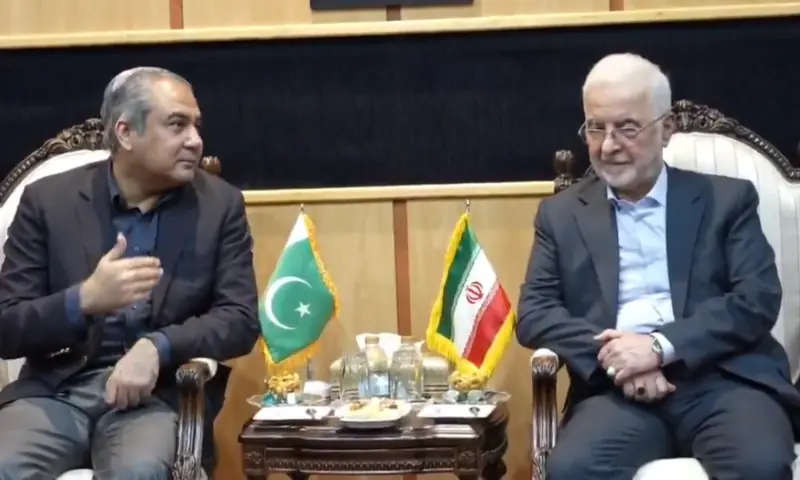
Mohsin Naqvi, who has become Pakistan’s most frequent envoy to the Iranian capital, met his Iranian counterpart, Eskandar Momeni, who received him at the airport. According to a statement from Pakistan’s interior ministry, Momeni thanked Field Marshal Asim Munir, who serves as both Chief of Defence Forces and Chief of the Army Staff, and Prime Minister Shehbaz Sharif for their work towards peace.
“We are grateful for Pakistan’s continuous efforts to establish peace in the region,” Momeni was quoted as saying. He described the visit as “beneficial”.
Naqvi said relations between the two neighbours would “become even stronger” in the coming days. The ministers also reviewed cooperation between their interior ministries, the statement said.
The visit, Naqvi’s sixth to Tehran since the war began, comes as Pakistan works to salvage the Islamabad Memorandum of Understanding, the agreement between Washington and Tehran that was meant to end a conflict triggered by US-Israeli strikes on Iran in late February. Pakistan hosted rare direct talks between the two sides and helped broker the interim ceasefire, but the deal unravelled and both sides resumed attacks.
Iranian state broadcaster IRIB quoted foreign ministry spokesperson Esmaeil Baqaei on Saturday as saying the trip would “focus on bilateral relations”, with “no plan to exchange any specific messages regarding mediation”. The Tasnim news agency likewise said Naqvi carried no message from Washington. Pakistani government sources, however, told Anadolu that discussions would cover regional developments, including Houthi attacks on Saudi Arabia and efforts to restart the stalled talks.
The trip follows Momeni’s official visit to Islamabad in July, when he also praised Sharif and Field Marshal Munir for their mediation.
Threat of renewed strikes
The diplomacy is unfolding against a sharply worsening backdrop. Iran’s Khatam al-Anbiya Central Headquarters, which oversees its armed forces, said on Sunday it had information that the US was preparing to resume strikes. It warned that any attack would bring retaliation against American bases and interests in the region, and that countries allowing their territory to be used would be “considered complicit”.
Hossein Mohebbi, spokesperson for the Islamic Revolutionary Guard Corps, told Iran’s Al-Alam channel that a fresh attack would “change the war’s geography”. He said Iran would introduce “new weapons with new capabilities” and had “new targets that have not been attacked yet”.
Donald Trump told Fox News on Sunday that he was in “deciding mode”, with options including further military action, economic pressure or a deal. He said he would be open to meeting the Iranian president, Masoud Pezeshkian, at the UN General Assembly in New York this week. Pezeshkian is due to address the assembly on Wednesday, with Trump speaking on Tuesday. Iran’s foreign minister, Abbas Araghchi, is already travelling there.
Airlines and blockade
Washington is also tightening the financial squeeze. The US Treasury secretary, Scott Bessent, told CNBC that “on September 23, all the Iranian airlines will be shut down around the world”, warning that airports, fuel suppliers and ticketing firms servicing them risked being “knocked out of the dollar system”. Iran Air said it would continue flights to Najaf in Iraq regardless.
US Central Command said its forces had redirected 110 commercial vessels as part of the blockade of Iranian ports.
Iran, for its part, has kept its grip on the Strait of Hormuz. Parliament speaker Mohammad Bagher Ghalibaf, Tehran’s chief negotiator, said the waterway would stay closed until the US honoured its commitments. Iranian conditions for talks, relayed via Qatari and Pakistani mediators, include an end to the war, the release of frozen funds and the lifting of the blockade. Shipping data showed 12 commodity vessels crossed the strait over the weekend, down from 35 the weekend before.
Copyright © 2021 Independent Pakistan | All rights reserved