By Staff Reporter
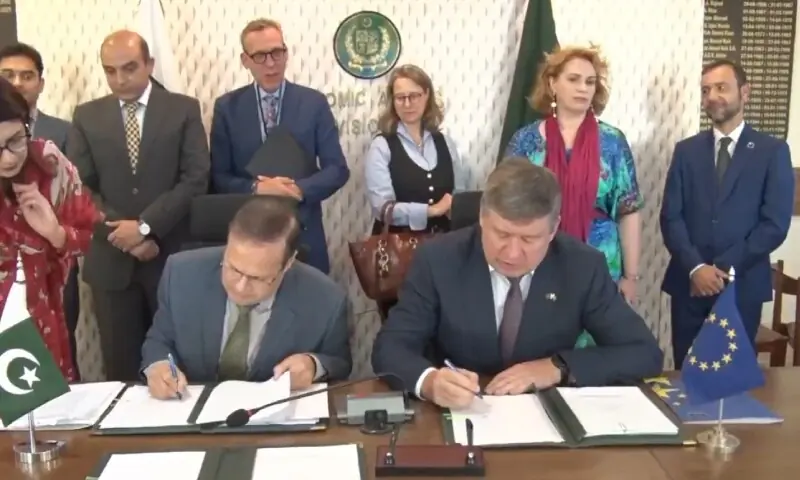
ISLAMABAD: Pakistan and the European Union signed three grant agreements worth €65 million ($74.6 million) on Monday, funding programs meant to attract foreign investment, bring renewable energy to off-grid communities and improve access to justice.
The agreements, worth about 20.64 billion rupees, were signed in Islamabad by EU Ambassador Raimundas Karoblis and Muhammad Humair Karim, secretary of the Economic Affairs Division, according to a statement. They are financed under the EU’s Multiannual Indicative Programme 2021-2027 and fall within Global Gateway, the European Commission’s infrastructure investment strategy, which aims to mobilize as much as €300 billion ($344.6 billion) in public and private money worldwide by 2027 across sectors including digital, energy and transport.
The signing comes as Islamabad works to raise foreign investment, which the government has called a priority for sustaining economic growth. In 2023, it created the Special Investment Facilitation Council, a hybrid body of civilian and military officials, to draw international capital into key sectors.
“These agreements demonstrate the EU’s commitment to supporting Pakistan’s economic development and investment ambitions under our flagship Global Gateway initiative,” Karoblis said at the signing.
Three Programs
The first, Global Gateway Development Facilitation for Pakistan, targets the investment climate by improving the tax system and strengthening the government’s long-term financial planning. It also covers investment management and financial enablement of environmental projects.
The second, Energy and Natural Environment Resilience in Khyber Pakhtunkhwa, will expand renewable energy in rural communities in the northwestern province that aren’t connected to the national grid. It also includes training intended to draw private investment into the provincial energy sector. Karoblis said it would help authorities in the province build a stronger and more resilient energy sector while promoting sustainable management of natural resources.
The third, EU Support to the Rule of Law and Business Environment in Pakistan, builds on earlier EU assistance and will help people in Khyber Pakhtunkhwa and Balochistan reach police, prosecution services, courts and legal aid. It will also support Punjab and Sindh, the country’s most populous and industrialized provinces, in expanding alternative and commercial dispute resolution, with the stated aim of making them more attractive to European and other companies. Karoblis said that work would proceed through collaboration with the judiciary, legal professionals, universities and the business community.
“The rule of law will further strengthen access to justice for citizens in KP and Balochistan,” he said.
Security Backdrop
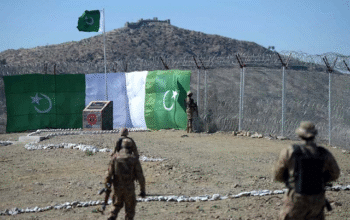
Khyber Pakhtunkhwa and Balochistan both border Afghanistan and have borne the brunt of militant attacks in recent years. Balochistan recorded the most violence in July, with 176 attacks and 438 deaths, according to the South Asia Terrorism Portal, a research and data platform. Khyber Pakhtunkhwa had 143 incidents and 244 fatalities over the same period.
Karim welcomed the EU’s continued support and described the interventions as timely, saying they align with Pakistan’s goals of increased foreign investment, better electricity access in off-grid rural areas of Khyber Pakhtunkhwa, and higher standards in the rule of law and commercial dispute resolution, according to the division.
The EAD said the EU’s development cooperation with Pakistan remains focused on economic development, climate resilience, governance, the rule of law, human rights and sustainable management of natural resources.
The grants arrive amid broader discussions over Pakistan’s trade access to Europe. The EU accounts for about 28% of Pakistan’s exports, with textiles and clothing among the biggest beneficiaries of the bloc’s Generalised Scheme of Preferences Plus, according to a report published this month. Karoblis said on Sept. 7, as reported by Dawn, that the outcome of Pakistan’s bid to keep preferential access “is not certain” and that GSP+ preferences “cannot be taken for granted.” The current scheme is due to expire at the end of this year and be replaced by a framework with tougher compliance requirements.
Karoblis met representatives of the All Pakistan Textile Mills Association on Friday and said Pakistan would need to show concrete progress in implementing and legislating the international conventions tied to GSP+ eligibility, ProPakistani reported.
Copyright © 2021 Independent Pakistan | All rights reserved