By Staff Reporter
ISLAMABAD: Leaders of Pakistan’s opposition alliance, Tehreek Tahafuz Ayeen-i-Pakistan (TTAP), unleashed a barrage of criticism against the government on Sunday, branding its domestic and foreign policies as deeply flawed and accusing it of driving the country toward irreversible harm through poor economic management and questionable international engagements.
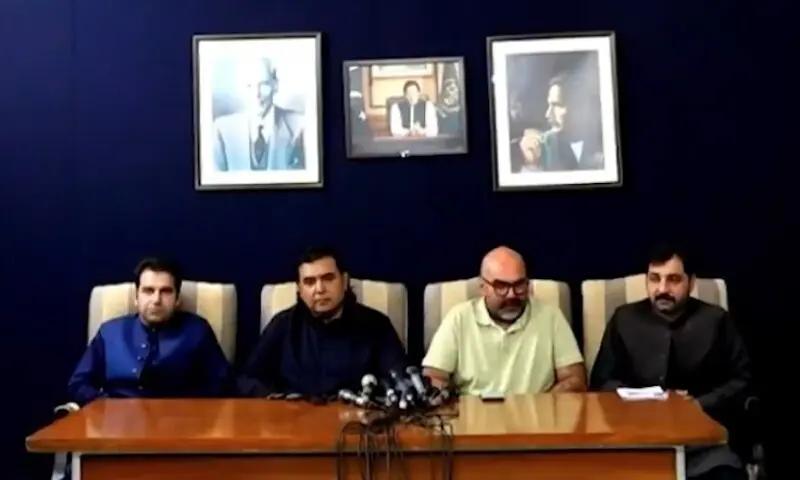
Speaking at a press conference in the capital, the opposition figures — including former Khyber Pakhtunkhwa finance minister Taimur Khan Jhagra, ex-Pakistan Peoples Party senator Mustafa Nawaz Khokhar, and TTAP spokesperson Akhunzada Hussain Yousafzai — laid out a litany of grievances, from soaring poverty rates to regional security lapses and opaque deals with foreign powers.
Jhagra, who served in the cabinet under former prime minister Imran Khan, took direct aim at the government’s rosy economic narrative, dismissing its claims of recovery as baseless. “The government lacks a plan to improve the country’s economic situation,” he said, pointing to official statistics that he argued painted a grim picture of widening inequality. Citing national poverty data, Jhagra noted that in 2018, 22 percent of Pakistanis lived below the poverty line — a figure that has climbed to 29 percent under the current administration. “Over the past 11 years, not only has poverty increased, but the gap between the rich and the poor has further widened, reaching a poverty level of 32.7 percent,” he added.
The increases were particularly stark in key provinces, Jhagra alleged: Poverty had surged by 41 percent in Punjab and 33 percent in Sindh, regions that together form the economic backbone of the country. He also highlighted the government’s latest unemployment report, which he said showed the highest jobless rate in 21 years, exacerbating the strain on ordinary families amid inflation and stagnant wages.
Jhagra didn’t stop at broad economic indicators. He accused the government of favoritism in resource allocation, claiming that Punjab’s inspector general of police and chief secretary had been granted special privileges, including the use of luxury 4,500-cc vehicles. More broadly, he alleged that officials in Punjab were provided with vehicles totaling 110 million rupees in value, a move he portrayed as emblematic of wasteful spending at a time when public services are underfunded.
Shifting to foreign affairs, Khokhar voiced alarm over escalating tensions in the region, warning that “clouds of war were looming over a neighboring country.” He specifically referenced Iran, claiming that the United States had deployed naval fleets in a buildup reminiscent of the prelude to the 2003 invasion of Iraq. “The heavy deployment is equal to the one deployed in 2003 before the attack on Iraq,” he said, framing the situation as a potential flashpoint that could spill over into Pakistan’s volatile border areas.
Khokhar also scrutinized Pakistan’s diplomatic choices, questioning its participation in what he called US President Donald Trump’s “Board of Peace.” Drawing on a report from The Guardian, he noted that the event drew representatives from authoritarian regimes and monarchies, while major powers like China opted out. “Why did Pakistan attend when China stayed away?” he asked, suggesting the move undermined Islamabad’s strategic independence.
In a pointed critique, Khokhar linked the timing of Pakistan’s involvement to emerging reports of a deal involving the Roosevelt Hotel, a New York property owned by Pakistan International Airlines. “Just after participation in the meeting, news emerged that a deal regarding the Roosevelt Hotel had been done,” he said, demanding transparency. “The government should share the terms and conditions of the agreement” to ensure it serves national interests rather than foreign agendas.
On the domestic security front, Khokhar called for a tougher stance against militant groups, urging the government to “strictly deal with the Balochistan Liberation Army (BLA), the Tehreek-i-Taliban Pakistan (TTP) and other terrorist organizations” amid a reported uptick in attacks. He argued that lax enforcement had allowed these threats to fester, endangering stability in restive provinces like Balochistan and Khyber Pakhtunkhwa.
Yousafzai, the TTAP spokesperson, turned attention to the plight of Pakistan Tehreek-e-Insaf (PTI) founder Imran Khan, the former prime minister who remains imprisoned on corruption charges that his supporters dismiss as politically motivated. Expressing concern for Khan’s health, Yousafzai said a second medical injection was scheduled for Feb. 24 or 25. “The PTI founder must be taken to the Shifa International Hospital for medical treatment in the presence of his family and Dr. Asim,” he demanded, emphasizing the need for independent oversight to prevent any mistreatment.
Yousafzai also addressed fraying ties with Afghanistan, condemning recent border tensions and advocating for diplomacy. “The disputes with neighboring countries should be resolved through dialogue,” he said, warning that ongoing hostilities could further isolate Pakistan at a precarious moment.
Copyright © 2021 Independent Pakistan | All rights reserved