By Staff Reporter
ISLAMABAD: Pakistan’s defence minister has confirmed that his country conducted airstrikes inside Afghanistan this month, targeting militants from the Tehreek-e-Taliban Pakistan (TTP), in Kabul and other cities, amid a sharp escalation in cross-border violence that has strained relations between the two neighbors.
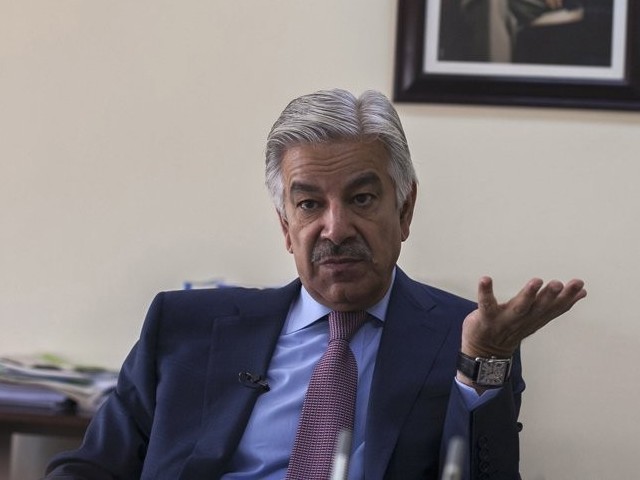
The acknowledgment by the defence minister, Khawaja Asif, came during an interview with Arab News on Monday, marking the first time a senior Pakistani official has openly conceded to such operations. Until now, Islamabad had described its actions only as counterterrorism efforts or responses to attacks along the frontier. “They are housed over there, nobody can deny that,” Asif said of the TTP militants. “And their leadership is there and that is why we went after them when there were strikes in Kabul last week and a couple of other cities.”
The flare-up, the most severe in years, began earlier this month after 11 Pakistani soldiers were killed in a TTP attack. Days later, two explosions struck central Kabul, and an airstrike hit a market in eastern Afghanistan. Afghan authorities accused Pakistan of carrying out the strikes, claiming civilian casualties, an allegation that Pakistan neither confirmed nor denied at the time.
Kabul retaliated with cross-border raids that killed at least 23 Pakistani soldiers. Pakistan struck back last Wednesday with attacks across the border, including airstrikes in Kabul and Kandahar, Afghanistan’s two largest cities. Hours after those strikes, the two sides agreed to an initial 48-hour ceasefire to ease tensions. When the truce expired on Friday, Afghanistan reported that new Pakistani airstrikes had killed 17 people. Pakistan rejected claims of civilian deaths, insisting the operations targeted militants. Throughout the clashes, the Pakistani military avoided confirming air raids, stating only that it had responded to assaults by Afghan forces and allied militants on its border posts. A new ceasefire was announced on Sunday following talks in Doha, Qatar, providing a temporary halt to the fighting.
Asif said an understanding had been reached in those discussions, with Turkey and Qatar serving as guarantors to prevent the TTP from using Afghan soil to launch attacks on Pakistan. The two sides are set to meet again in Istanbul on Oct. 25 for follow-up talks. “The mechanism of this arrangement will be decided over there, how to monitor the activities of the TTP in Afghanistan,” Asif said.
The violence underscores Pakistan’s ongoing struggle with a resurgence of militancy since 2021, when the Afghan Taliban regained power in Afghanistan, leading to a sharp increase in attacks by the TTP and its affiliates. Islamabad has repeatedly urged Kabul to curb militants it says are operating from safe havens in Afghanistan, a charge that the Afghan government denies. Even as Pakistan grapples with external threats, Asif has called for a tougher domestic stance against extremism, pointing to recent violent protests by the Tehreek-e-Labbaik Pakistan (TLP), a hardline religious group.
In remarks to a private television on Tuesday, he said the country must act as a “hard state” to rein in such organizations, which he described as unacceptable in any society. “We have to become a hard state,” Asif said, adding that religious extremist groups resorting to violence and property damage “cannot be tolerated in Pakistan.”
He noted that it was “too late” because such groups had been formed and encouraged for decades. “Everyone knows who created them and for what purpose,” he said. Asif’s comments followed the Punjab provincial government’s submission of a summary to the federal authorities seeking a ban on the TLP, after violent demonstrations in the province that left many dead and scores injured. Although official statements did not name the group, the provincial government pledged to arrest and prosecute those involved in spreading violence, inciting hatred or causing public harm under anti-terrorism laws.
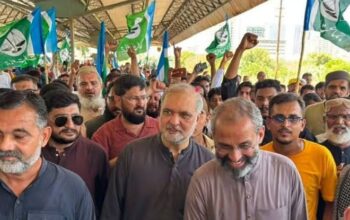
Asif declined to comment on whether a ban was being imposed on the TLP. The defence minister also said he was unaware of a statement by Maulana Fazlur Rehman, the chief of Jamiat Ulema-e-Islam-Fazl, claiming his workers were ready to march toward Islamabad.
He described Rehman as “highly respectable” and refrained from further comment. Rehman, once a close ally of the Pakistan Muslim League-Nawaz and the Pakistan Peoples Party, has become a vocal critic of the current government. Those parties, led by Nawaz Sharif and Bilawal Bhutto Zardari, formed coalition governments twice after the ouster of former Prime Minister Imran Khan through a no-confidence motion in 2022. After the 2024 general elections, Rehman rejected the coalition, alleging widespread electoral rigging and irregularities.
Punjab’s information minister, Azma Bokhari, said at a news conference that the provincial cabinet’s decision had been forwarded to the federal government, and she expressed hope that a ban on the TLP would be enforced within a day or two.
She announced the establishment of a special prosecution cell to handle cases related to the violence in Muridke, and hinted at strict measures against the group’s financiers. Bokhari reported that three passers-by were killed and 48 citizens injured in the incident. Additionally, 110 police personnel were wounded, 18 of them by gunfire, while eight police vans were torched and weapons seized.
Bokhari revealed that several mosques affiliated with the TLP. had been taken into government control and hundreds of seminaries geo-tagged. Thirty-three terrorism cases had been registered, and all nominated suspects would be arrested. “Saad Rizvi and his brother are being traced and will soon be apprehended,” Bokhari said, adding that those sheltering them were also under investigation. She noted that 95 bank accounts, along with both legal and illegal properties in Rizvi’s name, had been sealed.
Copyright © 2021 Independent Pakistan | All rights reserved