By Staff Reporter
ISLAMABAD: Saudi Arabia has secured the backing of 14 nations, including Pakistan, for a new multinational naval alliance to defend the Red Sea and Bab al-Mandeb Strait, as a war between the United States and Iran that began in February widened dramatically to strike an Egyptian port and three further Gulf states in a single day.
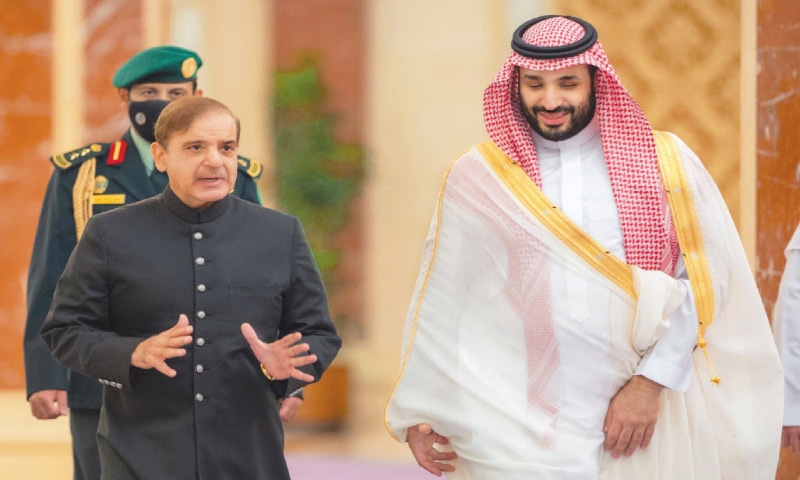
The kingdom unveiled the proposed Multinational Maritime Defence Coalition on Thursday at a meeting in Riyadh attended by chiefs of staff and representatives from 43 countries, out of 51 invited, along with a delegation from the European Union. Saudi Arabia will act as the coalition’s founding and leading state and will host its permanent headquarters, according to a statement from the kingdom’s defence ministry.
The announcement came hours after the United States said it had struck Revolutionary Guard command centres and drone facilities inside Iran, in retaliation for Iranian attacks on American forces in the region. Iran responded by striking targets linked to the United States in Jordan, Kuwait and Bahrain, while a drone attack on gas vessels at Egypt’s Mediterranean port of Damietta raised fears that the conflict, centred until now on the Gulf, was beginning to threaten shipping through the Suez Canal as well.
Fourteen countries signed a joint statement supporting the new coalition: Saudi Arabia, Pakistan, Bahrain, Bangladesh, Comoros, Djibouti, Egypt, Jordan, Kuwait, Qatar, Somalia, Sudan, Syria and Yemen. Notably absent from that list were two of Saudi Arabia’s fellow Gulf Arab states, Oman and the United Arab Emirates, despite both facing similar exposure to the unrest.
The Bab al-Mandeb Strait, which connects the Red Sea to the Gulf of Aden, ranks among the world’s busiest maritime chokepoints, carrying roughly 12 per cent of global trade. Shipping through the corridor has been disrupted repeatedly since late 2023, when Yemen’s Iran-aligned Houthi movement began targeting commercial vessels, forcing many operators to reroute around the southern tip of Africa at considerable extra cost and delay. Those disruptions have intensified sharply this month: the Houthis announced on 20 July that they would impose a naval blockade on Saudi Arabia in the Red Sea, and have since claimed a series of attacks on Saudi-linked shipping. Regional sources say the group is also weighing fees on commercial vessels passing through the southern Red Sea, though no timetable has been set.
Saudi Arabia’s defence ministry said the proposed coalition would be “exclusively defensive” in nature and would operate within the bounds of international law, respecting state sovereignty while protecting freedom of navigation. Riyadh described the initiative as “an open international defensive initiative,” open to any state that shares its aims and completes the necessary domestic legal procedures.
Delegates at Thursday’s meeting worked through the coalition’s draft charter, its command and control structure, and its operational mechanisms, alongside a future work plan that includes plans for a Joint Command, a Combined Maritime Operations Centre and a General Secretariat, all to be based in Saudi Arabia.
The push for a formal alliance follows weeks of rising alarm over threats to some of the world’s most economically vital waterways. Saudi Arabia has already carried out air strikes on Houthi military sites in Yemen’s Hodeidah province that it says were being used to threaten commercial shipping, and on Wednesday it went further, joining the United States in strikes against Iran-aligned factions in eastern Iraq, in retaliation for drone attacks launched from Iraqi territory against Saudi oil infrastructure. It marked the first time Saudi Arabia has publicly joined US forces in strikes during the five-month war.
Conflict spreads to Egypt
Egyptian authorities said preliminary investigations had confirmed that a drone strike caused the fire that broke out on two vessels at Damietta port on Wednesday. No group has claimed responsibility. President Abdel Fattah el-Sisi warned on Thursday that the wider regional conflict faced “the danger of regional escalation” following the strike, which hit a floating storage and regasification vessel before the blaze spread to a second ship nearby.
The incident is understood to be the first attack on Egyptian soil since the war between the United States and Iran began in February, and has stoked concern that the conflict could begin to threaten traffic through the Suez Canal, one of the most heavily used shipping lanes on Earth.
Iran strikes three Gulf states
Iranian state media reported that the US strikes on Iran killed three civilians and wounded two children on Qeshm Island, and that three members of the Revolutionary Guard were killed in Zanjan province. Authorities in Khuzestan province said two student dormitory complexes in the city of Ahvaz had also been damaged.
In response, the Revolutionary Guard said it had struck the Azraq military base in Jordan, targeting American F-35 fighter jets stationed there. The US military denied any aircraft had been destroyed or damaged, with Central Command saying all missiles and drones fired at the base were either intercepted or failed to reach their targets. Jordan’s armed forces said separately that they had intercepted five Iranian missiles on Thursday.
Iran also struck US assets at Kuwait’s Ali Al Salem Air Base, according to the country’s semi-official Tasnim news agency. A separate Iranian strike hit a building owned by a Chinese company in northern Kuwait, killing one worker and causing significant damage, Kuwait’s defence ministry said. In Bahrain, Iran’s military claimed it had used Arash drones to strike power generators, navigation systems and administrative buildings at the Sheikh Isa Air Base, according to state broadcaster Press TV.
Washington moved separately to tighten sanctions linked to the conflict, with the US Treasury designating six entities and individuals in China, India, Russia and Iran for acting as sales agents and support networks for Mahan Air, the Iranian carrier that the US alleges transports Revolutionary Guard personnel, weapons and drones.
In Washington, Senate Republicans blocked a bid to curb the White House’s authority to continue military action against Iran without congressional approval, with the measure falling in a 50-49 vote.
Iran also said on Wednesday that it had struck three tankers attempting to pass through the Strait of Hormuz by an unauthorised route. Despite the tension, a liquefied natural gas tanker controlled by QatarEnergy passed through the strait overnight, the first such vessel to do so since 11 July, after Iran’s Fars news agency said Tehran had granted permission for the passage.
Pakistan backs Saudi self-defence, insists mediator role intact
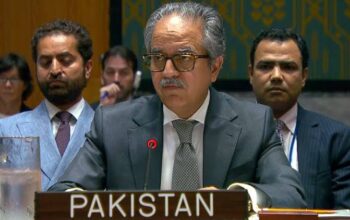
Pakistan gave its formal backing to Saudi Arabia’s strikes in Iraq on Thursday, while insisting that its expanding web of defence agreements in the Gulf does not compromise its efforts to mediate between Iran and the United States.
“The Kingdom of Saudi Arabia has the right to self-defence under Article 51 of the UN Charter, and we respect that right,” Foreign Office spokesperson Tahir Andrabi told reporters at the ministry’s weekly briefing in Islamabad. “The developments in the Gulf, the Strait of Hormuz and Red Sea are worrying. The attacks, particularly by non-state actors against Saudi Arabia, are utterly condemnable.”
His comments came two days after Saudi Arabia and the United States carried out coordinated strikes on positions belonging to Iraq’s Popular Mobilisation Units, whom Riyadh accuses of launching the drone attacks on its oil facilities. They also build on a warning Islamabad issued last week, after the Houthis first announced their blockade, in which it described any hostile action against Pakistani-flagged vessels as a “red line” that would be treated as an attack on Pakistan itself.
Pakistan and Saudi Arabia signed a Strategic Mutual Defence Agreement last year, which came into force earlier this year just as Islamabad launched its own diplomatic push to mediate between Tehran and Washington. Kuwait has since ratified a separate defence cooperation agreement with Pakistan, originally signed in 2023, while Islamabad also maintains defence arrangements with Bahrain and Jordan.
Asked whether the Kuwait agreement carried the same obligations as the pact with Saudi Arabia, Mr Andrabi said the distinction lay in the names themselves. “Obviously, it is not similar in a sense that one is called the strategic mutual defence, and the other defence cooperation agreement. So, the name is self-explanatory,” he said, adding that Pakistan’s defence ties with Jordan and Bahrain could yet be formalised further if the need arose.
He was careful, however, to draw a line around what those agreements actually mean in practice. “The substance of this agreement is geared towards peacetime cooperation,” he said. “When war takes place, obviously the two sides see how far these agreements are to be implemented.”
Mr Andrabi rejected any suggestion that Pakistan’s defence commitments undermined its credibility as a mediator between Iran and the United States. “Our role as mediator is not compromised by the fact that we have defence agreement,” he said. “The defence agreement in no way cuts down our role as mediator. The two operate in their own streams.” He said Islamabad continued to press both sides to return to the framework set out in the Islamabad memorandum of understanding, “in line with the Pakistan-Qatar Joint Statement of 21 June 2026,” and remained “hopeful for de-escalation and peaceful settlement of the issue.”
Separately, Pakistan’s deputy prime minister and foreign minister, Ishaq Dar, discussed the situation in the Red Sea and Bab al-Mandeb with his Saudi counterpart, Prince Faisal bin Farhan, according to the Foreign Office. The two ministers also welcomed a Jordanian proposal to convene a meeting of Arab and Islamic states to discuss the situation in Palestine, particularly East Jerusalem.
Copyright © 2021 Independent Pakistan | All rights reserved