By Staff Reporter
QUETTA: At least 34 coal miners have died after a methane gas explosion ripped through a mine complex in southern Pakistan, with rescue teams continuing to dig through the night in a race to reach an unknown number of workers still trapped underground.
The blast struck on Thursday afternoon at a privately owned mine in the Sorange coalfield, a remote stretch of Balochistan province roughly 50km from the provincial capital, Quetta. By the early hours of Friday, Balochistan’s Provincial Disaster Management Authority said rescue teams had recovered 34 bodies, after retrieving six more overnight, and that the search for those still missing was ongoing.
“The joint rescue operation is still underway to locate and recover the remaining trapped miners,” the authority said in a statement, without giving a precise figure for how many workers remained unaccounted for.
The explosion is believed to have been caused by a build-up of methane gas roughly 4,000 feet underground, where workers were carrying out their shifts when the blast hit. Fire broke out inside the mine within minutes, and parts of the structure collapsed, sealing off routes to those trapped inside and filling the tunnels with toxic gas. The force of the explosion was felt across a wide area of Sorange and severely damaged a second mine nearby, trapping a further group of miners working there.
Officials in Balochistan gave differing early estimates of how many people had been inside the complex when it exploded. Shoaib Nosherwani, the province’s minister for mines and mineral development, said 36 workers had been in the collapsed section at the time of the blast, of whom 25 remained missing by late Thursday night. Muhammad Atif, the province’s chief inspector of mines, said rescue efforts were being carried out at a depth of around 4,000 feet and that most explosions of this kind in Balochistan were caused by methane gas accumulating in poorly ventilated shafts.
“We are hopeful to find some miners alive, but chances are low,” Atif said as the operation stretched into its second day.
Miners who went back down to help also died
Witnesses described a chaotic and desperate scene in the moments after the blast, as miners working nearby rushed to help colleagues trapped inside, only to be caught by the fire and gas themselves.
“Other miners descended into the mine after the explosion for a rescue operation, but they also died,” said Ahmed Zada, a worker at the site.
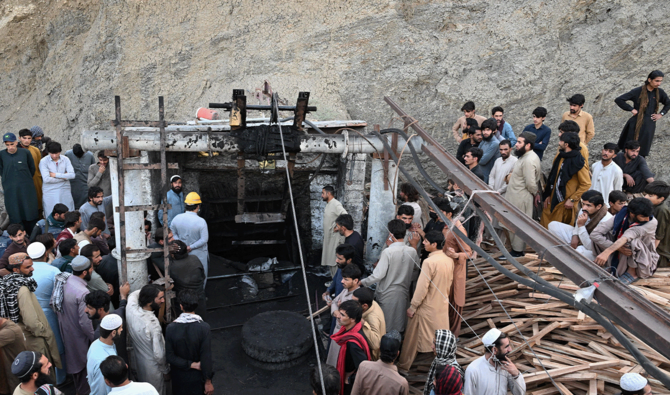
Families of the missing, along with off-duty miners and rescue workers, gathered at the mine entrance through the night as the operation continued. Many of those helping wore no more than everyday clothes rather than protective equipment, carrying the bodies of the dead out of the mine’s concrete tunnels on stretchers, some blackened with soot, before loading them into waiting ambulances.
Mining engineers attempted to cut alternative routes into the complex to reach those still trapped, but the scale of the fire and the volume of methane gas still present in the shafts made the approach slow and dangerous. Officials said all available resources, including teams from the Mines and Minerals Department and the disaster management authority, had been mobilised to the site.
“We share the grief of the bereaved families and will leave no stone unturned in completing the rescue operation,” Nosherwani said.
The minister announced that the provincial government would pay 500,000 rupees in compensation to the family of each miner confirmed dead, and 300,000 rupees to each worker injured in the blast. He said a formal inquiry into the cause of the disaster would follow once the rescue operation was complete.
A province where mining accidents are frequent
Balochistan is Pakistan’s largest province by area and its poorest by most measures, trailing the rest of the country on education, employment and economic development despite sitting on substantial reserves of coal, gold and copper. Most of its coal mines are privately run, and labour groups have for years pointed to poor ventilation, inadequate safety equipment and lax regulatory oversight as recurring factors behind the province’s high rate of mining deaths.
Thursday’s disaster is the latest in a string of fatal accidents in Balochistan’s coalfields. A methane explosion killed 12 miners in Harnai in March 2024, and a further 11 died in a similar blast in Sanjdi three months later. In January this year, 12 miners died in a methane explosion at a mine near Quetta following a six-day rescue effort that ultimately failed to find survivors.
Balochistan’s chief minister, Sarfraz Bugti, has ordered a detailed report into Thursday’s blast and warned that officials would face strict action if the inquiry uncovered negligence or misconduct. He also instructed provincial authorities to ensure stricter enforcement of safety regulations across the province’s coal mines going forward.
As the rescue operation entered its second day, officials said hopes of finding further survivors were fading, though teams remained at the site working to reach those still unaccounted for.
Copyright © 2021 Independent Pakistan | All rights reserved