By Staff Reporter
ISLAMABAD: Pakistan and the European Union called on Afghanistan’s Taliban rulers on Sunday to crack down on terrorist groups operating from Afghan soil and to safeguard human rights, particularly for women and girls, as relations between Islamabad and Kabul continue to fray over a surge in cross-border attacks.
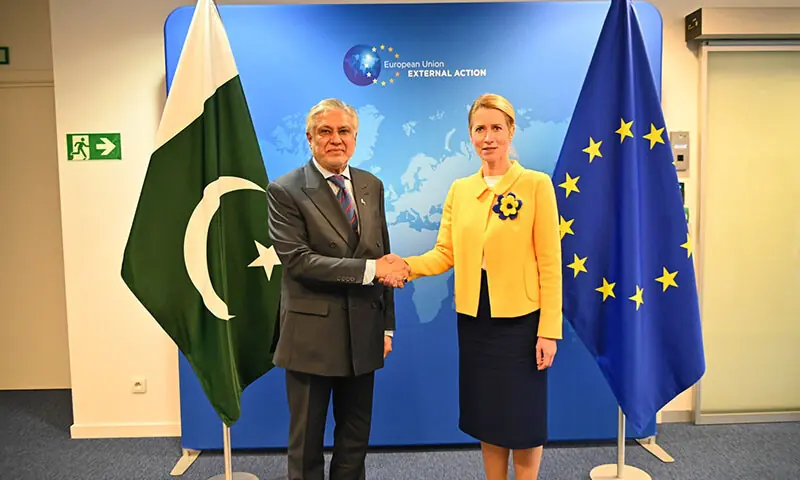
The appeal emerged from the seventh strategic dialogue between Pakistan and the European Union, held in Brussels and co-chaired by Pakistan’s deputy prime minister and foreign minister, Ishaq Dar, and the EU’s chief diplomat, Kaja Kallas. The meeting came against a backdrop of escalating tensions, including recent border clashes and failed negotiations aimed at curbing terrorism.
In a joint statement issued by Pakistan’s Foreign Office, the two sides addressed the strained ties between Islamabad and Kabul following cross-border incidents last month. Both diplomats reaffirmed their dedication to regional peace, stability and prosperity, and to settling disputes with neighbours through dialogue. “The two sides called on Afghanistan’s de facto authorities to play a constructive role in achieving the shared objective of rooting out terrorism from Afghan soil,” the statement said.
The statement also voiced concern over Afghanistan’s worsening socioeconomic conditions and supported the goal of a “peaceful, stable and self-reliant Afghanistan.” It expressed hope that Kabul would pursue a “credible political process aligned with the UN-led ‘Doha process’, and in line with the commitments made by the Taliban de-facto authorities to the international community.”
The European Union commended Pakistan for sheltering millions of Afghan nationals for more than four decades, but stressed that any repatriation efforts must be “safe, dignified and in line with international standards.” “Both sides called upon the Afghan authorities to ensure protection of human rights, especially for women, girls and vulnerable communities,” the statement added.
The dialogue’s focus on terrorism reflects longstanding grievances. Earlier this month, Denmark, in its role as chair of the United Nations Security Council’s sanctions committee on the Islamic State and Al Qaeda, highlighted the “serious threat” posed by the banned Tehrik-i-Taliban Pakistan in Central and South Asia. Denmark asserted that the group had been receiving “logistical and substantial support from the de facto authorities” in Afghanistan, according to a briefing delivered at a Security Council meeting in New York.
The TTP’s presence in Afghanistan has been a flashpoint between Islamabad and the Taliban government since the Taliban seized power in Kabul in 2021. Pakistan has repeatedly accused the Taliban of harbouring thousands of TTP militants, who have intensified assaults on Pakistani security forces, especially in the provinces of Khyber Pakhtunkhwa and Balochistan. Pakistan has experienced a sharp increase in terrorist incidents since 2022, when the TTP terminated a ceasefire with the government in November of that year and pledged to target security forces, police and law enforcement personnel. In response, Pakistani forces have conducted regular counterterrorism operations along the northwestern border to neutralise the threat. Bilateral relations have deteriorated further amid these attacks, with the TTP emerging as the primary source of discord. Pakistan has insisted that Kabul take decisive steps to halt cross-border terrorism, but the Afghan Taliban have rejected Islamabad’s claims, denying that militants are permitted to use Afghan territory for strikes against Pakistan.
Efforts to ease the impasse included talks following border skirmishes in October. The two sides convened in the Turkish capital for a second round of discussions on Oct. 25, but Pakistan’s information minister, Attaullah Tarar, later announced that the talks “failed to bring about any worthwhile results.” A third round on Nov. 7 yielded no progress either. Pakistan’s defence minister, Khawaja Asif, stated that negotiations on cross-border terrorism were “over” and had “entered an indefinite phase” due to irreconcilable differences. In the aftermath, the Afghan Taliban halted trade relations with Islamabad. Pakistan had already sealed its border to commerce shortly after the October clashes, exacerbating economic pressures on both sides.
Copyright © 2021 Independent Pakistan | All rights reserved