By Staff Reporter
ISLAMABAD: Prime Minister Shehbaz Sharif and Uzbek President Shavkat Mirziyoyev unveiled a series of business agreements worth $3.4 billion on Friday, pledging to double bilateral trade to $2 billion within five years as the two nations sought to capitalise on shared economic strengths amid a push for deeper regional ties.
The announcements came during a high-level business forum in Islamabad, where Sharif invited Uzbek firms to invest in Pakistan’s textile, pharmaceutical, mining, agriculture and tourism sectors. The event capped the first day of Mirziyoyev’s two-day state visit, which included meetings with Sharif and Pakistani President Asif Ali Zardari, culminating in a joint declaration that emphasised expanded cooperation on connectivity, security and trade.
Both leaders addressed a gathering of ministers and business executives from their countries, vowing to eliminate bureaucratic hurdles and foster a seamless environment for investors. Sharif, framing himself as Pakistan’s “CEO” for the occasion, assured participants that he and his team were “just a telephone call away” to resolve any issues. “We will remove any bottleneck or impediment on the way,” he said. “And I would like to assure you that bureaucracy and red tapism will not create any kind of hurdle in your business proposals.”
Mirziyoyev described the forum as a reflection of “long-standing shared intentions and deep mutual understanding.” He hailed the business community as a “true bridge” between the nations and called the $2 billion trade target “very much achievable,” citing a pre-drafted program for collaboration. The Uzbek leader highlighted opportunities for Pakistani expertise in pharmaceuticals, offering 10-year tax exemptions and full support for joint ventures. He also pointed to Uzbekistan’s 30 high-tech textile enterprises as ripe for Pakistani management to access global markets, alongside prospects in leather goods, mining and agriculture, including rice, potatoes and processed meat production.
The forum saw the signing of memoranda of understanding for business-to-business cooperation, with Sharif expressing confidence that the deals would materialise. He recalled a similar event in Tashkent last year that boosted trade to $450 million, though he noted it remained below potential. To build on this, the leaders agreed to form a working group tasked with drafting a five-year roadmap for trade, investment and joint projects in research and development, information technology and agriculture.
Sharif touted Pakistan’s recent economic turnaround, noting a drop in inflation from over 30 percent in 2023 to single digits, a reduction in the banking policy rate from 22.5 percent to 10.5 percent, and IT exports nearing $3.8 billion. He praised Mirziyoyev’s reforms in Uzbekistan, which have doubled GDP in a decade, lifted 8.5 million people out of poverty and halved unemployment. Sharif suggested that Uzbekistan’s 30 redundant textile plants could offer “win-win” opportunities for investors from both sides, and he hoped resumed flights by Pakistan International Airlines to Uzbekistan would enhance people-to-people contacts.
Mirziyoyev, in turn, congratulated Sharif on Pakistan’s progress, saying the reduced inflation and single-digit interest rates created “excellent opportunities for deeper cooperation.” He committed to zero corruption, no bottlenecks and no obstacles under the new trade protocol. The Uzbek president noted Uzbekistan’s demand for Pakistani pharmaceuticals and affordable medicines, and he invited Pakistani business leaders to visit his country to explore ventures, promising all necessary facilitation. He mentioned four weekly flights already operating between the nations, with plans to add more routes to bolster links.
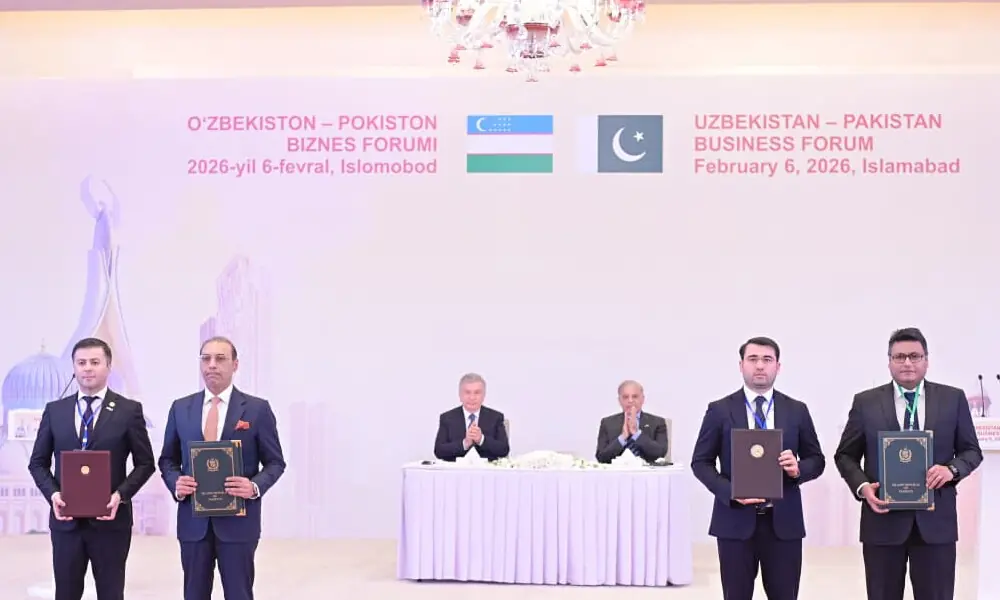
Later, the leaders witnessed the exchange of pre-signed documents for the MoUs. Sharif reiterated that Pakistan-Uzbekistan relations would henceforth be gauged by “trade flows, investment projects, industrial partnerships and people-to-people exchanges.” He described Uzbekistan as a gateway to Central Asia, with vast potential for joint ventures.
In a special ceremony, President Asif Ali Zardari conferred the Nishan-e-Pakistan, Pakistan’s highest civilian award, on Mirziyoyev for his role in bolstering relations. The event, attended by Sharif, cabinet members, military leaders, diplomats and parliamentarians, was followed by a state banquet.
A joint declaration issued by Sharif and Mirziyoyev underscored their resolve to deepen ties, supporting each other’s sovereignty and territorial integrity while advancing sustainable development. The document, signed after comprehensive talks, marked 34 years of diplomatic relations anchored in historical and cultural affinities. The leaders reaffirmed commitments from Sharif’s February 2025 visit to Uzbekistan, including a roadmap for cooperation. They hailed the establishment of a High-Level Strategic Cooperation Council as a milestone for oversight, noting its inaugural meeting during this visit yielded key decisions.
They commended the 10th session of the Joint Inter-Governmental Commission on Feb. 2, aiming to meet its targets. The declaration welcomed the July 2025 framework agreement for the Uzbekistan-Afghanistan-Pakistan Railway and stressed connectivity’s role in integration and trade. Both sides committed to operationalizing a September 2024 multimodal transport MoU, with Pakistan offering seaport access and road networks for Uzbek cargo.
Acknowledging Uzbekistan as the first Central Asian nation with which Pakistan signed transit and preferential trade agreements, the leaders pledged to hit the $2 billion trade mark by 2029. They agreed to joint economic zones for industrial cooperation focused on exports, and to launch an Inter-Regional Forum in Uzbekistan in 2026.Progress on expanding the preferential trade agreement, a bilateral investment treaty and standards alignment was noted, alongside efforts to diversify trade corridors and amend transit agreements. In defence and security, they expressed satisfaction with recent engagements, agreeing to joint exercises, training and institutional collaboration.
On international fronts, they pledged support under the U.N. Charter, favoring peaceful resolutions per resolutions. Uzbekistan backed Pakistan’s U.N. Security Council role for 2025-2026 and its presidencies of SCO bodies. Pakistan supported Uzbekistan’s WTO accession and congratulated it on hosting UNESCO’s 43rd session in Samarkand in 2025.Both emphasized Afghanistan’s stability for regional peace and the railway project, calling on Kabul to dismantle terrorist groups. They supported Palestinian statehood and pledged to back each other’s global initiatives.
Copyright © 2021 Independent Pakistan | All rights reserved