By Staff Reporter
ISLAMABAD: The government has imposed an outright ban on exports of all petroleum products and is actively considering holding domestic fuel prices steady despite relentless gains in international markets, tapping emergency budget allocations of about 389 billion rupees to absorb as much of the coming shock as possible.
Calculations based on current tax rates and the standard pricing formula point to potential increases of 56 rupees a liter for high-speed diesel and 41 rupees a liter for gasoline. Retail prices already sit on the higher side of 322 rupees for petrol and 337 rupees for high-speed diesel. Similar estimates show kerosene rising 7 rupees a liter and light diesel oil climbing 53 rupees. The next scheduled price review falls on March 15, though ministers have signaled it could be brought forward to March 13.
Prime Minister Shehbaz Sharif told a high-level consultative session with federal and provincial officials that he and the military leadership have jointly resolved to forgo any additional increases after the initial adjustment, at least in the near term, irrespective of movements in Middle East benchmarks. The meeting, also attended by Field Marshal Asim Munir, was briefed that the government would draw on block emergency allocations to cushion further cost pressure. “No other emergency could be worse than what the whole nation is facing at the moment because of fuel supply disruptions,” Sharif told the gathering, according to people familiar with the discussions.
Cabinet members remain divided on the stance. Technocrats, particularly those handling relations with the International Monetary Fund, have pushed back against altering the existing pricing buffers. That tension surfaced publicly at a Senate Standing Committee on Finance meeting. Petroleum Minister Ali Pervez Malik said efforts are under way to manage prices in line with the prime minister’s directives and that a call would follow a fresh review of global levels on Friday.
Minister of State for Finance and Railways Bilal Azhar Kiyani told the panel the government would review prices as planned but would “make all efforts not to further burden the people.” International prices continue to trend higher, he added. “The prime minister has also directed that the burden should not be passed on to the people,” Kiyani said.
Both ministers defended the March 7 decision to lift prices by 55 rupees a liter, arguing it was necessary to avert supply disruptions of the kind seen in Bangladesh and India, where consumers attacked retail outlets.
Finance Minister Muhammad Aurangzeb separately noted that international oil prices are still climbing. Public and social-media comparisons often focus on Brent crude, which currently trades around $105 a barrel. That benchmark has no direct bearing on Pakistan’s costs and instead swings largely on statements from US President Donald Trump, his aides and aligned analysts regarding the Iran conflict.
Pakistan sources more than 95 percent of its oil imports from the Middle East, with most volumes moving through the troubled Strait of Hormuz despite some recent alternative routing. Pricing is tied to Dubai markers, where Middle East crude stands at $135 a barrel. Imported petrol and diesel are quoted separately in Dubai at $120 and $168 a barrel, respectively.
To safeguard domestic supplies, the government has barred local refineries from exporting furnace oil and naphtha, creating a buffer for power generation after Qatar declared force majeure on liquefied natural gas shipments last week following attacks on its processing facilities by Iran. Gas deliveries to fertilizer plants are being curtailed, and rationing is set to resume after Eidul Fitr to limit electricity load-shedding as summer demand rises and to preserve foreign-exchange reserves.
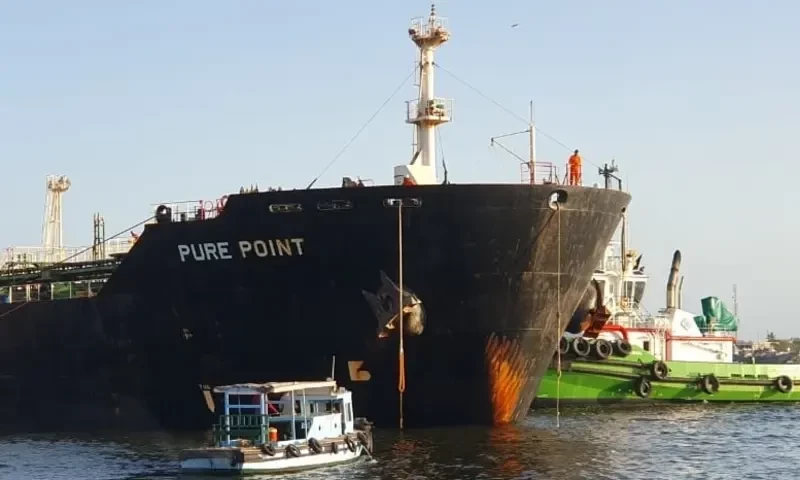
Current petrol and diesel inventories cover 22-23 days of consumption. Diesel faces particular risks: alternative import routes require more than 20 days of transit time. Saudi Arabia is providing maximum support, including crude supplies to run local refineries at full capacity for high-speed diesel output. Even so, very large crude carrier rates have surged roughly 15-fold and cannot reach Pakistani ports; the best option is to anchor in Oman and transfer cargoes to feeder vessels.
On a brighter note, supplies of liquefied petroleum gas through informal channels from Iran have nearly doubled since the Iran war erupted, apparently driven by cash requirements on the other side of the border and bottlenecks in formal supply lines.
Copyright © 2021 Independent Pakistan | All rights reserved