By Staff Reporter
ISLAMABAD: Pakistan said on that a fragile ceasefire with Afghanistan was faltering, accusing its neighbour of failing to curb terrorist attacks launched from its territory, as tensions between the two countries reached their lowest ebb since the Taliban seized power in Kabul four years ago.
The statement, delivered by the Foreign Office during a weekly briefing, came amid a spate of deadly incidents that officials have linked to Afghan soil, including a suicide bombing in Islamabad and an assault on a cadet college in the country’s northwest. It also followed Afghan threats of retaliation over alleged Pakistani airstrikes, which Islamabad has denied, further straining a border already sealed since mid-October.
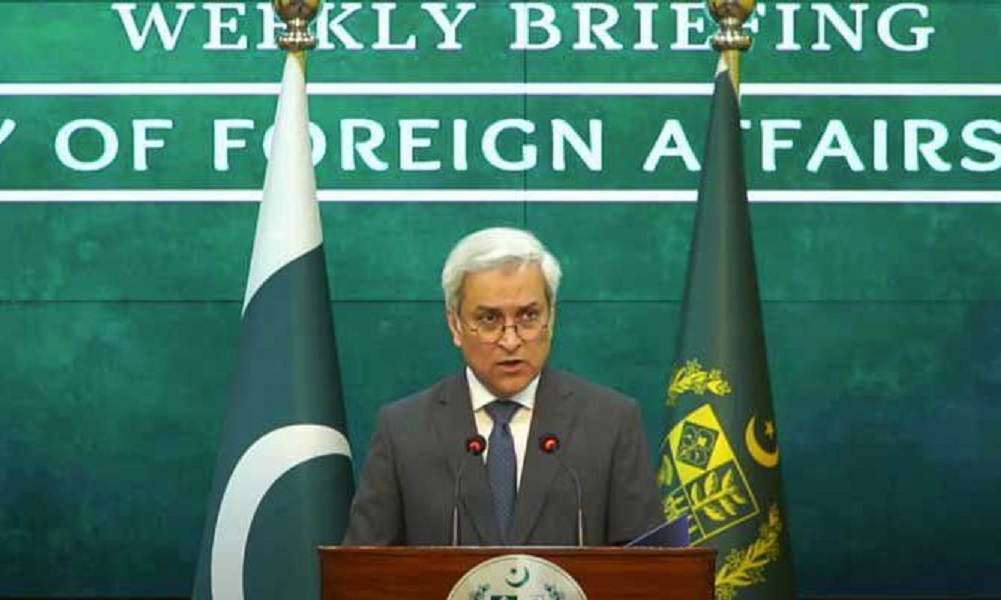
“The ceasefire is not holding because the ceasefire was about ceasing terrorist attacks inside Pakistan by the Tehreek-i-Taliban Pakistan, Fitna-al-Khwarij and Afghan nationals using Afghan soil,” said Tahir Andrabi, the Foreign Office spokesman, emphasising that the truce was not a conventional one between warring states but rather an understanding to halt cross-border terrorism.
Relations have deteriorated sharply since clashes along the 2,600-kilometer frontier in October, which involved ground fighting and Pakistani airstrikes that left dozens dead on both sides, the deadliest violence since the Taliban’s 2021 takeover. Border crossings have remained closed since Oct. 11, halting trade and prompting mediation efforts by Qatar and Turkey.
The first round of talks in Doha yielded a tentative ceasefire, while a second session produced only a vague agreement to establish a verification mechanism and continue discussions. A third round, held in Istanbul, ended without progress. Nearly six weeks later, Pakistani officials report about 20 terrorism incidents traced to Afghanistan, including thwarted attempts by the Tehreek-i-Taliban Pakistan, to infiltrate the border.
“The ceasefire between Pakistan and Afghanistan does not imply a traditional ceasefire implemented after two belligerent states in a war or a conflict situation,” Andrabi said. “Pakistan-Afghanistan ceasefire implied that there would be no terrorist attack by Afghan-sponsored terrorist proxies into Pakistan. There have been major terrorist attacks after this ceasefire.”
“So, interpreting in that sense, the ceasefire is not holding because the ceasefire was about ceasing terrorist attacks inside Pakistan by TTP, FAK, and Afghan nationals using Afghan soil.”
Among the recent attacks, a suicide bomber struck outside the district and sessions court building in Islamabad’s G-11 area, killing 12 people and injuring 36. Minister of State for Interior Talal Chaudhry said the bomber was “not a Pakistani national.” Separately, militants targeted the main gate of Cadet College Wana in South Waziristan, but security forces repelled them, averting a larger catastrophe. The information ministry said all the terrorists involved were Afghan citizens, and government ministers attributed the assault to orchestration from Afghanistan.
Prime Minister Shehbaz Sharif, addressing the incidents in Islamabad and Khyber Pakhtunkhwa Province, accused Afghanistan and India of involvement in terrorism and vowed a “befitting response” to the nation’s enemies. Defence Minister Khawaja Asif went further, stating that attacks on terrorist sanctuaries in Afghanistan could not be ruled out. In response to Afghan threats of retaliation, Andrabi said Pakistan’s forces were on high alert. “As regards the threat you mentioned from Afghanistan, our security forces remain fully alert,” he said. “Our military preparedness is robust. The security challenges we face would be addressed with the seriousness that they merit.”
Security officials indicated that the army had deployed additional hardware to sensitive positions along the frontier, with surveillance tightened on all approaches, amid warnings that the situation could escalate.
The briefing also highlighted broader regional concerns, particularly after a drone-and-firearms attack from Afghanistan on a Tajik-Chinese gold mining site in Tajikistan’s Khatlon Province, which killed three Chinese workers a day earlier, the second fatal assault on Chinese nationals in Tajikistan this year. In a statement, the Foreign Office described the incident as underscoring “the gravity of the threat emanating from Afghanistan and the brazenness of those behind it.” “As a neighbour that has repeatedly suffered terrorist attacks orchestrated from Afghan soil, the people of Pakistan fully understand and share the grief and anguish of our Chinese friends and Tajik partners.”
The statement portrayed the attack as validation of Pakistan’s position. “Pakistan has consistently stressed that Afghan territory must not be used for terrorism against its neighbours or any other country. The repeated use of Afghan soil by terrorist elements and their continued presence under the patronage of the Afghan Taliban regime, is a matter of serious concern for the entire region and the wider international community.”
Andrabi called for enhanced regional cooperation, saying, “joint coordination needs to be enhanced in days to come because this menace is growing and is reaching, as we mentioned, across national, transnational proportions.” He noted that Pakistan would leverage bilateral channels with Tajikistan and China, as well as trilateral contacts among the three nations, to bolster counterterrorism efforts.
Multilateral forums, including Pakistan’s chairmanship of the Shanghai Cooperation Organization’s Regional Anti-Terrorist Structure, would also be utilised. Coordination with the United States remained active, he said, including discussions in United Nations Security Council counterterrorism committees. “Pakistan and the US are in the UN Security Council, where this issue is discussed in the relevant counter-terrorism committees of the Security Council,” Andrabi said. “So, we have multiple platforms to discuss and to follow up on these issues.”
The spokesman dismissed Afghan Taliban allegations that Pakistan was harboring the banned Islamic State group as “outrageous.” “It is a figment of the imagination of the Afghan Taliban regime,” he said. “Afghan side wants to externalise this menace of terrorism, which inherently is on their own soil and of their own making. They want to externalise it to Pakistan, naming various organisations. Any extremist terrorist element in Pakistan is treated, is dealt, as per our laws. This statement, of presence of any ISIS in Pakistan is totally baseless.”
Copyright © 2021 Independent Pakistan | All rights reserved