By Staff Reporter
ISLAMABAD: Pakistan has again pressed the United States and Iran to return to a fragile ceasefire framework it helped broker in June, as the conflict between Washington and Tehran flares anew and threatens to draw in Saudi Arabia’s oil infrastructure and the wider shipping routes of the Middle East.
Deputy Prime Minister and Foreign Minister Ishaq Dar spoke by telephone late on Monday with Rafael Grossi, director general of the International Atomic Energy Agency, in the latest of a string of Pakistani interventions aimed at shoring up the Islamabad Memorandum of Understanding. The two discussed the evolving regional situation and agreed that implementation of the MoU remained the best course of action to defuse tensions, Pakistan’s foreign ministry said afterwards, adding that Grossi had offered the agency’s technical support should it be needed.
It is the third such call between the two men since the accord was signed, and comes as Dar has separately pressed both the United States and Iran directly to honour its terms. He raised the matter with Iranian Foreign Minister Abbas Araghchi at the Shanghai Cooperation Organisation summit in Bishkek earlier this month, describing sincere implementation of the memorandum by both the US and Iran as the only way forward, and had earlier appealed directly to the American side, telling the US chargé d’affaires in Islamabad, Natalie Baker, that Washington’s full implementation of the deal remained the best route to a diplomatic solution.
The Islamabad memorandum, signed on 18 June after months of Pakistani-mediated contacts between senior American and Iranian officials, set out an end to military operations, the reopening of the Strait of Hormuz to commercial traffic, an end to the US naval blockade of Iranian ports, and a pathway toward negotiations covering Iran’s nuclear programme, sanctions relief and its frozen assets. It also touched on a halt to hostilities on other fronts, including Lebanon. The agreement produced a genuine, if temporary, pause in fighting, but has been under mounting strain for weeks, with each side accusing the other of violations even as attacks across the region intensify once more.
Grossi, an Argentine diplomat who has led the IAEA since 2019 and has been closely involved in nuclear diplomacy with Tehran throughout the conflict, is among the candidates nominated to succeed António Guterres as UN secretary-general when his term ends this year; Dar used Monday’s call to wish him well in the contest. Pakistan has cultivated a close working relationship with the agency under his tenure, and Dar used the call, as he has in previous public remarks, to stress the importance of the UN system to global peace and development.
Pressure mounts on Saudi oil exports
The diplomatic push comes as the practical consequences of the stalled truce deepen by the day. Saudi Arabia has been forced to lean almost entirely on its Red Sea export route since the Strait of Hormuz effectively closed to commercial shipping after the war began on 28 February — and that route is now itself under sustained pressure.
The kingdom’s East-West pipeline, which carries Saudi crude some 1,200 kilometres from the Abqaiq fields to the Red Sea port of Yanbu, was shut down last week after a drone attack, cutting off the principal alternative to the blocked strait. Saudi Arabia had enough crude stored at Yanbu to sustain roughly five to seven days of exports at current levels without the pipeline, according to Reuters reporting citing Saudi oil buyers and traders — a window that, on the timeline first reported over the weekend, is now close to running out. Before the shutdown, the pipeline had been carrying the large majority of Saudi Arabia’s oil exports since the war began, according to Rystad Energy.
Industry analysts have warned that if the pipeline remains offline for an extended period, the shortfall could strip roughly four million barrels a day from global supply, on top of the losses already caused by the closure of Hormuz. Asian refiners who rely on Yanbu cargoes said they were still waiting for clarity from Saudi Arabia on loading schedules days after the pipeline closure, with several processors reporting they had received no official communication.
The Yanbu complex has itself come under direct attack. Houthi forces have separately claimed strikes on oil installations at the port, part of a broader campaign against Saudi energy infrastructure that has also hit facilities at Jizan. Saudi Aramco has said repeatedly that such attacks have caused only minor damage and no lasting disruption to its ability to supply customers, though the scale of last week’s pipeline strike has been described by analysts as considerably more serious than an earlier, minor attack in the spring.
Houthi advance reshapes the Red Sea
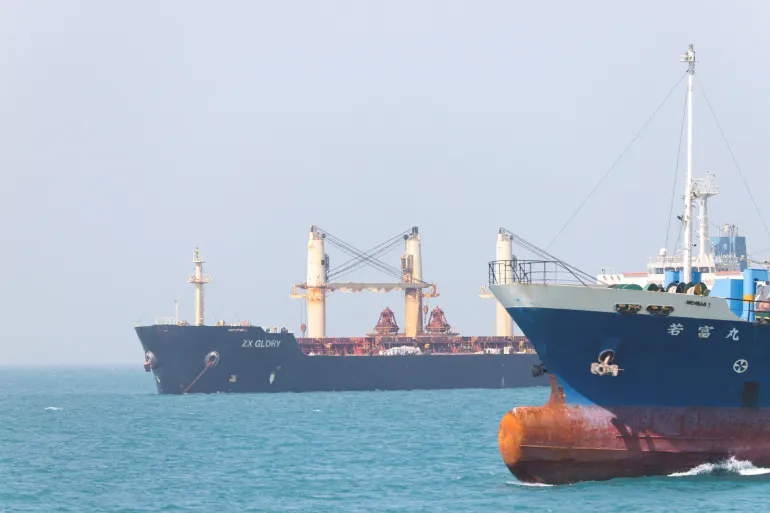
Adding to the pressure on Riyadh’s remaining export options, Yemen’s Houthi movement has in recent weeks seized effective control of virtually the entire Red Sea coastline of Yemen, including the strategically vital Perim Island, which sits at the narrowest point of the Bab al-Mandeb Strait. Shipping traffic through Bab al-Mandeb has roughly halved as a result, according to preliminary data from the tracking firm Kpler, while traffic through Hormuz itself has collapsed to a fraction of its pre-war volume, with oil flows through the strait now running at around 10 million barrels a day, down from more than 20 million before the conflict began.
The advance has alarmed Gulf capitals well beyond Saudi Arabia. Qatar has warned that a full closure of Bab al-Mandeb, layered on top of the paralysis at Hormuz, would be “catastrophic for the entire world,” according to a foreign ministry official, who said Doha was pressing for renewed diplomacy to prevent it. The United Nations Security Council was expected to take up the situation in the strait on Tuesday, in a session called by France, according to diplomats — underscoring how far a conflict that began as a bilateral confrontation between Washington and Tehran has now widened into a threat to global shipping lanes on two fronts simultaneously.
Riyadh has so far resisted calls to draw in direct American military support beyond intelligence-sharing, a stance reported by Reuters sources amid Saudi requests for a more active US role against the Houthis. Crown Prince Mohammed bin Salman met the US regional commander, Admiral Brad Cooper, in Jeddah this week, according to Saudi state media, as the kingdom weighs its response to an insurgency that has re-ignited after a period of relative quiet under a truce dating back several years.
A wider diplomatic scramble
Turkey has joined the chorus of governments urging restraint. Speaking in Baku on Tuesday alongside his Azerbaijani counterpart, Foreign Minister Hakan Fidan said safe and free passage through the Strait of Hormuz should be ensured and that mutual attacks between the Gulf countries should stop, adding that Ankara valued the stability of neighbouring Iran and remained in contact with all sides in search of a solution.
China, too, has urged a diplomatic resolution. Foreign ministry spokesperson Guo Jiakun told a briefing in Beijing that China was closely following developments in the Middle East and Gulf region and hoped the relevant parties would resolve their disputes through political and diplomatic means — remarks that came as the Pentagon’s own inspector general reported that four months of fighting had caused serious strain on American ammunition stockpiles and exposed bottlenecks in the US defence industrial base. Iran’s foreign minister, Abbas Araghchi, is due in Beijing on Wednesday for talks with his Chinese counterpart, Wang Yi.
For all the renewed diplomatic activity, a breakthrough remains elusive. A meeting that had been due to take place in Oman between Iran and Gulf states, aimed at reopening Hormuz, was postponed this week — Tehran said at Saudi Arabia’s request — while a senior Iranian security official dismissed talk of an imminent deal, saying on social media that there would be no talks until Iran’s own conditions were met.
Copyright © 2021 Independent Pakistan | All rights reserved