By Staff Reporter
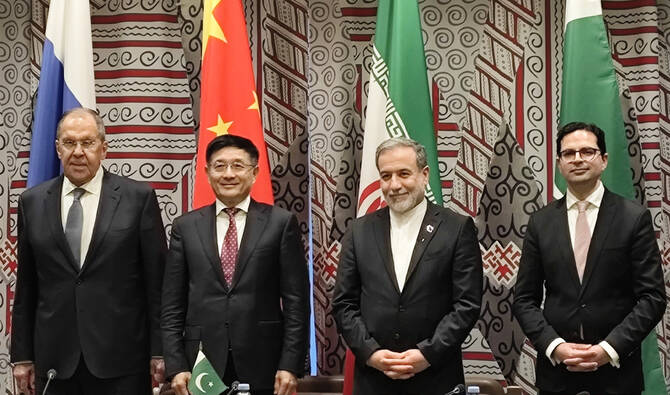
ISLAMABAD: Pakistan, China, Russia, and Iran have issued a forceful call for Afghanistan to take decisive action against militant groups operating within its borders, warning that these organizations threaten regional and global security.
The demand came in a joint statement released after a high-level meeting on the sidelines of the 80th United Nations General Assembly in New York, reflecting deepening concerns over Afghanistan’s role in harboring terrorism.
The four nations, meeting as part of a regional consultation framework established in 2017, reaffirmed their support for an independent and peaceful Afghanistan “free from terrorism, war, and narcotics.” However, they underscored that Afghan authorities must implement “effective, concrete, and verifiable actions” to prevent militants from using the country as a base for attacks.
The statement singled out terrorist groups, including the Islamic State (ISIL), Al-Qaeda, the Eastern Turkestan Islamic Movement (ETIM), Tehreek-i-Taliban Pakistan (TTP), Jaish Al-Adl, the Balochistan Liberation Army (BLA), and the Majeed Brigade, noting that these groups “continue to pose a serious threat to regional and global security.” The four countries expressed “deep concern” over Afghanistan’s deteriorating security situation and urged Kabul to dismantle terrorist training camps and infrastructure.
The joint call comes amid a surge in militant activity in Pakistan’s Khyber Pakhtunkhwa and Balochistan provinces, which border Afghanistan. The TTP and Baloch separatist groups, including the BLA, have claimed responsibility for numerous attacks in these regions. Pakistan has repeatedly accused Afghanistan of allowing its territory to be used for cross-border militancy, a charge Kabul denies.
Iran, meanwhile, has faced attacks from Jaish Al-Adl, a Baloch militant group operating in the restive Sistan-Baluchestan region along the Iran-Pakistan-Afghanistan border. The group has claimed several assaults on Iranian security forces this year, heightening tensions in the region.
The four nations emphasized that combating terrorism, radicalism, and drug trafficking from Afghanistan serves their “common interests.” They urged Afghan authorities to honor international commitments by disrupting militant recruitment, fundraising, and access to weapons, as well as preventing collaboration with foreign fighters.
The statement also addressed the Afghan refugee crisis, calling on Kabul to create conditions for the safe and sustainable return of millions of displaced Afghans. Pakistan and Iran, which host millions of Afghan refugees, were commended for their “significant contributions” to providing shelter and support.
“The four sides expressed appreciation for the regional countries, especially the Islamic Republic of Iran and Pakistan, for hosting millions of Afghan refugees,” the statement said. It pressed the international community to provide “adequate, predictable, regular, and sustainable financial support” to support the repatriation and reintegration of refugees into Afghan society, in line with shared global responsibility.
The statement urged Afghan authorities to ensure returnees’ livelihoods and inclusion in political and social processes to achieve a durable solution to the crisis.
In a related move, Pakistan said it will shutter 16 Afghan refugee camps in Khyber Pakhtunkhwa, Balochistan, and Punjab, as the government presses forward with repatriating more than 1.3 million Afghans whose Proof of Registration cards expired in June.
The closures, outlined in notifications issued September 25 by the Ministry of States and Frontier Regions, target camps established in the early 1980s after the Soviet invasion of Afghanistan. Affected sites include Haripur, Chitral, and Upper Dir in Khyber Pakhtunkhwa; Chaghai, Loralai, Killa Saifullah, Pishin, and Quetta in Balochistan; and Mianwali in Punjab. The ministry directed that all land and non-movable assets in these camps be transferred to provincial governments and district deputy commissioners.
The federal government informed provinces last month that repatriation and deportation of the 1.3 million PoR cardholders, Afghans previously residing legally without visas, would begin September 1, following the interior ministry’s July 31 announcement that the cards’ expiration on June 30 rendered holders unlawful residents.
The United Nations High Commissioner for Refugees expressed alarm, stressing that returns to Afghanistan must be voluntary, phased, safe, and dignified. “Many of the people affected are Afghan refugees who have lived for years in these villages and have expressed great despair about how this development is going to impact their lives,” Qaiser Khan Afridi, UNHCR’s Pakistan spokesperson, said. He urged protection for those with international protection needs or humanitarian concerns, warning against forced returns.
Pakistan’s repatriation push, launched in 2023 amid security concerns and tensions with Afghanistan’s Taliban government, rests on the argument that Afghanistan’s war has ended, justifying refugees’ return. Yet refugees and aid groups counter that Afghanistan remains unstable, with limited access to basic services.
As of June 30, UNHCR reported 1.3 million Afghan refugees in Pakistan: 717,945 in Khyber Pakhtunkhwa, 326,584 in Balochistan, 195,188 in Punjab, 75,510 in Sindh, and 43,154 in Islamabad.
Copyright © 2021 Independent Pakistan | All rights reserved