By Staff Reporter
ISLAMABAD: Pakistan has recorded its ninth polio case of the year, with genetic tests linking the latest infection, in a seven-month-old boy, to the virus circulating across the border in Afghanistan, health officials said on Thursday.
The child is from Mastak union council in Bara tehsil of Khyber district in Khyber Pakhtunkhwa (KP), according to the National Emergency Operations Centre (NEOC). It is the third case from the district this year and the seventh from the province. The other two cases in 2026 were in Sindh.
“The poliovirus detected in all three cases from Khyber district has genetic linkages to Afghanistan – which is facing an intense outbreak with 50 cases reported this year – indicating cross-border circulation of the virus,” the NEOC said in a statement.
The case follows the eighth of the year, confirmed on Sunday in a 13-month-old girl from the same district.
“The case is a stark reminder that poliovirus knows no borders and no child anywhere will be safe from polio until every child is safe, and poliovirus transmission has stopped completely,” the statement said.
The NEOC said wild poliovirus transmission had declined overall this year. But it said the Peshawar block, which covers Khyber and Peshawar districts and borders Afghanistan, and neighbouring districts in southern KP were still reporting detections, including cases. Environmental surveillance has found poliovirus in sewage samples from the Peshawar block, which indicates the virus is circulating despite repeated vaccination rounds.
The infection was confirmed during a nationwide vaccination campaign that has been marked by violence in KP.
Gunmen opened fire on police guarding a vaccination team in Mohmand district on Tuesday, killing two officers and wounding a third. A police official said no vaccination staff were in the vehicle. In a separate incident, four polio workers were abducted by unidentified armed men in Tank district. Search efforts for the four were reported to be under way. Two other vaccinators were abducted in Azam Warsak, in Lower South Waziristan, and were later released. On Thursday, local media reported that a campaign team supervisor had been kidnapped in Jamrud, in the same province.
No group has claimed responsibility for the shooting, though similar attacks have regularly been carried out by the Pakistan Taliban, known as the TTP, and other armed groups.
Polio campaigns in Pakistan have long been hampered by misinformation and vaccine refusals, as well as by militants who falsely claim the vaccines are part of a Western plot to sterilise Muslim children or cause infertility. In September, unidentified gunmen killed two police constables deployed to protect a vaccination team in Balochistan. No group claimed responsibility.
Prime Minister Shehbaz Sharif separately called for a coordinated strategy with the provinces to eradicate the disease, and directed officials to prepare an action plan within a week. He was chairing a meeting in Islamabad to review progress, according to a statement from the Prime Minister’s Office.
“Achieving a polio-free Pakistan is a major challenge,” he said. “However, our resolve and morale are far stronger than this challenge.”
Sharif directed the federal health minister, the minister of state for health, the health secretary and members of the polio eradication team to visit all four provinces and meet their chief ministers and chief secretaries. He said providing security and uninterrupted access to vaccination teams was the government’s top priority. He also told officials to improve routine immunisation, particularly in polio-affected areas, and commended the improved access to security-sensitive areas for campaigns.
The meeting was told that cross-border movement from Afghanistan was a major factor in the spread of the virus in Pakistan. It was also told that no new case had been reported from Punjab since February 2025, and that Balochistan had recorded none in 2025 or 2026. Azad Jammu and Kashmir and Gilgit-Baltistan remained polio-free, and the quantity of virus detected in environmental samples from Sindh had fallen this year. Officials said measures were being taken to improve the security of vaccination teams and access in the southern districts of KP.
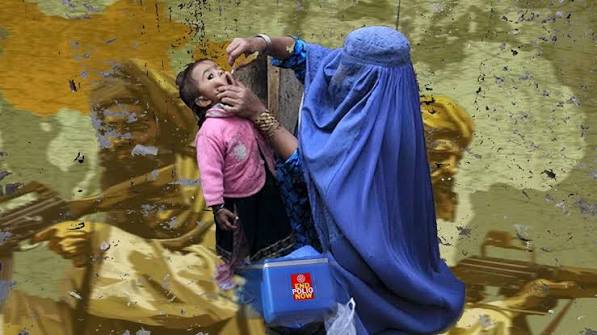
The seven-day drive, which began on 2 November and runs until 8 November, aims to vaccinate about 24 million children under five in 97 districts. It is the fifth large campaign of 2026 and the third sub-national round, with more than 200,000 frontline workers going door to door.
The NEOC said more than 19.6 million children had been vaccinated in the first three days. Punjab accounted for more than 7.5 million across 13 districts, Sindh for 5.659 million across 20 districts, and KP for 4.002 million across 27 districts. Balochistan recorded more than 1.65 million, Islamabad 418,000, Gilgit-Baltistan more than 149,000 and Azad Kashmir more than 182,000.
“Polio workers are coming to your doorstep to protect your children,” the NEOC said. “Cooperate with them, ensure that every child under five years of age receives polio drops during the ongoing polio campaign.”
Federal Health Minister Syed Mustafa Kamal urged parents to make sure every eligible child receives the oral vaccine, regardless of previous doses. Health authorities said repeated vaccination was essential to build immunity and interrupt transmission, particularly in high-risk districts along the Afghan border.
Pakistan and Afghanistan are the only two countries where polio remains endemic. The disease is highly infectious and incurable, and can cause lifelong paralysis and, in some cases, death. The World Health Organisation has repeatedly described the two countries as a single epidemiological block, in which transmission on one side of the border endangers the other.
The WHO has also raised concerns about restrictions on house-to-house campaigns in Afghanistan, particularly in the south, where vaccination has largely been carried out at designated sites. Health officials say this can leave infants and children in remote communities unvaccinated.
Experts cautioned that cross-border transmission is not the only problem. Continued local circulation, children missed during campaigns and weak immunity in vulnerable communities also keep the disease alive, they said.
Pakistan reported 74 cases in 2024 and 31 in 2025. Government data show a 99.8 percent fall from an estimated 20,000 cases a year in the early 1990s to 31 last year. Officials called the decline this year encouraging, but said the continued detection of the virus in children and in sewage showed the threat had not gone.
They said progress would depend on reaching every missed child, strengthening routine immunisation and keeping up cross-border coordination with Afghanistan. Until transmission is stopped in both countries, they warned, children on either side of the border will remain at risk.
Copyright © 2021 Independent Pakistan | All rights reserved