By Staff Reporter
ISLAMABAD: The armed forces have declared the successful conclusion of a major counter-terrorism operation in Balochistan, saying they killed 216 militants accused of links to India in a campaign triggered by a wave of deadly attacks last week.
The Inter-Services Public Relations (ISPR), the armed forces’ media wing, said Operation Raddul Fitna 1 had been brought to a successful close through “coordinated, swift, and intelligence-driven operations” against “Indian sponsored terrorist elements seeking to disrupt peace and development by targeting innocent civilians, including women and children”.
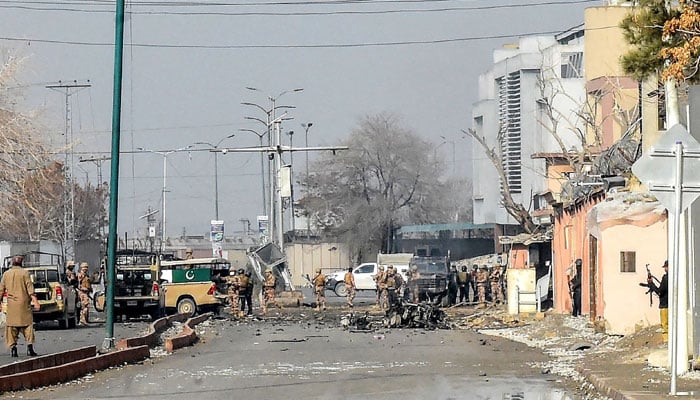
The assaults hit civilian targets across the province, including in Quetta, Mastung, Nushki, Dalbandin, Kharan, Panjgur, Tump, Gwadar and Pasni.
The military’s media wing said the operations had “sent to hell” 216 terrorists. “As a result of these well-coordinated engagements and subsequent clearance operations, 216 terrorists have been sent to hell, significantly degrading the leadership, command-and-control structures and operational capabilities of terrorist networks,” the ISPR said. “Through meticulous planning, actionable intelligence, and seamless joint execution, Pakistan’s security forces and law enforcement agencies (LEAs), with support of intelligence agencies, under Operation Radd-ul-Fitna-1 responded with precision and resolve.”
The operation carried a heavy human cost. The ISPR reported that 36 innocent civilians, among them women and children, had been martyred, while 22 security personnel and law enforcement officers “made the ultimate sacrifice in defence of Pakistan’s territorial integrity and the protection of its citizens,” the statement said. “Their courage, professionalism, and unwavering commitment reflect the highest traditions of service. The nation honours their sacrifice and stands in solidarity with the families of all martyrs.”
The campaign began on “29 January in Panjgur and the outskirts of Harnai district after credible and verified intelligence confirmed the presence of terrorist elements posing an imminent threat to local public”.
“During this phase, security forces undertook operations against identified terrorist hideouts, resulting in the elimination of 41 terrorists affiliated with Indian proxy networks,” the statement said. “Subsequently, aggressive and steadfast responses by the brave security forces effectively thwarted the desperate attacks of Fitna-al-Hindustan to destabilise the peace of Balochistan.” “Sequel to these, a broader series of intelligence-based operations were launched in multiple areas to dismantle terrorist sleeper cells through sustained combing and sanitisation operations,” the ISPR added.
A substantial cache of weapons, ammunition, explosives and equipment of foreign origin was recovered during the counteroffensive operations. “Preliminary analysis indicates systematic external facilitation and logistical support to these extremist proxies,” it observed.
The military said Pakistan’s armed forces remain steadfast in their resolve to combat “terrorism,” vowing that counterterror operations will continue until militants are completely eliminated. “Operation Radd-ul-Fitna-1 stands as a testament to Pakistan’s and particularly Balochistan’s proud peoples’ unwavering commitment to always prefer peace over violence, unity over division and development over violence.”
Balochistan, Pakistan’s largest province by land area, has long faced a separatist insurgency that has intensified in recent years. Militants frequently target security forces, government officials, infrastructure projects, foreigners and non-local workers.
The province holds vast reserves of minerals and hydrocarbons and is central to the multibillion-dollar China-Pakistan Economic Corridor (CPEC), a flagship component of China’s Belt and Road Initiative.
Separatist groups such as the BLA accuse Islamabad of exploiting Balochistan’s natural resources while denying locals a fair share. Pakistan’s civilian and military leadership reject the claim and say they are investing in the province’s development.
Balochistan’s chief minister, Sarfaraz Bugti, described the operation as a “clear message to those committing acts of bloodshed”. In a post on X, he called the banned Baloch Liberation Army “a fitna targeting innocent civilians and labourers” that was working “at the behest of India”. “Pakistan will not compromise on its unity, development, and the protection of its people,” he wrote, warning that any attempt to destabilise the country would meet “a decisive response”. “The nation stands united, and any hand raised against Pakistan will not only be dealt with law and full force but will be broken.”
Copyright © 2021 Independent Pakistan | All rights reserved