By Staff Reporter
ISLAMABAD: The Foreign Ministry on Monday rejected media reports that it had turned down a Chinese offer to mediate escalating cross-border tensions with Afghanistan, insisting the two countries maintain close and regular coordination on all shared concerns and dismissing any contrary claims as “unwarranted speculation or fabrication.”
The statement came hours after China publicly reiterated its willingness to help ease the fighting, which erupted in late February and has raised fears of a wider conflict along the porous 1,600-mile frontier. Pakistani officials have long accused the Taliban government in Kabul of harboring militants from the banned Tehreek-i-Taliban Pakistan (TTP), who have stepped up attacks inside Pakistan since the Taliban returned to power in 2021. Those appeals, Islamabad says, have gone largely unanswered.
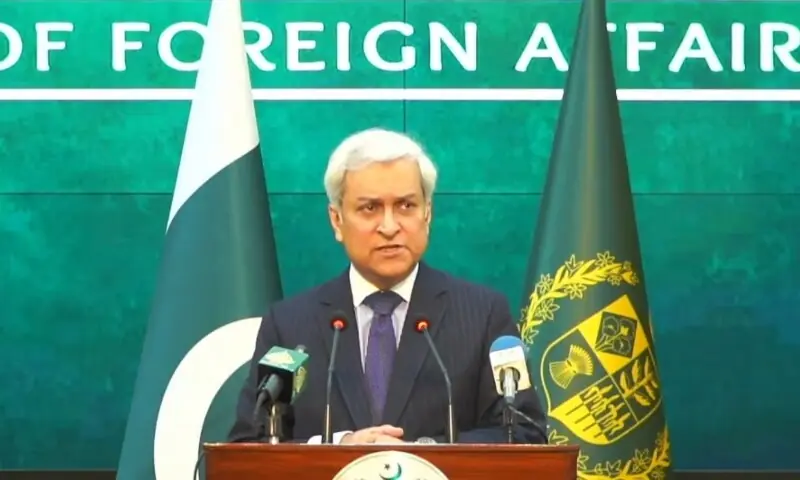
Foreign Ministry spokesman Tahir Andrabi, responding to queries about the reports, emphasised the durability of the Beijing-Islamabad alliance. “Pakistan and China remain trusted partners and close friends, and both maintain regular and close communication on all issues of mutual concern and shared interest,” he said. He pointed specifically to a recent telephone conversation between Deputy Prime Minister and Foreign Minister Ishaq Dar and Chinese Foreign Minister Wang Yi, during which Afghanistan-related developments were discussed, as well as consultations held by Chinese Special Representative for Afghanistan Ambassador Yue Xiaoyong during a visit focused on regional peace and stability.
Andrabi called those accounts baseless. “Therefore, any unnecessary speculation or fabrication of facts in this regard is unwarranted,” he said, repeating the ministry’s core message.
The denial followed weeks of tit-for-tat violence. Officials said the latest flare-up began when Afghan forces fired on Pakistani border posts on the night of Feb. 26, prompting Islamabad to launch Operation Ghazab lil-Haq in response to the unprovoked aggression. That exchange came days after Pakistani airstrikes targeted TTP and Islamic State camps inside Afghan territory. The clashes have killed soldiers on both sides and displaced civilians near the border.
In Beijing, Foreign Ministry spokesman Lin Jian used language that closely mirrored Pakistan’s emphasis on diplomacy. “The most urgent task is to avoid the expansion of the war and return the two countries to the negotiating table as soon as possible,” he told reporters. “China is willing to continue to make efforts to achieve reconciliation and ease relations between Afghanistan and Pakistan.” He added that Beijing has been actively mediating in recent days.
The comments followed a phone call days earlier in which Wang Yi told Afghan Acting Foreign Minister Amir Khan Muttaqi that disputes between Islamabad and Kabul must be resolved through “dialogue and consultation, not force.” Lin Jian reinforced the point on Monday, noting that Afghanistan and Pakistan are immovable neighbours whose problems “could only be resolved through dialogue and consultation.”
Chinese officials also disclosed that Beijing’s special envoy for Afghan affairs had spent the past week shuttling between the two capitals, pressing for an immediate ceasefire after the deadly exchanges. Some Pakistani media outlets had reported that Islamabad politely declined the overture, citing Kabul’s refusal to act against TTP sanctuaries on Afghan soil.
China’s stake in the outcome is substantial. Beijing has invested tens of billions of dollars in Pakistani infrastructure, energy and transport projects under its Belt and Road Initiative. Islamabad has also relied on Chinese-made military hardware, including fighter jets used in a brief conflict with India last May.
Since the Taliban’s takeover in Kabul, analysts say China has emerged as one of the few major powers maintaining pragmatic ties with the new Afghan authorities. The border region has grown increasingly volatile. Pakistani security officials say TTP fighters have used Afghan territory as a launchpad for attacks inside Pakistan, including high-profile strikes on military installations and urban centers. Islamabad has repeatedly pressed the Taliban to dismantle those sanctuaries, only to be told that the issue is an internal Afghan matter.
Pakistan, which helped broker the Taliban’s return to power in 2021, now finds itself in open conflict with its former proxy. Afghanistan’s Taliban leadership, struggling with its own internal challenges and international isolation, has shown little appetite for concessions on militants it views as ideological kin. And China, eager to protect its investments and prevent any spillover that could threaten its own western regions, has stepped in as the only external actor both sides appear willing to hear.
Copyright © 2021 Independent Pakistan | All rights reserved