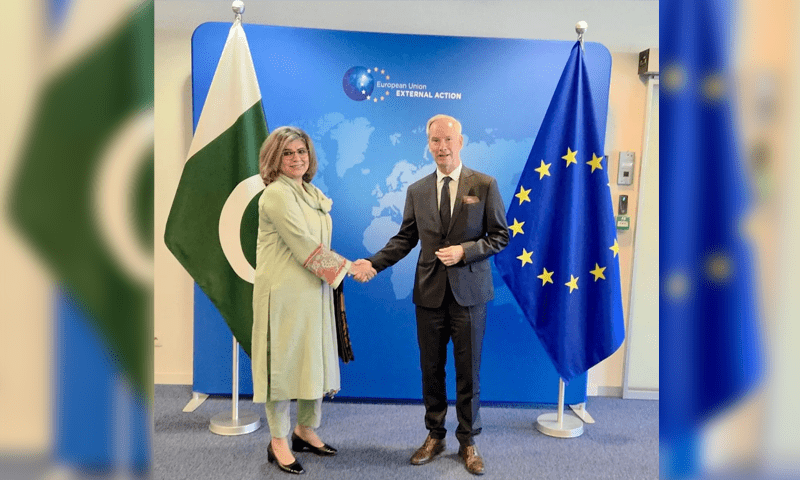
By Staff Reporter
ISLAMABAD: Senior officials from Pakistan and the European Union met in Brussels on Thursday to strengthen their partnership under the Generalized Scheme of Preferences Plus (GSP+), a trade framework that has fueled a 108 percent surge in Pakistani exports to Europe since 2014.
The talks, part of the 10th Political Dialogue between the two sides, also tackled pressing global issues, including counterterrorism, migration, and the humanitarian crisis in Gaza, where more than 57,000 Palestinians have been killed in Israeli military operations since October 2023.
The discussions, led by Pakistan’s Foreign Secretary Amna Baloch and Olof Skoog, deputy secretary general of the European External Action Service, underscored a mutual commitment to deepen cooperation on multiple fronts. “The two sides reiterated their resolve to continue close engagement under the GSP+ framework,” the Foreign Office said in a statement, highlighting the trade scheme’s role in granting Pakistan duty-free access to European markets in exchange for adhering to 27 international conventions on human rights, labor, and environmental standards.
The EU, Pakistan’s second-largest trading partner, extended the GSP+ program for developing nations, including Pakistan, until 2027 in a unanimous vote in October 2023. The trade arrangement has proven vital for Pakistan, which has emerged as the largest beneficiary of the scheme. Since its inception in 2014, Pakistani businesses have significantly expanded their footprint in Europe, a point echoed earlier this year by EU Ambassador to Pakistan Dr. Riina Kionka, who noted that European companies increasingly view Pakistan as a promising destination for investment and economic partnership.
Beyond trade, Thursday’s dialogue emphasized security cooperation, with both sides pledging to bolster efforts in counterterrorism and counter-narcotics. “They condemned all forms of terrorism,” the Foreign Office said, signaling a shared resolve to address regional and global security threats. The delegations also agreed to advance discussions on migration, with plans for a third Comprehensive Migration and Mobility Dialogue later in 2025.
The talks covered contentious regional disputes, including the ongoing conflict in Ukraine and the long-standing Kashmir issue between Pakistan and India. “Both sides agreed on the need for efforts based on dialogue and diplomacy in order to solve contentious issues and underscored the importance of upholding international law and the sanctity of international agreements [and] treaties,” the Foreign Office statement said.
A significant portion of the dialogue focused on the Middle East, particularly the worsening humanitarian crisis in Gaza. “They agreed on the urgent need to improve the humanitarian situation in Gaza,” the statement said, noting that both sides called for an immediate ceasefire and expressed support for a “just, lasting, and comprehensive peace in Palestine in accordance with the two-state solution.”
The Brussels meeting reaffirmed the 2019 Strategic Engagement Plan (SEP), a cornerstone of Pakistan-EU relations that outlines cooperation in areas ranging from trade to security. “The EU and Pakistan reaffirmed their commitment to the implementation of the Strategic Engagement Plan,” the Foreign Office said. “Both sides aim to further deepen cooperation in all areas covered under the SEP.”
The two sides also agreed to convene the 7th Strategic Dialogue in 2025 to further strengthen ties and to hold the next Political Dialogue in Islamabad next year. The commitments reflect a shared vision for a multifaceted partnership, one that balances economic interests with pressing geopolitical concerns.
Copyright © 2021 Independent Pakistan | All rights reserved