By Staff Reporter
ISLAMABAD: Pakistan will continue passing the impact of higher global oil prices directly to consumers under its existing fortnightly adjustment mechanism, the government decided Monday, aiming to prevent any sudden fiscal strain while a new high-level cabinet committee tracks supplies amid fresh disruptions in the Middle East.
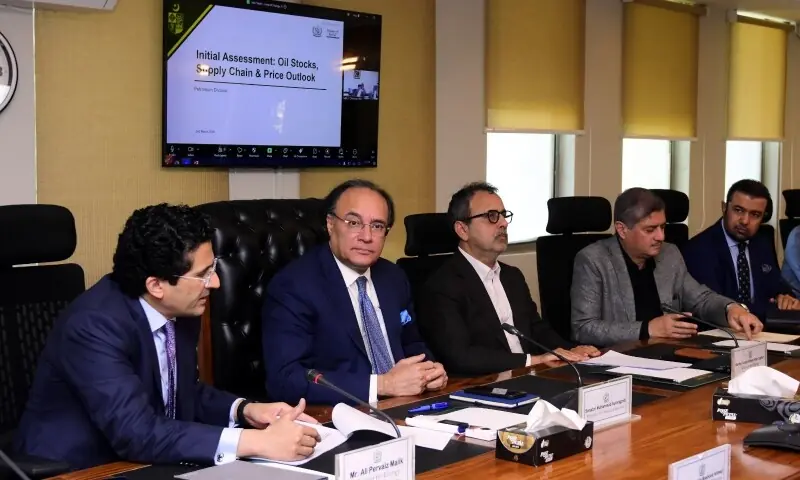
The 18-member panel, formed by Prime Minister Shehbaz Sharif to monitor petroleum markets in response to the escalating regional situation, held its inaugural meeting under Finance Minister Muhammad Aurangzeb. Members were told that petrol and diesel inventories across the country stand at comfortable levels, providing almost 30 days of cover. Liquefied natural gas imports from Qatar, however, face an immediate squeeze after the closure of a key facility there following an Iranian attack.
Official confirmation from Doha was still pending as of Monday afternoon. Supplies will be limited to just a handful of cargoes that have already cleared the Strait of Hormuz and are en route to Karachi. The committee’s makeup reflects the gravity of the situation. It includes the ministers for petroleum and power, State Bank of Pakistan Governor, secretaries of petroleum, power and finance, Oil and Gas Regulatory Authority chairman, Pakistan Refinery Ltd. managing director, and representatives from the Inter-Services Intelligence and Intelligence Bureau, among others.
Discussions focused squarely on the potential closure of the Strait of Hormuz and contingency planning. Authorities were directed to identify alternative supply lines. Saudi Arabia’s shipments of finished petroleum products could be rerouted via the Red Sea, while imports from the United Arab Emirates through Fujairah sit outside the immediate risk zone, the meeting was told.
A comprehensive review of national fuel stocks, forward and futures prices, regional supply-chain resilience, freight and insurance costs, and alternative sourcing options was presented. The panel also examined short- and medium-term foreign-exchange pressures from price volatility and weighed fiscal risks should the conflict drag on. Visibility remains limited because of the fast-moving uncertainties, officials noted.
National petroleum-product inventories are holding steady at healthy levels with no immediate supply stress, according to the Finance Division statement issued after the meeting. Aurangzeb told the committee that Pakistan’s energy supply chain remains stable and fully operational despite the fluid international environment. “Maintaining market confidence and orderly conditions remains essential,” the finance minister was quoted as saying in the official readout.
He added that any pricing adjustments made necessary by international market moves will be handled through established mechanisms in a predictable manner to avoid distortions or abrupt changes. The committee noted that a prolonged shutdown of the Strait of Hormuz — which carries roughly one-fifth of global seaborne oil — combined with tensions around the Bab al-Mandeb Strait, poses clear challenges to energy security worldwide and could affect Pakistan if the situation persists.
Aurangzeb directed all relevant agencies to step up coordination, double-check physical stock positions, track inbound shipments and storage in real time, and stay ready to act on any new developments. He described the panel as a strategic governance forum that will conduct structured scenario planning and meet daily going forward. Structured data on international prices, domestic stocks, foreign-exchange exposure and supply-chain status will be consolidated ahead of each session.
Separately, the Prime Minister’s Office issued a formal notification Monday confirming the committee’s creation and its broad mandate. The panel is tasked with assessing the foreign-exchange implications of oil-price swings over the short and medium term, recommending steps to keep supplies uninterrupted and markets adequately stocked, and conducting a detailed fiscal analysis should the conflict extend. It will also review the wider economic fallout for Pakistan and report regularly to Sharif. The Petroleum Division will provide secretarial support and may add members as needed.
Oil markets reacted sharply earlier Monday to the US-Israeli strikes on Iran, which assassinated Supreme Leader Ayatollah Ali Khamenei and other senior officials. Brent crude briefly jumped as much as 14 percent while West Texas Intermediate rose nearly 12 percent at the open. The attacks also triggered reports of attacks on ships and an effective shutdown of the Strait of Hormuz, amplifying supply concerns.
Energy regulators and industry players moved quickly to reassure the market. OGRA spokesman Imran Ghaznavi confirmed Sunday that the country holds 28 days of petrol and diesel — well above mandatory reserves. An energy ministry official, speaking on condition of anonymity, said finished-product stocks exceed one month. Pakistan State Oil described its own inventories as “healthy” and said it was monitoring developments in line with ministry directives.
Analysts warned that any sustained disruption through Hormuz would ripple quickly into global prices and Pakistan’s import bill. Shankar Terleja, head of research at Topline Securities Ltd., said the strait handles a material share of regional oil flows and that prolonged closure risks shortages and sharp price spikes. Ahsan Mehanti, chief executive of Arif Habib Commodities, called the waterway “highly critical” to Pakistan’s energy security and industrial activity.
Copyright © 2021 Independent Pakistan | All rights reserved