By Staff Reporter
ISLAMABAD: Prime Minister Shehbaz Sharif has set up a high-level committee to negotiate a settlement with Iran over a stalled natural gas pipeline, as the government seeks to limit its exposure to a Paris arbitration claim that could cost the cash-strapped economy as much as $18 billion.
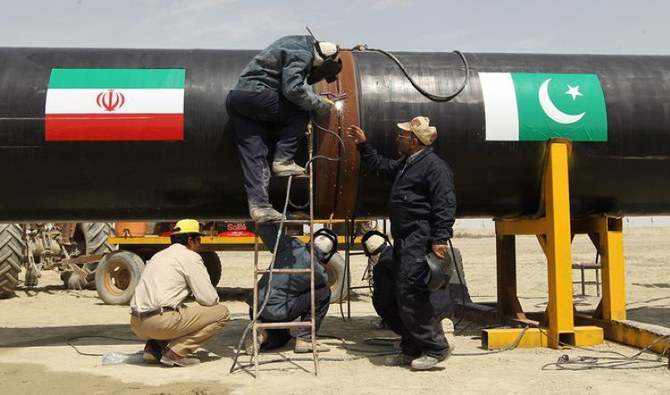
Petroleum Minister Ali Pervaiz Malik disclosed the committee’s formation in the Senate on Tuesday, responding to a query from lawmaker Talha Mahmood over the fate of the 1,900-kilometer pipeline, which was designed to carry as much as 1 billion cubic feet of Iranian gas into Pakistan every day for 25 years. The panel is weighing the legal, financial and energy dimensions of a project that has sat unfinished for more than a decade, Malik said, according to state-run Associated Press of Pakistan.
The dispute traces back to Pakistan’s failure to build its 780-kilometer section of the pipeline, a project first agreed in 2009 and repeatedly delayed as Islamabad cited the risk of running afoul of US sanctions on Tehran. Iran, which says it has already spent $2 billion laying pipe on its side of the border and delivering gas from the South Pars field to a city near the frontier, granted Pakistan a series of extensions before losing patience last year.
Under a 2019 revision to the countries’ Gas Sales Purchase Agreement, Pakistan was obligated to complete construction by early 2024. Iran extended that deadline by 180 days after issuing a formal notice in August, but Pakistan again missed the cutoff in September. Tehran filed for arbitration before the Paris-based International Chamber of Commerce weeks later, seeking roughly $18 billion in damages — a sum that analysts have said would equal close to 6% of Pakistan’s gross domestic product if awarded in full.
Islamabad has assembled a legal team that includes White & Case LLP, Willkie Farr & Gallagher LLP and the arbitration boutique Three Crowns to contest the claim, which was formally lodged with the arbitration court’s Paris secretariat in October 2024. A ruling isn’t expected until 2027 or 2028, according to Pakistani officials cited in local media.
“The leadership of the two countries remained fully engaged in efforts to reach an amicable settlement acceptable to both sides,” Malik told lawmakers, describing Iran as a “brotherly country” even as the two sides remain locked in a formal legal dispute.
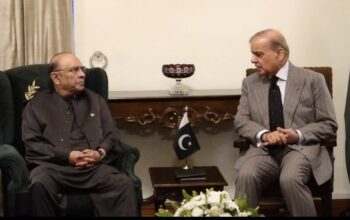
The committee, which includes Deputy Prime Minister and Foreign Minister Ishaq Dar and the country’s attorney general alongside Malik, is tasked with weighing Pakistan’s potential arbitration liability against its worsening energy shortfall, the minister said. Pakistan’s domestic gas reserves are declining rapidly, and the government has increasingly turned to imported liquefied natural gas to cover the gap — a costlier alternative complicated further by periodic disruptions to shipping through the Strait of Hormuz.
Iran, for its part, holds some of the world’s largest natural gas reserves but has struggled to develop them into major export capacity, hampered by Western sanctions and years of political isolation.
Malik’s remarks come as Islamabad has separately pursued a parallel track: Pakistani officials have asked Iran for a fresh extension, this time to 2035, to complete construction, while simultaneously exploring a possible US sanctions waiver that would let the project proceed without legal jeopardy. Pakistan greenlit construction of an initial 80-kilometer domestic stretch of pipeline, running from the Iranian border to the port city of Gwadar, in 2024 in a bid to demonstrate good-faith progress and blunt the arbitration threat.
Malik also told the Senate that Sharif had ordered him to engage with stakeholders in Balochistan province over separate, longstanding disputes involving gas supply and unpaid dues. A second committee, chaired by Dar, is examining those issues, Malik said, including technical and payment-related complications specific to the province.
The pipeline, sometimes referred to as the “Peace Pipeline” in earlier iterations of the project dating to the 1990s, was once envisioned as a three-country venture that would have extended into India before New Delhi withdrew from talks over pricing and security concerns, leaving Islamabad and Tehran to pursue a bilateral arrangement.
Copyright © 2021 Independent Pakistan | All rights reserved