By Staff Reporter
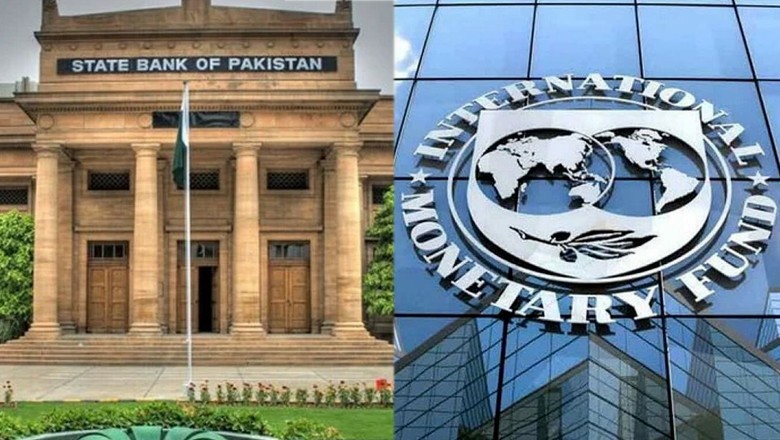
KARACHI: Pakistan received $1.0269 billion on Friday, the first tranche of a $7 billion International Monetary Fund (IMF) bailout, after the lender’s Executive Board approved a 37-month Extended Fund Facility (EFF) to bolster the country’s fragile economy.
The IMF’s Executive Board on Wednesday approved the new loan agreement for Pakistan that requires sound policies and reforms to strengthen macroeconomic stability. The approval releases an immediate $1 billion disbursement to Islamabad.
“The inflows will be reflected in SBP’s liquid reserves to be released on Oct. 3,” the State Bank of Pakistan said in a statement.
The inflow will lift the central bank’s reserves to over $10.6 billion in next week. The central bank’s foreign exchange reserves as of week ending Sept 30 stood at $9.53 billion. The country’s total liquid foreign reserves stood at $14.87 billion, with commercial banks holding net foreign reserves of $5.34 billion.
Pakistan secured the IMF’s backing after fulfilling the lender’s conditions and confirming $12 billion in bilateral loans from Saudi Arabia, China, and the UAE, plus $2 billion in external financing. The funding will help Pakistan address fiscal and external imbalances, while implementing structural reforms to boost growth.
The package, Pakistan’s 25th IMF program since 1958 and sixth EFF, requires Islamabad to implement tough economic reforms. These include overhauling the agriculture income tax, transferring fiscal responsibilities to provinces, and eliminating subsidies on electricity and gas.
Pakistan’s last $3 billion IMF program helped avert a sovereign default in 2023 amid a sharp decline in foreign exchange reserves, currency depreciation and record inflation.
The country has received “significant financing assurances” from China, Saudi Arabia and the United Arab Emirates linked to a the new IMF that go beyond a deal to roll over $12 billion in bilateral loans owed to them by Islamabad, Reuters reported on Thursday.
IMF Pakistan Mission Chief Nathan Porter declined to provide details of additional financing amounts committed by the three countries but said they would come on top of the debt rollover.
“I won’t go into the specifics, but UAE, China and the Kingdom of Saudi Arabia all provided significant financing assurances joined up in this program,” Porter told reporters on a conference call.
Porter said Pakistan has staged a “really remarkable” economic turnaround since mid-2023, with inflation down dramatically, stable exchange rates and foreign reserves that have more than doubled.
“So what we’ve seen is the benefits of undertaking good policies,” Porter said, adding that the challenge now was to build stronger and sustained growth by keeping monetary, fiscal and exchange rate policy consistent, raising more taxes and improving public spending.
Last year, Pakistan achieved its first primary budget surplus in 20 years, and the program calls for growing that to 2 percent of gross domestic product. Porter said it depends in part on reforms to improve collections from under-taxed sectors such as retailers.
The next review of the loan would likely take place in March or April of 2025, based on end-2024 performance criteria, Porter said.
Non-filer
Finance Minister Muhammad Aurangzeb said the country will abolish its “non-filer” tax category, taking punitive action against those who pay minimal taxes to avoid filing returns.
In an interview with Voice of America, Aurangzeb described the existing system as one where non-filers “pay a nominal rate and stay outside the tax system”.
“Now, we’re taking it to a punitive level. It’s about time we address this invention of the non-filer status, which I think only exists in our country,” the minister said. “As a country, our hand has been forced,” he continued. “We no longer have the capacity to allow anyone in this country to remain a non-filer.”
The move is part of Pakistan’s efforts to stabilize its finances, following IMF recommendations.
Aurangzeb warned of “transitional pain” if Pakistan aims to make its current IMF programme its last by pursuing structural reforms. He blamed Pakistan’s history of failing to implement agreed reforms for the IMF’s stricter conditions, citing a “credibility and trust deficit.”
“We sign the structural benchmarks but never follow through,” Aurangzeb said. “That’s why they are strict. This time, we are going to go through the reforms.”
Pakistan plans to expand its tax net to include agriculture, retail, and wholesale sectors, and improve compliance and enforcement.
“As a country, our hand has been forced,” Aurangzeb said. “We no longer have the capacity to allow anyone in this country to remain a non-filer.”
Copyright © 2021 Independent Pakistan | All rights reserved