By Staff Reporter
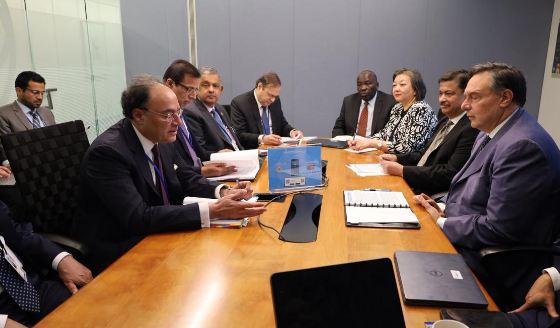
ISLAMABAD: Finance Minister Muhammad Aurangzeb on Monday held talks with officials from the International Finance Corporation and the Islamic Development Bank aimed at boosting private sector investment and speeding up infrastructure projects, while inviting US firms to invest in key sectors during meetings in Washington.
Aurangzeb, attending the annual meetings of the International Monetary Fund and the World Bank, discussed accelerating the IFC’s investment plans, including the Reko Diq project, and expediting IsDB-funded initiatives such as the M-6 Motorway, along with advancing new frameworks for deeper economic collaboration with both institutions.
In a meeting with IFC Regional Vice President Riccardo Puliti for the Middle East, Central Asia, Türkiye, Afghanistan and Pakistan, the minister highlighted Pakistan’s improving macroeconomic indicators and the importance of strengthening the IFC’s partnership with the country. “We value IFC’s role in scaling up private sector investment, particularly through multi-billion-dollar commitments under the 10-year Country Partnership Framework,” Aurangzeb said.
Both sides agreed to work toward early financial closure of the IFC’s flagship Reko Diq project, and the minister welcomed the IFC’s new regional set-up, including a regional office in Islamabad, describing it as a “significant step to deepen collaboration and support sustainable investment in Pakistan.”
In separate talks with IsDB President Dr Muhammad Sulaiman Al-Jasser, Aurangzeb thanked the bank for its long-standing support to Pakistan and reviewed the current project portfolio. He emphasised the need for faster implementation of ongoing initiatives and welcomed the IsDB Board’s approval of financing for two sections of the M-6 Motorway.
Aurangzeb also discussed continued cooperation in Pakistan’s polio eradication efforts and the oil financing facility, noting that both sides had agreed to develop a new Country Engagement Framework to guide future collaboration.
Separately, Aurangzeb invited US firms to invest in Pakistan’s oil, gas, minerals, agriculture and IT sectors, while hailing a recently-agreed US tariff framework supporting bilateral trade. He expressed these views during a meeting with Robert Kaproth, Assistant U.S. Treasury Secretary for International Finance, and Counsellor Jonathan Greenstein. During the discussion, the finance minister underlined Pakistan’s improving economic fundamentals, supported by the ongoing IMF programme. He also briefed the US Treasury officials on Pakistan’s recent legislation to regulate virtual assets.
Aurangzeb also attended the Commonwealth Finance Ministers Meeting, focusing on “Strengthening Economic Resilience amidst International Policy Shifts”. In his address to the meeting, the finance minister emphasised the importance of prioritising actions and focusing on delivery to move towards the goal of a resilient and prosperous Commonwealth.
Aurangzeb supported measures for operationalising the Commonwealth infrastructure, Financial Resilience Hub and Technical Assistance Fund for peer review and capacity building. He further underscored the centrality of climate financing for a country like Pakistan and the imperative of operationalising institutions, including the Loss and Damage Fund.
The Pakistani delegation was also hosted by the leadership and members of the US-Pakistan Business Council. Speaking on the occasion, Aurangzeb briefed the participants about improvements in the macroeconomic indicators of Pakistan. He also underlined that the private sector has to lead the country. He reiterated that the Government of Pakistan was conscious of the challenges being faced by businesses and was working to provide maximum relief. He highlighted the trade deal negotiated with the U.S. authorities, saying he looked forward to enhanced G2G and B2B engagements with U.S. companies in priority sectors, including mines & minerals, agriculture, IT, and pharmaceuticals.
Copyright © 2021 Independent Pakistan | All rights reserved