By Staff Reporter
ISLAMABAD: Pakistan and Iran said talks on a long-delayed free-trade agreement are nearing completion, as the two neighbors moved to capitalize on warming political ties and push bilateral commerce toward a $10 billion target that has eluded them for years.
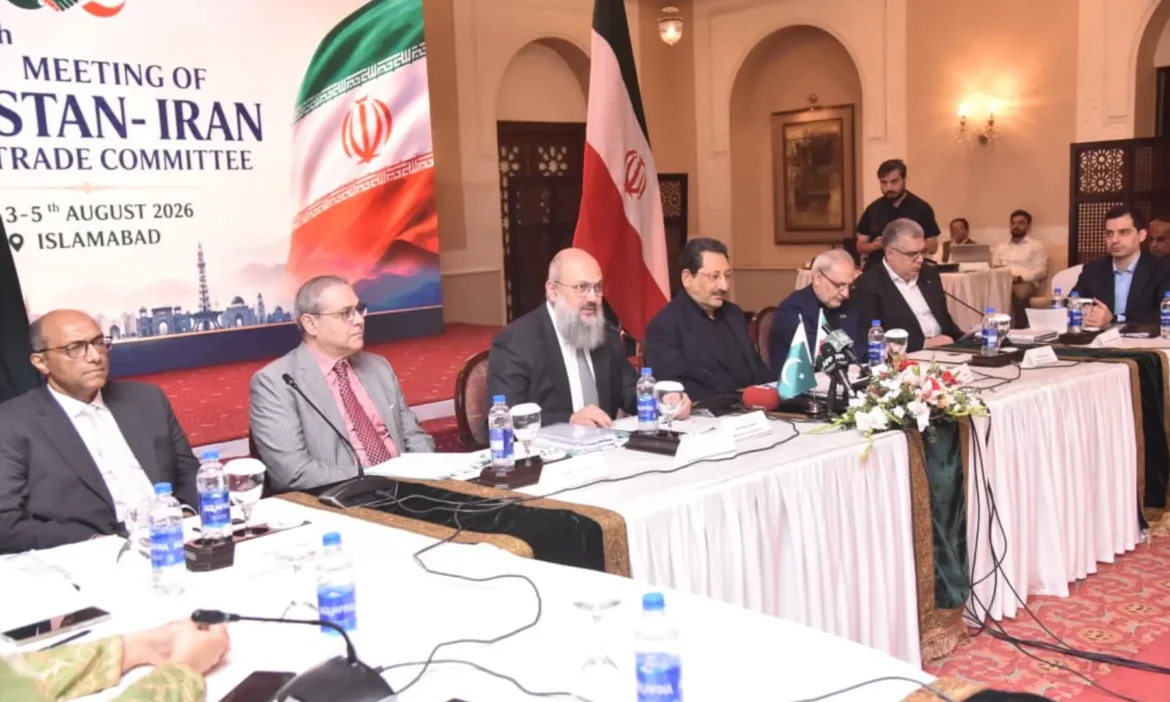
Officials from both countries met in Islamabad on Tuesday for the 10th session of the Pakistan-Iran Joint Trade Committee, the highest-level forum for economic cooperation between the two states, co-chaired by Pakistan’s Commerce Minister Jam Kamal Khan and Iran’s Minister of Industry, Mine and Trade, Mohammad Atabak.
“Negotiations on Iran and Pakistan free trade agreements are progressing well and we hope that they will be concluded successfully in near future,” Atabak told delegates in his opening remarks.
The push to deepen trade ties comes as both governments try to insulate their economies from the fallout of conflict in the Middle East, where a US-Israeli military campaign against Iran has disrupted shipping and strained regional supply chains for months. Atabak thanked Pakistan for its “principled and brotherly support” during the confrontation and credited Islamabad’s diplomacy for helping push the two sides toward de-escalation.
Trade between the countries has climbed past $3 billion, still a fraction of the $10 billion goal set during a visit by the late Iranian President Ebrahim Raisi to Pakistan in April 2024. The shortfall reflects years of structural obstacles: international sanctions on Iran, banking restrictions that complicate cross-border payments, gaps in transport infrastructure, and persistent security concerns along the 900-kilometer frontier the two countries share.
Khan called for dismantling barriers in border logistics and cargo movement, framing the moment as an opportunity to convert what he termed “historic brotherly relations” into a more substantive economic partnership. He pointed to joint border markets and electronic data interchange as tools that could meaningfully lift trade volumes, and said the private sector in both countries was already positioned to scale up activity — the burden now fell on governments to deliver what he called a predictable and reliable business environment.
Atabak, in turn, described Pakistan as Iran’s long-term strategic trade partner and said Tehran was looking to expand logistics cooperation through the ports of Karachi and Gwadar, which he characterized as alternative gateways for Iranian exports and for importing industrial raw materials from third countries. He also flagged electricity trade and regional connectivity as emerging areas of economic opportunity.
Extending operating hours at key border crossings and getting joint border markets fully functional emerged as near-term priorities. Khan said in televised remarks that longer hours would speed up trade processing, while operational border markets were critical to boosting livelihoods in frontier communities, curbing informal trade, and pulling more commerce into the formal economy. Both countries have leaned on barter arrangements in recent years — letting businesses swap goods directly rather than route payments through conventional banking channels — as a workaround for the financial restrictions that complicate formal trade with Iran.
The committee also pledged to review customs and banking cooperation, transport and transit connectivity, and broader investment links between the two economies.
Border Infrastructure Push
Tuesday’s meeting builds on a string of measures rolled out since March aimed at formalizing and expanding cross-border trade. Pakistan eased customs procedures, designated Taftan as an official customs station, and notified new transit routes for goods movement.
In March, Islamabad also permitted exporters to keep shipping food and pharmaceutical products to Iran via land routes without mandatory banking instruments — a workaround for maritime trade disrupted by the Gulf crisis. Ten food items, including rice, seafood, potatoes, meat, onions, maize, citrus fruits, bananas, tomatoes and frozen chicken, along with pharmaceuticals and tents, were cleared for land-route exports without requiring financial instruments. Pakistan separately authorized rice exports to Central Asian Republics and Azerbaijan routed through Iran.
That same month, Pakistan opened a new customs station at Jeerak in Panjgur district, its fifth official crossing point with Iran, designed to formalize passenger movement and channel informal trade into documented channels. It follows the Kohak Cheedgi crossing, opened in January 2025, and the Gabd Rimdan border point, which opened in December 2024.
In April, Pakistan’s commerce ministry notified six transit routes for shipping goods to Iran via the Gwadar and Karachi seaports — a move that followed reports of thousands of containers bound for Iran sitting stalled at Pakistani ports awaiting clearance.
The trade push also follows a visit roughly two weeks ago by Iranian Interior Minister Eskandar Momeni to Islamabad, where he met with Pakistan’s Railways Minister, Hanif Abbasi. That meeting produced an agreement to expand railway cooperation and discussed reviving the Islamabad-Tehran-Istanbul freight train service.
Pakistan and Iran have operated under a bilateral Preferential Trade Agreement since September 2006, under which Pakistan grants tariff concessions to Iran on 338 tariff lines while Iran offers concessions on 309 lines, with average concessions of about 18%. But Iran’s more restrictive tariff regime means duties on Pakistani exports remain considerably higher than those Pakistan applies to Iranian goods entering its market — an imbalance officials on both sides have cited as a reason to accelerate the free-trade negotiations.
Tuesday’s session was only the 10th JTC meeting since the mechanism was established, with the previous gathering held in Tehran in November 2021 — an interval that underscores how long the two countries have struggled to translate political goodwill into commercial momentum.
Copyright © 2021 Independent Pakistan | All rights reserved