By Staff Reporter
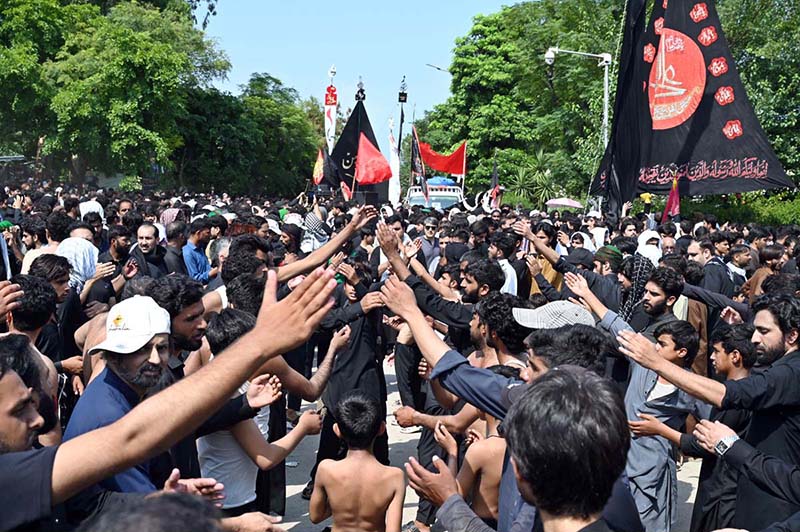
ISLAMABAD: Millions of Pakistanis took to the streets on Friday for Ashura, the most solemn day of the Islamic month of Muharram, as authorities deployed tens of thousands of security personnel across the country — a day after four people died from suffocation during a procession in the southern province of Sindh.
The 10th of Muharram marks the martyrdom of Imam Hussain, grandson of the Prophet Mohammad, along with 72 companions at the Battle of Karbala in what is now Iraq in 680 AD. Processions moved through the narrow lanes of Lahore’s walled city and the streets of Karachi, Islamabad and cities as far north as Gilgit and Skardu, with the federal government having declared a public holiday for both Thursday and Friday.
Sindh Home Minister Ziaul Hassan Lanjar said four people died and 14 were lightly injured in a crowd crush during the “Nau Dhala” procession in Rohri, a city in Sukkur district, on Thursday. After conducting an aerial review of security arrangements, he visited the site alongside Sindh Assembly Speaker Awais Qadir Shah and ordered full coordination between police, rescue teams and the district administration.
President Asif Ali Zardari and Prime Minister Shehbaz Sharif each issued Ashura statements calling on Pakistanis to uphold the values exemplified at Karbala. Zardari described the battle as “more than a historical event” and “a living lesson and an enduring message for humanity,” adding that Imam Hussain had demonstrated that every sacrifice was justified in defence of truth and human dignity, but that submission to tyranny was not. He appealed for inter-sect harmony and asked citizens to shun rumours and provocative behaviour. Sharif, in a separate message, pledged to protect the rights of the “weak and deprived” and called on religious scholars, media organisations and young Pakistanis to carry Karbala’s message forward.
In Lahore, the main Ashura procession departed Nisar Haveli inside the historic Mochi Gate, winding toward Karbala Gamay Shah through the old city, with thousands of mourners — men, women and children — taking part. In Karachi, the central procession was to leave Nishtar Park following a Majlis-e-Aza. Processions were also underway in Multan, Peshawar, Quetta, Islamabad, Rawalpindi, Gilgit, Skardu and Muzaffarabad. Along routes, devotees maintained Niaz and Sabeels — stalls providing meals and water to mourners and passers-by — a centuries-old tradition of communal hospitality observed on Ashura.
In Rawalpindi, authorities deployed five army companies, seven Rangers companies and thousands of police, while the Punjab government suspended the Metro Bus Service connecting the city with Islamabad on the recommendation of intelligence agencies. Officials said the main mourning procession was to pass along Murree Road directly beneath the metro track, raising security concerns.
Across Pakistan, the scale of the Muharram security operation reflected the day’s historical sensitivity. In Islamabad, around 16,000 personnel from police, Rangers and the army were deployed in five security layers, with armoured personnel carriers on standby and the procession route cleared in advance by a bomb disposal squad. Drone surveillance covered processions and gatherings, while authorities launched “Mehfooz Muharram,” a mobile application allowing citizens to report suspicious activity with live location and image-sharing features.
In Punjab, more than 152,000 police personnel were committed to Muharram security for the entire month, supplemented by the army and Rangers. Chief Minister Maryam Nawaz had directed the implementation of a three-tier security plan and asked organisers of religious gatherings to activate QR-coded panic buttons installed at 4,700 imambargahs across the province. On Muharram 9 alone, over 70,000 security personnel were in the field, with 5,623 CCTV cameras active province-wide.
In Khyber Pakhtunkhwa, 43,317 police personnel were deployed across the province for the month, with 12,000 in Peshawar. Of the province’s 614 imambargahs, 127 were classified as highly sensitive. The Peshawar Transport Department suspended Bus Rapid Transit services on both the ninth and tenth of Muharram as a security measure. KP Governor Faisal Karim Kundi, after inspecting security installations and a command room in Peshawar, called on citizens to set aside political divisions in the interest of peace.
In Balochistan, mobile and internet services remained suspended in Quetta and other parts of the province, state news agency APP reported. Entry points to procession routes were sealed with barbed wire and heavy trucks, hospitals declared emergencies and personnel from the Frontier Corps, Anti-Terrorism Force, Rapid Response Group and Balochistan Constabulary were deployed alongside police. Chief Minister Sarfraz Bugti said the government had made “comprehensive arrangements” for order during Muharram.
At the federal level, State Minister for Interior Tallal Chaudhry chaired a security review meeting on Thursday attended by home secretaries and police officials from all four provinces, Gilgit-Baltistan and Azad Jammu and Kashmir. He said protecting citizens’ lives and property was the government’s top priority and that Interior Minister Mohsin Naqvi was personally monitoring nationwide Muharram security arrangements from a central control room.
Copyright © 2021 Independent Pakistan | All rights reserved