By Staff Reporter
ISLAMABAD: Pakistan’s military on Monday dismissed conditions set by Afghanistan in recent border talks as irrelevant, emphasising that only the complete elimination of terrorism from Afghan soil would satisfy Islamabad, amid escalating tensions marked by cross-border skirmishes and accusations of harboring militants.
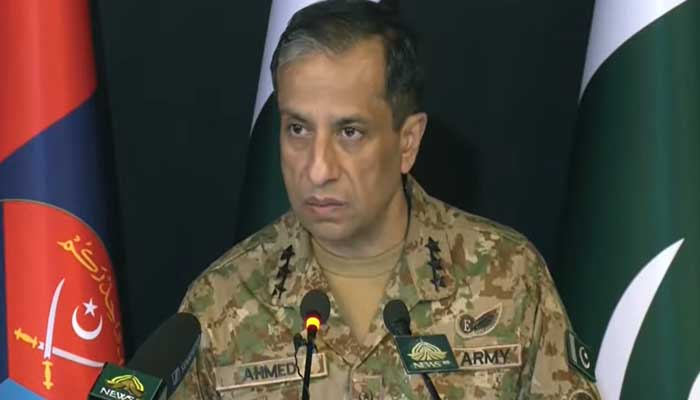
In a briefing to selected journalists, Lt. Gen. Ahmed Sharif Chaudhry, the director general of the military’s Inter-Services Public Relations, outlined Pakistan’s unyielding position following negotiations in Doha and Istanbul. “The conditions set by Afghanistan hold no significance,” General Chaudhry said. “The important thing is the eradication of terrorism.”
The briefing came against the backdrop of strained relations between the two neighbors, which have deteriorated in recent weeks with border clashes and mutual recriminations. Hostilities intensified last month when an attack was launched on Pakistan from Afghanistan on the night of Oct. 11, following Afghan Taliban allegations of Pakistani airstrikes into Afghanistan — claims that Islamabad has neither confirmed nor denied.
Pakistan has long accused the Taliban of allowing terrorist groups, including the Tehreek-i-Taliban Pakistan (TTP) and the Balochistan Liberation Army (BLA), to operate from Afghan territory. For its part, Islamabad has demanded that the Taliban prevent such groups from using Afghan soil to launch attacks. The Oct. 11 incident was followed by multiple skirmishes along the Pakistan-Afghanistan border, including Pakistani strikes targeting camps of the Gul Bahadur group in Afghanistan.
The two sides eventually agreed to dialogue, culminating in high-level talks in Doha on Oct. 19, where they pledged an immediate ceasefire and mutual respect for sovereignty. A second round began in Istanbul on Oct. 25, with Pakistan seeking a “concrete” mechanism to monitor Taliban actions against cross-border terrorism.
General Chaudhry stressed that the guarantors of Pakistan’s security are its armed forces, not Afghanistan, and that Islamabad has “never celebrated” the Taliban’s rise to power. He reiterated that there would be no negotiations with terrorists. “There will be no talks with terrorists, and Pakistan gave the Afghan Taliban a befitting response, which yielded the results we wanted,” he said.
Operations against banned groups like the TTP and BLA are ongoing, General Chaudhry said, with 1,667 terrorists killed so far this year. He said in the past three to four months of clashes, 112 foreign terrorists were killed, including 206 Afghan soldiers. A significant number of those killed in border regions were Afghan nationals, he said, noting that Afghan Taliban, BLA and Khwarij elements are relocating their bases from border areas to residential zones “to use civilians as human shields.”
General Chaudhry presented evidence, showing Afghan Taliban soldiers’ involvement in terrorism inside Pakistan. “We were presented with the same evidence shared with the Afghan Taliban in Doha…These soldiers had Afghan and Afghan Army identification cards.”
General Chaudhry highlighted a nexus between criminal networks and terrorist organisations, fueled by opium cultivation that generates millions of rupee per acre. “The entire population joins them, even warlords join in, and they all work together,” he said. Drugs are being smuggled from Afghanistan into Pakistan and beyond, with “Afghan drug smugglers interfering in Afghan politics.”
In Khyber-Pakhtunkhwa Province, terrorism is directly linked to the narco-economy, General Chaudhry said. Around 12,000 acres of land have been used for poppy cultivation, yielding profits of Rs1.8 million to 3.2 million per acre. Local politicians and influential figures are involved in these activities, he added, with the Afghan Taliban protecting them because the poppy is transported to Afghanistan for processing into ice and other narcotics.
Due to military operations in the Tirah Valley, poppy crops were destroyed through coordinated efforts involving drones, the Anti-Narcotics Force and the Frontier Corps, General Chaudhry said. Terrorist groups also profit from non-custom-paid vehicles and the smuggling of Iranian oil.
Pakistan continues to grapple with terrorism, suffering multiple casualties among security forces in intelligence-based operations. General Chaudhry said 62,113 such operations have been carried out in 2025, averaging 208 per day, amid 4,373 terrorist incidents this year. Among the 1,667 terrorists killed were 128 Afghan nationals.
The military spokesman said the discussions in Doha and Istanbul focused on a single agenda: ending cross-border terrorism from Afghanistan. He criticized the Taliban for failing to implement the Doha Agreement, under which they had pledged to the United States to convene a Loya Jirga to form a representative government. “The Taliban have not fulfilled that promise,” General Chaudhry said. “The solution to the problem lies in establishing a representative government in Afghanistan.”
Still, Islamabad desires peace and prefers to resolve issues through dialogue. “We want peace and a negotiated settlement,” General Chaudhry said. “But if talks fail, we will resolve the problem ourselves. In recent days, we have already demonstrated that we are capable of doing so.” Pakistan agreed to mediation only at the request of third parties, including Türkiye and Qatar, which have deep ties with Islamabad. Qatar played a major role in past negotiations between the Taliban and NATO forces.
In Istanbul, the Taliban were told to control terrorism, General Chaudhry said. “How they do it is their job. We conducted a counter-terrorism operation, and the terrorists fled to Afghanistan. Hand them over, we’ll deal with them according to the Constitution and the law.” These were Pakistan’s own people who fled, he noted, and it is the Taliban’s responsibility to explain how they will curb terrorism.
General Chaudhry dismissed reports of any Pakistan-United States understanding on drone operations in Afghanistan as “completely baseless.” “Pakistan has no agreement with the United States, and no formal complaint about drones has been received from the Taliban regime,” he said. The Ministry of Information has repeatedly clarified the matter, he added. “There is no arrangement whatsoever under which drones operate from Pakistan to Afghanistan.”
He also warned of potential Indian involvement, saying India might stage a false flag operation via maritime routes to falsely claim a major strike on Pakistan. “We have some evidence which indicates India’s false flag operation through sea routes,” General Chaudhry said, adding that the armed forces are fully alert.
Copyright © 2021 Independent Pakistan | All rights reserved