By Staff Reporter
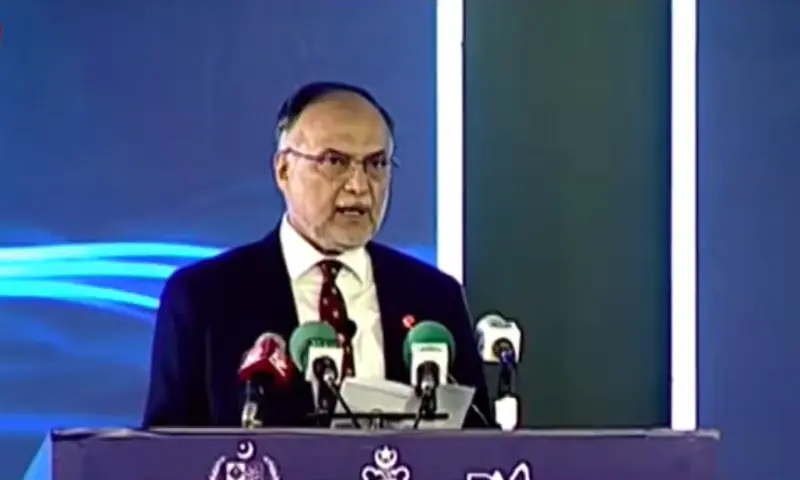
KARACHI: Planning minister on Monday inaugurated a major international maritime exposition in the southern port city of Karachi, calling the country a “natural maritime bridge” between East and West and urging greater investment in an underdeveloped sector that he said could unlock billions in economic potential.
The four-day Pakistan International Maritime Expo and Conference, known as PIMEC, drew representatives from 44 countries, including the United Kingdom, Saudi Arabia, China, Egypt and Turkiye, as part of 133 international delegations from Europe, Asia, North and South America, and the Far East.
Held at the Karachi Expo Centre and organised by the Pakistan Navy with support from federal and provincial departments, the event runs through Thursday and features 178 exhibitors — 150 local organisations and 28 global firms.
In his address, Planning Minister Ahsan Iqbal highlighted Pakistan’s strategic geography, where regions of South Asia, Central Asia, the Middle East and Africa converge, positioning the country at a crossroads of global trade. But he lamented that the maritime sector contributes less than 1 percent to Pakistan’s gross domestic product, far below the 4 to 7 percent seen in other maritime nations.
Pakistan boasts a coastline of more than 1,000 kilometers, an exclusive economic zone of nearly 290,000 square kilometers and “vast offshore potential” in renewable energy, fisheries and mineral resources, Iqbal said.
He tied the sector’s growth to the government’s Uraan Pakistan plan, which aims to transform the economy into a $1 trillion powerhouse by 2035 through a framework known as the 5Es: exports; e-Pakistan; equity and empowerment; environment and climate change; and energy and infrastructure.
The minister identified eight key drivers of export-led growth, including agriculture and food processing, manufacturing and industry, information technology and digital services, mines and minerals, manpower and skills export, creative and cultural industries, services sector and tourism, and the blue economy.
“In this age of interconnectedness, the oceans have re-emerged as the highways of global commerce, energy and communication, and these nations that harness them wisely are shaping the future of economic power,” Iqbal said. “The world’s prosperity literally sails on the seas.”
The global blue economy, he added, contributes more than $2.5 trillion annually to the world’s GDP and sustains over 350 million jobs in shipping, ports, fisheries, coastal tourism and related fields. Iqbal described the spirit of the modern blue economy as seeking God’s “bounty through trade, innovation and exploration while being grateful and responsible stewards of his creation.”
Sindh Chief Minister Murad Ali Shah, who attended the inaugural ceremony, called PIMEC a “great opportunity” in a statement, saying it brings together national and international maritime business leaders and opens new investment doors. “Sindh government is committed to promoting maritime trade, strengthening ties all over the world,” he asserted.
Officials and representatives from countries including the U.K., Italy, Saudi Arabia, Iran, Turkiye, Egypt, China and Australia are attending, according to state media. The exposition is designed to foster collaboration and partnerships in key maritime sectors such as ports, shipping, fisheries and coastal development. It includes business-to-business and business-to-government meetings, the signing of memorandums of understanding, and an international conference on “Harnessing Blue Economy Potential for Sustainable Development,” as reported by state broadcaster Radio Pakistan.
According to the event’s website, PIMEC provides opportunities for public and private maritime industries to display products and develop business relationships. It brings together stakeholders from diverse fields including hydrocarbon extraction, coastal development, shipping ports and infrastructure, fisheries, marine tourism, offshore renewable energy, aquaculture, seabed mining and marine biotechnology to exploit the ocean’s untapped resources. Experts have said Pakistan’s maritime sector could contribute over $100 billion annually to the national economy and called for urgent action to unlock its potential.
Copyright © 2021 Independent Pakistan | All rights reserved