By Staff Reporter
ISLAMABAD: Pakistan’s first nationwide polio vaccination drive of 2026 left nearly a million children without shots and recorded more than 50,000 refusals, officials said, showing persistent challenges in the country’s push to eradicate the crippling disease despite vaccinating over 44 million others.
The campaign, which wrapped up on Feb. 5 in most parts of the country but extended to Feb. 8 in the southern Sindh province, achieved a household coverage rate of 98%, according to data from the National Emergency Operation Center (EOC). But the 2% of children missed translated into a substantial 950,000 youngsters, a figure officials described as worrisome in a nation of more than 230 million people.
A large chunk of those missed – 670,000 – were absent from home during vaccination rounds, the data showed. Separately, teams administered polio drops to 2.5 million “guest children,” a category that often includes mobile or visiting families and likely overlapped with some of the unavailable cases. Refusals totaled 53,000, or 0.14% of the targeted population, with 58% concentrated in Karachi, Pakistan’s sprawling commercial hub and largest city. “31,000 refusals from Karachi, forming the largest share,” an official with the polio program said, speaking on condition of anonymity.
Security issues, community boycotts and harsh weather further hampered efforts, leaving 233,000 children as “leftovers.” Of these, 184,000 were in the northwestern Khyber Pakhtunkhwa (KP) province, including 113,000 in its southern districts. In the mountainous regions of Azad Jammu and Kashmir (AJK) and Gilgit-Baltistan, about 50,000 children went unreached due to snow-bound areas and campaigns that could not proceed. In the southwestern Balochistan province, the drive was postponed entirely in the districts of Mastung, Gwadar, Chagai and Awaran because of security concerns.
Despite the gaps, the EOC hailed the effort as a milestone, with more than 44.3 million children receiving the oral vaccine nationwide. Breakdowns by region showed Punjab leading with over 22.9 million vaccinations, followed by Sindh with more than 10.5 million, KP with over 7.13 million and Balochistan with more than 2.36 million. The capital Islamabad recorded over 455,000, Gilgit-Baltistan about 261,000 and AJK more than 673,000.
“The National Emergency Operation Center (EOC) extends its sincere appreciation to all relevant stakeholders for their cooperation, commitment, and active participation in ensuring the successful implementation of the campaign,” the EOC said in a statement. The drive ran concurrently with a similar effort in neighboring Afghanistan, highlighting stepped-up coordination across the porous border to curb poliovirus spread. “The Government of Pakistan reaffirmed its strong commitment to achieve a polio-free Pakistan through sustained immunisation efforts, community engagement, and regional collaboration,” the statement added.
Pakistan remains one of just two countries where polio is still endemic, alongside Afghanistan. Anwarul Haq, head of the Pakistan Polio Programme, said confirmed cases dropped to 31 in 2025 from 74 the previous year. “Moreover, in terms of poliovirus, Punjab is negative, Peshawar is negative, and Balochistan is also negative. We just need to focus more on some critical areas, namely Sindh and south KP,” Haq said.
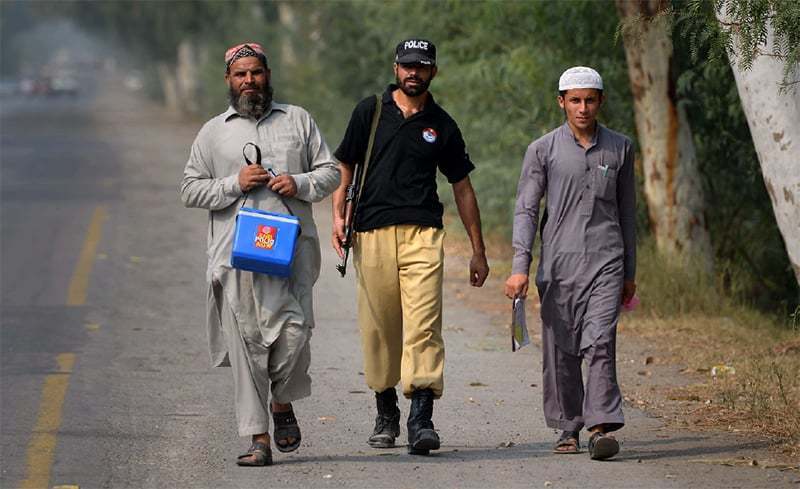
Ayesha Raza Farooq, the prime minister’s focal person on polio, said an independent post-campaign assessment was in progress. “It will take a week before results are compiled and the programme will share them with all the stakeholders,” she said. Pakistan has intensified its polio eradication push in recent years, deploying thousands of health workers under heavy security amid threats from militants who have targeted campaigns, viewing them as a Western plot. The latest drive aimed to build on gains, but the missed children and refusals highlight enduring hurdles in high-risk zones.
Copyright © 2021 Independent Pakistan | All rights reserved