By Staff Reporter
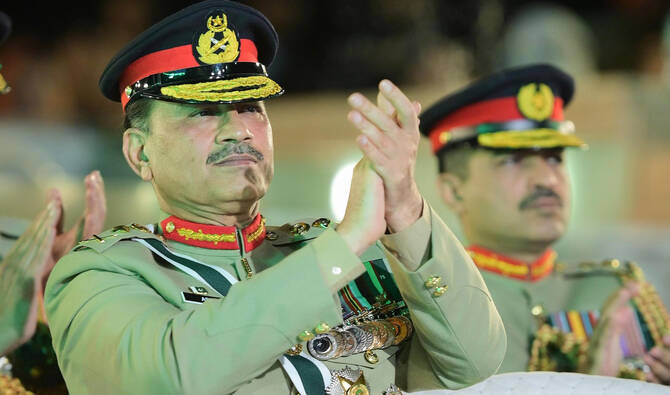
ISLAMABAD: Pakistan has thrust itself forward as the primary mediator seeking to negotiate an end to the war between the United States, Israel and Iran, drawing on the Pakistani army chief’s longstanding connections in Tehran and the close rapport between Islamabad’s leadership and President Donald Trump, FT reported on Monday.
Two officials familiar with the discussions said Pakistan has proposed Islamabad as the site for talks in the coming days that would bring together senior figures from the Trump administration and Iran. The overture comes as the conflict, now in its fourth week, threatens to disrupt global energy markets and further destabilise the Middle East.
Army Chief Gen. Asim Munir spoke by telephone with Trump on Sunday, according to two people briefed on the call. On Monday, Prime Minister Muhammad Shehbaz Sharif held direct talks with Iranian President Masoud Pezeshkian. Those conversations coincided with Trump’s announcement that he was postponing by five days his threat to “obliterate” Iran’s power plants, a warning the president had issued after what he described as “very good and productive” exchanges with Tehran aimed at ending the fighting.
It remained unclear whether Pakistan’s mediation initiative influenced Trump’s decision to step back the deadline. A Truth Social post by the president on Monday sent oil prices tumbling sharply. The White House declined to provide details on the negotiations. “These are sensitive diplomatic discussions and the United States will not negotiate through the news media,” it said in a statement.
Turkey, which played a mediation role before the war began, has also been engaged with Iranian officials and Trump’s special envoy Steve Witkoff in an effort to secure a short-term cease-fire that could create space for broader talks. Pakistan’s foreign minister, Muhammad Ishaq Dar, met with his Turkish counterpart, Hakan Fidan, on Monday. Egypt’s foreign minister, Badr Abdelatty, held separate conversations Sunday with his Iranian and Pakistani counterparts, Witkoff and Qatar’s top diplomat.
Iran’s foreign ministry insisted there had been no direct negotiations with the United States since the conflict erupted. But spokesperson Esmaeil Baqaei acknowledged that messages had been relayed through intermediaries. “Over the past few days, messages were received via certain friendly states conveying the US request for negotiations to end the war,” Baqaei told the official Islamic Republic News Agency. “Appropriate responses were given [to those initiatives] in accordance with the country’s fundamental positions.”
Baqaei said Iran’s stance on freedom of navigation through the Strait of Hormuz and its conditions for ending the war had not changed. The narrow waterway carries roughly one-fifth of the world’s oil and liquefied natural gas trade; Trump had warned Saturday that the United States would strike Iran’s power plants, “starting with the biggest one,” if Tehran continued to block vessels from transiting the strait. Iran has vowed that any attack on its power infrastructure would trigger retaliation against critical targets across the region, including energy facilities and water desalination plants.
Analysts and diplomats warned that the flurry of diplomatic activity remains in its earliest stages and cautioned against expecting a swift breakthrough. Sanam Vakil, director of the Middle East and North Africa program at the Chatham House think tank in London, said multiple countries were “scrambling” to de-escalate the conflict but added, “I don’t take this as any signal the war is coming to an end.”
Vakil suggested Trump’s decision to suspend the strike threat could reflect pressure from Gulf states. “It’s positive to play out what a compromise and agreement might look like,” she said, “but I don’t see a willingness on either side to compromise. I don’t think Trump can walk away from this crisis of his making. And I just don’t see Iran caving. They feel they have the upper hand and the leverage — this is again about their survival and the conditions that will assure their survival.”
Mediation between Washington and Tehran has historically been channeled through Oman and Qatar. Regional officials said those traditional avenues have shown little momentum since the United States and Israel launched the war just two days after a round of talks between Trump administration officials and Iranian representatives in Geneva. People briefed on the latest efforts said senior Pakistani officials have been conducting back-channel communications between Tehran and both Witkoff and Jared Kushner, Trump’s son-in-law and another key envoy. Sharif has spoken with Pezeshkian multiple times since the fighting began.
A Pakistani government readout of Monday’s conversation between Sharif and Pezeshkian said the prime minister “assured the Iranian leadership that Pakistan would continue to play a constructive role in facilitating peace” while briefing his counterpart on Islamabad’s diplomatic outreach. Last week in Riyadh, Dar told Arab counterparts that Pakistan was actively mediating between the United States and Iran, according to a diplomat who was present but spoke on the condition of anonymity to discuss private conversations.
The diplomat said Pakistan had taken the lead in the effort. Pakistan’s credentials as a potential honest broker rest on several factors. It hosts no American military bases and is one of the few US allies in the region that has not come under Iranian missile or drone attack. It is home to the world’s second-largest Shia Muslim population after Iran, yet maintains close ties to Gulf Arab states, including a mutual defence pact signed last year with Saudi Arabia. At the same time, Pakistan depends heavily on the Gulf for its oil and gas imports, making it acutely vulnerable to any prolonged disruption in energy flows.
Iran’s supreme leader, Ayatollah Mojtaba Khamenei, appeared to signal goodwill toward Islamabad in a written message published in Iranian state media last week to mark the Iranian new year. He said he held a “special feeling” toward the people of Pakistan. Diplomats and analysts described the current mediation push as preliminary messaging rather than a structured negotiation process.
Copyright © 2021 Independent Pakistan | All rights reserved