By Staff Reporter
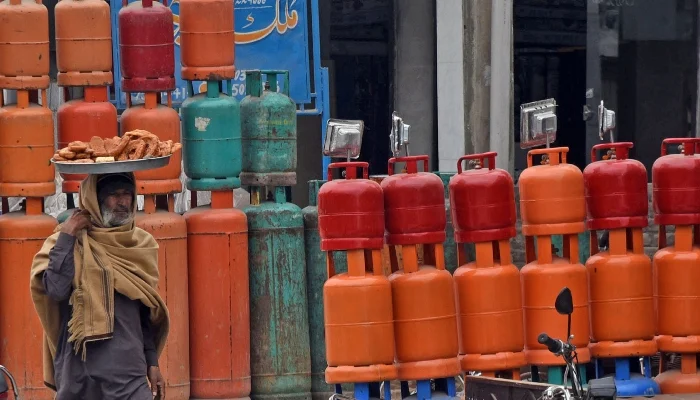
ISLAMABAD: The oil and gas regulator raised the official price of liquefied petroleum gas for a second straight month, a move that puts households already paying close to double that rate on the open market, driven by a shortage tied to the US-Iran war.
The Oil and Gas Regulatory Authority set the November price at 294,075 rupees a ton, or 294.1 rupees a kilogram, from 279,341 rupees in October, a 5.27% increase, according to a notification issued on Saturday. The new rate took effect Sunday.
The official price of an 11.8-kilogram household cylinder rises to 3,470 rupees from 3,296 rupees, an increase of about 174 rupees. A 45.4-kilogram commercial cylinder goes up by 669 rupees to 13,351 rupees, raising costs for businesses that use the fuel for cooking and heating. In October, the regulator raised the price by 8%, or about 244 rupees a cylinder.
Ogra said the producer price is tied to the Saudi Aramco contract price and the dollar exchange rate. The Aramco benchmark rose 6.47% from the previous month while the average rupee-dollar rate eased 0.12%, adding 14.73 rupees to each kilogram.
Prices at the pump, so to speak, bear little resemblance to the notified rate. LPG is selling for as much as 630 rupees a kilogram on the open market, while company-run franchises charge up to 400 rupees. Dealers in Islamabad said they were selling at around 550 to 600 rupees a kilogram, with prices of 700 to 800 rupees in smaller towns and mountainous areas. Many in the trade warn the crisis will worsen.
The squeeze follows a disruption on the Iran frontier. Pakistan announced on Oct. 17 that it had temporarily closed border crossings with Iran for security reasons, while Tehran pointed to technical reasons; traders said the border reopened on Oct. 25. Retailers say relief will not be immediate. One Islamabad dealer said it would take at least seven to 10 days for supplies to reach major cities even with the border open.
Petroleum Minister Ali Pervaiz Malik told parliament on Monday that the border closure was a main reason for the price surge, adding that supplies from Qatar remain suspended because of the US-Iran conflict. He said the government is seeking cargo by sea and preparing a policy to protect low-income households, and acknowledged it has no comprehensive pricing mechanism for imported LPG.
LPG Distributors Association of Pakistan Chairman Irfan Khokhar called the situation serious. He said at least 70% of the LPG Pakistan consumes is imported, with only 30% produced locally. “The government has to make serious efforts to control market manipulations,” Khokhar said.
Industry is also pressing the government on the policy that will govern the sector. The Pakistan LPG Marketers Association said its members will strike from Nov. 16 if the private sector is sidelined in the forthcoming LPG policy. Chairman Ali Haider said the government should not reverse the deregulation of LPG, and that the shortage stems from the Iran border closure.
“Out of around 1.3 million tonnes, only around 225,000 is imported from the Gulf, and that too has been mainly imported by the private sector,” Haider said. He said the ProGas terminal at Port Qasim is controlled by Sui Southern Gas Co., which “imported LPG around seven months back.”
The association has written to Malik, saying the draft policy sent to the prime minister had no private-sector input, and has called for full deregulation of the sector. It also took aim at the 2016 LPG policy, which imposed a petroleum development levy of 4,669 rupees a ton on locally produced LPG to fund subsidies that would let state-owned entities including Pakistan State Oil, Parco and Sui Southern import the fuel in winter and in emergencies. “Despite billions of rupees collected in terms of PDL through this formula, the state-owned entities have failed to import LPG during these days,” Haider alleged.
Taxes make up a sizable share of the regulated price. Ogra’s structure includes the 4,669-rupee levy and sales tax of 38,559 rupees a ton. A further 18% sales tax, amounting to 6,300 rupees, applies to marketing, distribution and transportation margins, which together total about 35,000 rupees a ton.
The tension between industry and government has been building. Prime Minister Shehbaz Sharif rejected a plan this month to auction LPG produced by state-owned companies, saying a comprehensive policy and legal framework must come first. LPG dealers shut roughly 5,500 to 6,000 shops in Lahore and other cities in a strike last weekend, leaving consumers scrambling for cooking fuel.
The price increase also comes days after the central bank tightened policy to contain an energy-driven inflation shock. The State Bank of Pakistan raised its benchmark rate by 50 basis points to 12% on Oct. 26, the first increase since April, with nine of 10 Monetary Policy Committee members in favor. One member voted for a larger move, Governor Jameel Ahmad said.
In its statement, the committee said the Middle East conflict and domestic wheat supply problems are keeping inflation elevated and that the outlook has worsened, with September’s 10.3% headline reading coming in above its expectations. It flagged unanticipated adjustments in energy tariffs among the risks. The rate increase was “necessary to keep inflation expectations anchored,” the committee said, against a medium-term target range of 5% to 7%. Ahmad pointed to oil prices that have stayed above $100 a barrel.
Copyright © 2021 Independent Pakistan | All rights reserved