By Staff Reporter
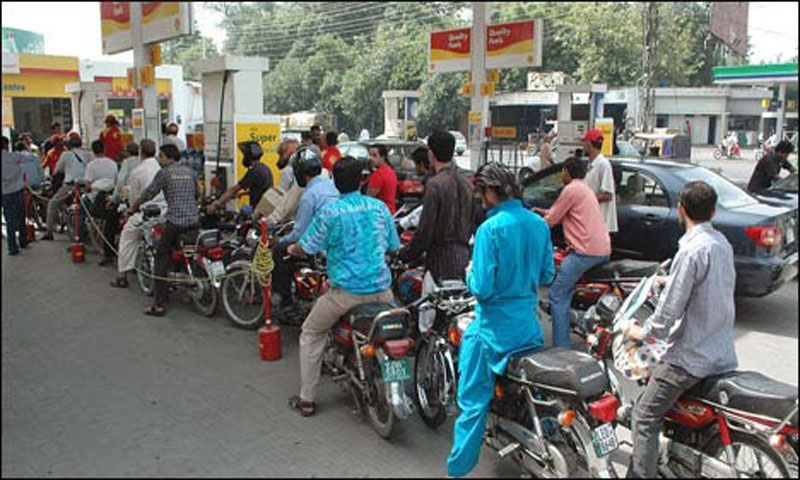
ISLAMABAD: Pakistan increased the price of petrol and high-speed diesel by Rs55 a liter each on Friday, passing on part of the sharp rise in global crude costs triggered by the escalating conflict in the Middle East and the effective closure of the Strait of Hormuz.
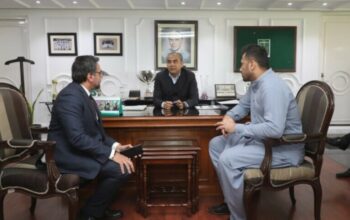
The new petrol price will be Rs321.17 a liter, up from Rs266.17, while diesel will rise to Rs335.86 from Rs280.86. The higher rates take effect at midnight, Petroleum Minister Ali Pervaiz Malik announced at a press conference alongside Deputy Prime Minister and Foreign Minister Ishaq Dar and Finance Minister Muhammad Aurangzeb. The adjustment marks the first weekly review of domestic fuel prices since regional tensions threatened a major share of global energy supplies. The government previously adjusted rates on a fortnightly basis.
Malik said the decision followed deliberations on the rapidly evolving international market situation. “We will review these prices on a weekly basis,” he said, adding that the government would move quickly to lower prices once conditions improve. “There is no doubt that we are going through extraordinary circumstances today.” The minister said authorities had spent recent weeks building petroleum reserves to guarantee uninterrupted supply. “Over the past few weeks, we have preserved petroleum reserves and maintained supply according to our available stocks,” he said.
The minister warned that strict action would be taken against anyone hoarding fuel for illegal profit. “Action will be taken against those who stopped selling petrol in order to make undue profits,” Malik said. Pakistan also warned of a possible gas crisis after QatarEnergy issued Pakistan a force majeure notice linked to the war. officials said the crisis could last “weeks, not days,” forcing demand-curtailment measures similar to those used during the pandemic, including work-from-home policies and limits on intercity travel.
Malik, praising Sharif’s guidance, said the government had built reserves to a “comfortable level” precisely because the duration of the crisis was unknown. “As far as our reserves allow, we should utilise them to the fullest extent, and in this, price-setting plays a crucial role,” he said. The government directed provincial authorities on Friday to crack down on hoarders and ensure uninterrupted supply, confirming that current stocks were sufficient to meet domestic needs despite the external shock.
Dar told reporters that Prime Minister Shehbaz Sharif chaired a meeting earlier Friday to assess the situation. The premier was “very concerned” about the developments, he said, and the government was weighing options to limit the impact on consumers while protecting the economy. “We have to see how much increase is required,” Dar said. He described the broader context: global petroleum product prices had risen 50% to 70% in recent days, with automatic pass-through in many countries.
In Pakistan, Sharif had ordered careful deliberations over the past two to three weeks, including meetings of a permanent review committee led by Malik and Aurangzeb. A separate committee headed by Dar, also including the petroleum and finance ministers, consulted stakeholders with the explicit goal of passing the “minimum effect” of the crisis to end users.
Dar said Pakistan had contacted foreign ministers across the region and Central Asia to push for de-escalation. “Pakistan is making every effort, in coordination with its partners, to de-escalate the conflict that is currently underway and to bring under control what has virtually become a war situation,” he said. How long the process would take “was known only to God,” he added. Sharif and Chief of Army Staff Field Marshal Asim Munir had also reached out to civilian and military leaders abroad.
Aurangzeb said officials were examining the potential effects on imports and exports and would shape policy according to how the situation unfolded. “We are also reviewing what impact the increase in prices will have on imports and exports.” He reassured the public that reserves were adequate and urged calm. Pakistan’s macroeconomic position remained stable, he added, but “hope is not a strategy.” The entire government needed to engage in proactive scenario planning, the minister said, and Sharif had instructed coordination with provincial governments.
The price increase comes after US and Israeli air strikes last week killed Iran’s Supreme Leader Ayatollah Ali Khamenei and several senior officials, prompting Iranian retaliation including attacks on US military bases in Gulf countries and the closure of the Strait of Hormuz. The waterway, through which roughly 20% of global oil demand normally flows each day, has been blocked for seven days, equivalent to about 140 million barrels of supply — or 1.4 days of worldwide demand — unable to reach markets.
As a result, crude was on track Friday for its strongest weekly gain since the extreme volatility of the COVID-19 pandemic in spring 2020. Brent crude futures rose $5.42, or 6.35%, to $90.83 a barrel at 10:37 a.m. CST. West Texas Intermediate crude climbed $7.81, or 9.81%, to $88.96, with gains in US crude outpacing Brent for a second straight day. Qatar’s energy minister told the Financial Times he expects all Gulf producers to halt exports within weeks, a scenario that could push oil to $150 a barrel.
US President Donald Trump told Reuters he was unconcerned about rising American gasoline prices, saying “if they rise, they rise,” and that the military operation remained the priority. A White House official indicated the Treasury Department was preparing measures to address energy price pressure, though the administration has ruled out using Treasury to trade oil futures for now.
Copyright © 2021 Independent Pakistan | All rights reserved