By Staff Reporter
ISLAMABAD: The information ministry on Tuesday denied a report claiming that Pakistan’s top military leader had held clandestine meetings with the CIA and Israel’s Mossad to deploy thousands of troops to Gaza, calling the account “completely fabricated” and a “deliberate fabrication aimed at misrepresenting Pakistan’s foreign policy.”
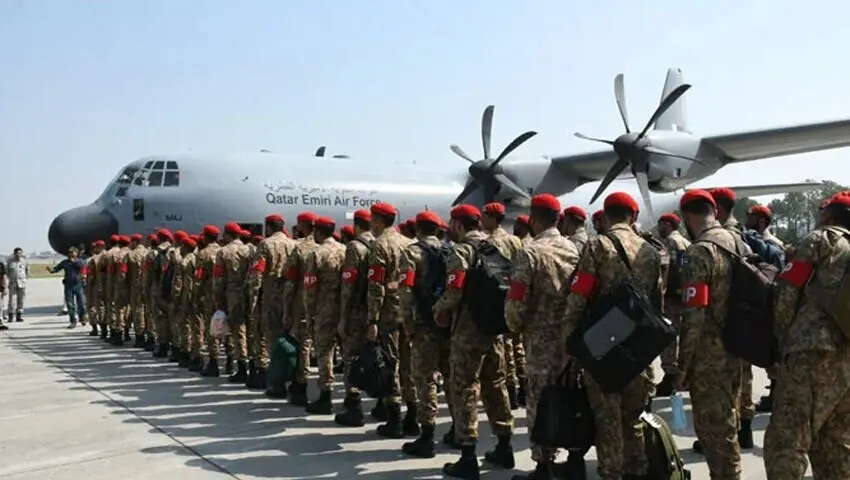
The denial came amid mounting speculation about Islamabad’s potential involvement in a multinational stabilisation force for Gaza, a centerpiece of a United States-brokered peace agreement reached earlier this month. Officials familiar with the internal discussions said deliberations were at an “advanced stage,” with the government leaning toward participation — though emphatically not through any covert deal with Israel or the United States.
The controversy erupted earlier Tuesday when the Indian news outlet Firstpost cited CNN-News18, which in turn quoted unnamed “top intelligence sources” asserting that Field Marshal Asim Munir, Pakistan’s army chief, had met secretly with senior American and Israeli intelligence officials. The report alleged that Pakistan was preparing to send up to 20,000 troops to Gaza, where they would “neutralise remaining Hamas elements and stabilise the territory under Western instructions,” act as a “buffer force between Israel and Gaza’s remaining armed factions,” and provide a “security umbrella while facilitating reconstruction and institutional restructuring.”
In exchange, the Indian media claimed, Israel and the United States had offered Pakistan economic incentives, including “World Bank loan leniency, deferred repayment schedules, and financial support routed through Gulf intermediaries.”
The information ministry swiftly rebutted the claims in a statement posted on X. “The news item is completely fabricated,” it said. “No such meetings, understandings, or ‘deals’ ever took place between Pakistan’s leadership, CIA or Mossad.” “Pakistan does not recognise Israel, has no diplomatic or military engagement with it, and maintains a clear, principled stance in support of Palestinian self-determination,” the ministry added.
It emphasised that neither the military’s media wing nor any credible Pakistani or international source had verified any plan for troop deployment, dismissing the entire story as a “manufactured propaganda piece” with “no factual or institutional basis.” The ministry took particular aim at CNN-News18, accusing it of having a “history of publishing anti-Pakistan disinformation, including multiple unverified ‘intelligence source’ stories in the past.” The “claim of a CIA–Mossad–Munir deal and Pakistan sending 20,000 troops to Gaza,” the ministry said, was intended “to sow distrust and stir regional polarisation.”
The furor underscored the high stakes for Pakistan as it navigates its potential role in the International Stabilization Force, envisioned as the linchpin of the Gaza peace plan. Composed primarily of troops from Muslim-majority countries, the force’s mandate would encompass maintaining internal security, disarming Hamas, securing border crossings and assisting with humanitarian relief and reconstruction, all under the supervision of a transitional Palestinian authority.
According to officials close to the discussions, an announcement from the federal government is expected soon. The tone of internal consultations within the government and military establishment, they said, “suggests that Islamabad is inclined to take part in the mission.” Pakistan’s consideration of involvement draws from a mix of moral conviction, operational expertise and strategic imperatives.
Officials in Islamabad argue that the country bears a responsibility to aid Palestinians, having been among the original eight nations to propose a peace framework in late 2024, a plan backed by several Muslim-majority states and now underpinning the American-led accord. Pakistan’s storied history in peacekeeping bolsters the case. As one of the United Nations’ largest troop contributors, it has dispatched more than 200,000 personnel to over 40 missions across Africa, Asia and the Middle East. “This experience not only equips Pakistani forces to manage volatile post-conflict environments but also lends credibility and legitimacy to the ISF,” one official said.
Geopolitically, participation could cement warming ties with the United States. Relations between Islamabad and Washington have thawed gradually since Donald Trump’s return to the White House, after years of strain over Afghanistan and counterterrorism. Joining a US-supported multilateral effort, officials said, might unlock fresh economic cooperation, defence assistance and influence in the region.
Officials stressed a preference for a United Nations mandate to provide legal cover. “Ideally, we would like this deployment to take place under a UN mandate,” one said. Gaza’s volatility poses operational risks, but domestic backlash may prove thornier. Many Pakistanis, steeped in sympathy for the Palestinian cause, could view the mission, designed in part by Washington, as tilting toward Israeli interests or even betraying resistance fighters. “It’s a difficult but defining choice,” another official acknowledged. The debate has already spilled into public view. Politicians and journalists voiced alarm on social media after the report surfaced, decrying any troop commitment.
Copyright © 2021 Independent Pakistan | All rights reserved