By Staff Reporter
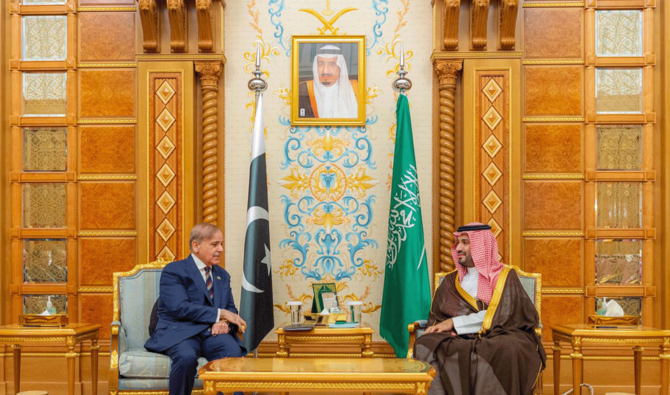
ISLAMABAD: Pakistan and Saudi Arabia launched on Tuesday an Economic Cooperation Framework aimed at boosting trade and investment ties, following a meeting a day earlier between Prime Minister Shehbaz Sharif and Saudi Crown Prince Mohammed bin Salman on the sidelines of the Future Investment Initiative (FII9) in Riyadh.
The Foreign Office (FO) said in a statement that the framework, rooted in shared economic interests, would see the two nations discuss “several strategic and high-impact projects” in economic, trade, investment and development fields.These initiatives are set to enhance private sector roles and increase bilateral trade, prioritising sectors including energy, industry, mining, information technology, tourism, agriculture and food security.
Islamabad and Riyadh are also studying joint economic projects, including memoranda of understanding (MoU) for an electricity interconnection link and broader energy cooperation. “This framework represents an extension of both countries’ efforts to strengthen their fraternal relations and reaffirms their shared vision toward building a sustainable partnership across various economic, trade and investment fields in a manner that fulfils the aspirations of their leaderships and the brotherly peoples of both nations and serves their mutual interests,” the FO statement read.
The FII9 conference, which drew global leaders, investors, policymakers and innovators to Riyadh, centred on the theme ‘The Key to Prosperity: Unlocking New Frontiers of Growth’, covering topics such as innovation, sustainability, economic inclusion and geopolitical shifts. Information Minister Attaullah Tarar hailed the launch as “another historic chapter” in Pakistan-Saudi relations, calling it a “high point” that would strengthen trade, energy and investment links.
During a panel discussion at the FII9 on Tuesday, Sharif highlighted Pakistan’s resource wealth while acknowledging past errors. “Very honest mistakes were made in the country’s history but it had learnt from them,” he said. “Important thing is to learn from your mistakes and that is what we are doing. At this point in time, we are undertaking most robust changes and deeprooted reforms which are deeply required.”
Sharif pointed to the digitisation of the Federal Board of Revenue to combat corruption, and stressed Pakistan’s vulnerability to climate change despite minimal carbon emissions of “less than a fraction of one percent”. The prime minister described Pakistan as trapped in a cycle of recovery from disasters like the 2022 floods and this year’s events. “This is not acceptable. This is not where humanity should be directed towards. It has to be mutual cooperation,” he said, adding that loans alone were insufficient. “If humanity was to move forward, it would have to do so in unison while sharing its bounties and grievances together,” Sharif said.
He pledged to turn Pakistan around through “untiring efforts” and optimal use of resources, while noting the country’s rapid adoption of technology and artificial intelligence – though with warnings of its risks. Sharif called for the global north and south to agree on equitable resource distribution for an “egalitarian economy for all”.
In parallel diplomacy, Deputy Prime Minister and Foreign Minister Ishaq Dar met Saudi Foreign Minister Faisal bin Farhan al Saud in Riyadh to review bilateral ties, regional and international issues, including the Gaza humanitarian crisis. “They agreed to further deepen the Pak-Saudi multifaceted partnership across all domains, and to continue strengthening the bonds of brotherhood and friendship between the two countries,” the FO said in a post on X, adding that both reaffirmed commitment to multilateral cooperation including at the United Nations.
Pakistan-Saudi ties, built on strategic military cooperation, economic interests and Islamic heritage, include Riyadh’s financial aid and oil supplies to Islamabad. Last month, the two signed a “Strategic Mutual Defence Agreement” in Riyadh’s Yamama Palace, under which “any aggression against either country shall be considered an act of aggression against both”. Earlier this year, the nations inked 34 MoUs worth $2.8 billion, building on a prior package of 27 MoUs valued at $2.2 billion.
Copyright © 2021 Independent Pakistan | All rights reserved