By Staff Reporter
LAHORE: Pakistan will not chase a consumption-led growth surge and will press ahead with tariff cuts to build an export-driven economy, Finance Minister Muhammad Aurangzeb said, rejecting a repeat of the import-fueled booms that have ended in balance-of-payments crises.
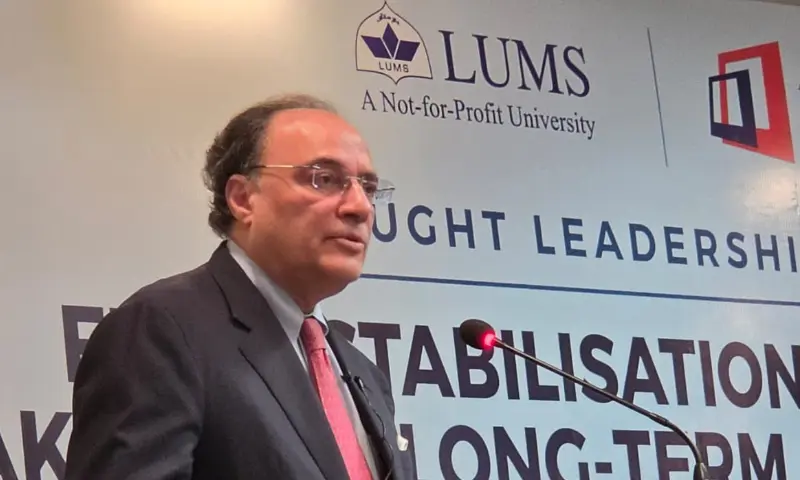
“We are very clear: no matter how much pressure there is, we are not going to go for liquidity-fuelled, consumption-led growth,” Aurangzeb said Saturday at the Lahore University of Management Sciences, at an event organized by the American Business Forum. The session, titled “From Stabilisation to Growth: Pakistan’s Long-Term Reform Agenda,” also featured former State Bank of Pakistan Governor Reza Baqir. ABF President Osman Khalid Waheed and Habib Group Vice Chairman Salman Burni also spoke.
Aurangzeb said Pakistan can’t afford another cycle in which a temporary acceleration in activity is followed by a balance-of-payments crisis, the pattern that previously forced the country to seek help from lenders of last resort.
The government will continue lowering tariffs, mainly to cut the cost of raw materials and intermediate goods for exporters, he said, despite concerns about the timing. Domestic industries have been protected for too long without sunset clauses, and that approach can’t continue indefinitely, he said.
“We are in year two of the tariff reform, and we are going to continue with that; there is no turning back,” he said.
The latest budget was meant to point the economy toward exports, Aurangzeb said, with measures that he said included the elimination of super taxes, lower tax slabs and export financing at 4.5%.
He also said growth has to create jobs. He contrasted Pakistan’s path with that of a neighboring economy where growth of 7% to 8%, he argued, hasn’t produced enough employment. “That’s why you see people there where they are,” he said, adding that the sectors driving expansion must also tackle unemployment.
Economic backdrop
The government is targeting growth of about 4% this fiscal year. Aurangzeb said earlier this month that Pakistan could lift growth to 6% quickly through a consumption-led model, but that the short-term gain would add balance-of-payments pressure and revive a boom-and-bust cycle. The International Monetary Fund estimates last fiscal year’s expansion at 3.6%.
Inflation is a constraint. Consumer prices rose 10.26% in September from a year earlier, according to the Pakistan Bureau of Statistics, after 11.15% in August. That remains well above the central bank’s 5% to 7% target range. The State Bank of Pakistan’s Monetary Policy Committee held its benchmark rate at 11.5% on Sept. 14.
The minister said Pakistan has made substantial progress in repairing its fiscal and external accounts. The combined twin deficits narrowed to 2.6% of gross domestic product by the end of the last fiscal year from 12.5%, he said. The fiscal deficit fell to a 22-year low, and the country has posted primary surpluses for three straight years. The current account deficit shrank to about 0.1% of GDP, helped by remittances and information-technology exports.
IT services exports have climbed to $4.6 billion from less than $1 billion and are projected to reach $5.5 billion this fiscal year, he said. Foreign-exchange reserves cover more than three months of imports, compared with two weeks at the depth of the crisis.
Citing three credit-rating upgrades since April last year, Aurangzeb pointed to investor demand for a recent bond sale, which he said drew an order book twice its size, as evidence of confidence that extends beyond Pakistan’s current IMF program. Pakistan raised $3 billion in a two-part Eurobond sale on Sept. 3, with orders of nearly $6 billion, the finance ministry said. In May it sold 1.75 billion yuan ($250 million) of three-year Panda bonds at a 2.5% coupon, with demand more than five times the amount offered.
The IMF program is due to end in October next year. The Fund and Pakistan reached a staff-level agreement on Oct. 8 that could unlock about $1.21 billion, with roughly $1 billion under the Extended Fund Facility and $210 million under the Resilience and Sustainability Facility, subject to approval by the IMF’s Executive Board. Speaking in Bangkok on the sidelines of the IMF-World Bank annual meetings, Aurangzeb reaffirmed Pakistan’s commitment to completing the program and sustaining policy credibility after it ends.
Global outlook
Reflecting on meetings in New York and London and at the IMF-World Bank gatherings in Bangkok, Aurangzeb described the global economy as resilient but facing an uncertain and worrying outlook. He said discussions had centered on a widening gap between oil-exporting and oil-importing countries and on economies benefiting from artificial intelligence.
Energy shocks and the El Nino weather pattern featured prominently, he said, warning that their effects are intensifying and adding to food-security concerns in parts of the world. He also pointed to high debt levels, limited fiscal space in some economies, and the growing importance of digital infrastructure and labor-market readiness for AI.
With trade fragmentation and geopolitical polarization deepening, regional corridors and blocs are emerging as significant opportunities, he said, which could prove especially important for Pakistan.
Pakistan has handled immediate energy-supply challenges stemming from the Middle East conflict, Aurangzeb said, with supplies secured through November and winter arrangements under way. Qatar supplies about 90% of Pakistan’s liquefied natural gas, and shipments through the Strait of Hormuz have been sharply curtailed since the conflict began. Energy and gas supplies remain areas needing attention, he said.
The government has moved from blanket subsidies to targeted support because of the high cost of universal schemes, he said. Assuming households of four to five people, the program has reached an estimated 40 million to 50 million people.
Government borrowing has placed a disproportionate burden on the banking sector, Aurangzeb said, but domestic debt-management operations helped cut debt-servicing costs to 6.9 trillion rupees last fiscal year, against a budgeted 8.2 trillion rupees. External debt payments fall to $21.5 billion this fiscal year from $26.5 billion last year and are expected to decline further, he said. New external borrowing is largely meant to replace existing obligations rather than add to the debt burden.
He also highlighted pension changes, saying new entrants to the civil bureaucracy have moved from defined-benefit to defined-contribution schemes, while talks with the armed forces continue.
Aurangzeb identified climate change and population growth as major challenges and called for measures to slow the country’s 2.55% annual population growth. He cited Bangladesh, Indonesia and Iran, which he said each brought growth below 1% over a decade, and named women’s education, workforce participation and engagement with religious scholars as key tools.
Restoring investor confidence requires macroeconomic stability and the clearance of about $4 billion in outstanding dividend and profit-repatriation obligations, he said. He pointed to improving domestic investment, with 11 initial public offerings last year, a 20-year high, and five so far this year.
Harmonizing federal and provincial regulations is essential to attract investment, he said, because businesses often face differing requirements at each level. Reforms in taxation, energy and financing are needed to sustain growth, improve export competitiveness and create jobs, he said.
Copyright © 2021 Independent Pakistan | All rights reserved