By Staff Reporter
ISLAMABAD: Pakistan has declared an emergency across its state-run railway network until 31 December, cancelling leave for field officers and ordering senior staff to travel by train, after more than 55 accidents since January.
The measures were ordered by the railways minister, Hanif Abbasi, according to a statement issued by Pakistan Railways headquarters in Lahore on Saturday. All leave for field officers has been cancelled for three months. Officers must also visit the field and supervise train operations on Sundays, and anyone travelling to another city on official business has been told to go by rail.
Chief engineers in the civil and mechanical departments must send the ministry daily reports on their areas of responsibility, and the head of safety has been asked for the same. State broadcaster Radio Pakistan said the emergency would stay in force until the last day of the year.
“We will provide passengers with the safest possible travel in line with the prime minister’s vision,” Abbasi said.
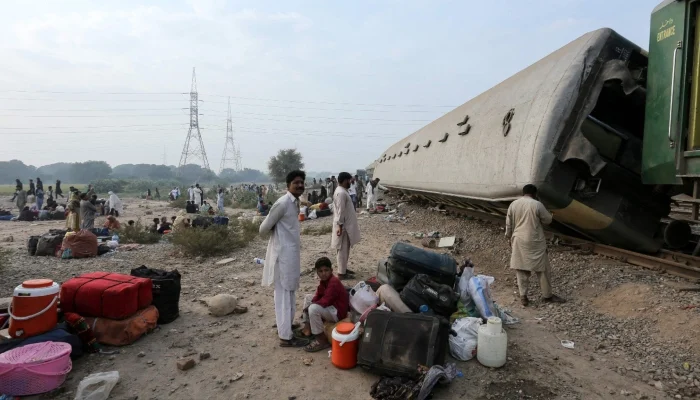
The order follows the derailment of the Rehman Baba Express on 13 October. The Karachi to Peshawar service came off the tracks at about 5.15am near Sher Shah railway station in Punjab, with all 14 carriages leaving the rails and several overturning with passengers trapped inside. Early reports put the death toll at four or five, while Minute Mirror, a Pakistani news site, later reported six dead and 34 injured. Other outlets cited more than 40 injured, and the figures varied through the day.
Speaking at the site, Abbasi said the train had received mechanical attention at Samasatta junction before the crash, and questioned how it could then have derailed. He said responsibility for safe travel was his, and that nobody involved would be spared if wrongdoing was found. He appointed the federal government inspector of railways to lead the inquiry. Compensation for the dead and injured would be paid under the railways’ insurance policy, he said.
A passenger told reporters that workers had repaired nuts and bolts on coach nine near Rohri before the accident. The claim has not been independently verified. A preliminary joint investigation report later pointed to a mechanical fault. It said a side hanger on the train’s luggage coach had broken and lodged in a turnout crossing. Further findings are needed to establish whether maintenance failures played a part.
On the same day, Abbasi made an admission about freight services. More than half of the department’s freight trains had been running without brakes, he said, and 31 December 2026 was the deadline for fixing the problem.
Pakistan Railways has recorded more than 55 accidents involving passenger and freight trains since 1 January, according to local media. Railway sources cited by local media named the Sukkur, Karachi and Multan divisions as the worst affected. Several of the accidents involved the Yusufwala coal train.
Ten wagons of a freight train derailed near Khanpur on 27 August, the same day the engine and two coaches of the Rawal Express left the tracks near Kala Gujran. On 2 September, the power van of the Khyber Mail derailed near Sanjani. A coal train lost seven wagons on 6 September, and three wagons of another came off at Kotri yard three days later. The Yusufwala coal train was in a further accident near Khairpur on 27 September. Earlier in the year, on 24 May, saboteurs targeted a shuttle train in Quetta and damaged three coaches.
Local media reports said railway officials had continued to offer reassuring assessments even as the accidents kept coming, and that the incidents had put the department’s maintenance and safety arrangements under scrutiny. Passengers have questioned how they are expected to stay off the trains when rail remains, for many of them, the only affordable way to travel.
A week before the emergency was announced, on 17 October, Mr Abbasi toured the Steel and Carriage Shops in Mughalpura. He inspected the electric arc furnace at the steel shop and the spectro laboratory that tests the parts it produces, and told officials to hold manufacturing of railway components to proper quality standards.
Train accidents are relatively common in Pakistan, where the network has suffered decades of underinvestment, outdated tracks and ageing signalling. The system has nearly 7,500km of track and carries more than 80 million passengers a year, with some tracks, junctions and bridges more than 150 years old. In 2023, ten carriages of a passenger train derailed in the south of the country, killing 30 people and injuring more than 90.
Copyright © 2021 Independent Pakistan | All rights reserved