By Staff Reporter
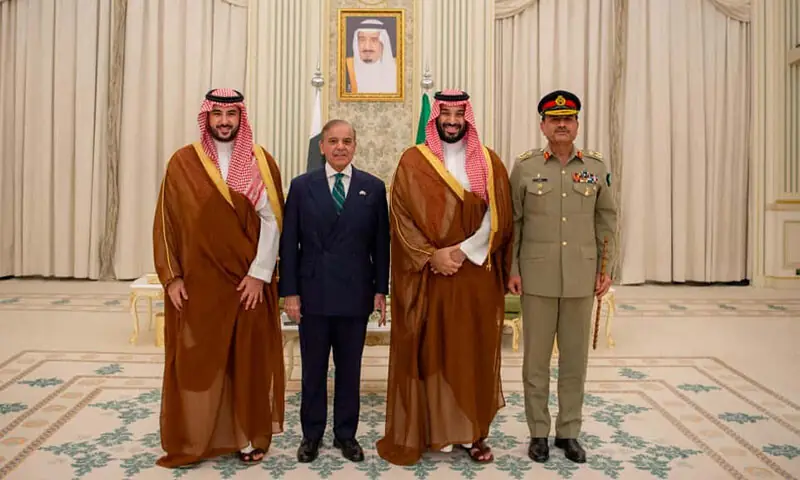
ISLAMABAD: Prime Minister Shehbaz Sharif and Saudi Crown Prince Mohammed bin Salman signed a “Strategic Mutual Defence Agreement” on Wednesday, formalising a pledge that any aggression against one nation would be regarded as an assault on both, in a deepening of ties between the two Muslim states at a moment of escalating conflict across the Middle East.
The accord, announced in a statement from Sharif’s office, underscores the breadth of a relationship that has long blended economic lifelines, military alignment and religious solidarity. Riyadh has served as a crucial benefactor for Islamabad, providing financial bailouts, discounted oil shipments and a steady stream of remittances from millions of Pakistani workers in the kingdom. The pact arrives as Israel intensifies airstrikes against Palestinians targets in Qatar, including a Sept. 9 barrage in Doha, and as Sharif has publicly backed the Gulf host amid the fallout.
“Building on the historic partnership extending for nearly eight decades between the Kingdom of Saudi Arabia and the Islamic Republic of Pakistan, and based on the bonds of brotherhood and Islamic solidarity, as well as shared strategic interests and close defense cooperation between the two countries, His Royal Highness Prince Mohammed bin Salman bin Abdulaziz Al Saud, Crown Prince and Prime Minister and His Excellency Mr. Muhammad Shehbaz Sharif, Prime Minister of the Islamic Republic of Pakistan signed the “Strategic Mutual Defense Agreement”,” Sharif’s office said.
“This agreement, which reflects the shared commitment of both nations to enhance their security and to achieving security and peace in the region and the world, aims to develop aspects of defense cooperation between the two countries and strengthen joint deterrence against any aggression. The agreement states that any aggression against either country shall be considered an aggression against both.”
Sharif, on an official visit at the invitation of the crown prince, arrived in Riyadh to a display of protocol befitting the closest of allies. State-run PTV News reported that as soon as his plane crossed into Saudi airspace, Air Force jets shadowed the aircraft in escort. “This was a gesture of brotherly love and respect by the Government of Saudi Arabia,” PTV quoted officials as saying. “This honour in the Muslim world is the result of Allah’s blessings, Shehbaz Sharif’s diplomatic skills, and the unparalleled achievements of our Armed Forces.”
Upon landing, Sharif was greeted by Riyadh Deputy Governor Muhammad bin Abdulrahman bin Abdulaziz, with PTV posting images of the two in talks. Later, at Yamama Palace, the crown prince personally welcomed the prime minister, who received a guard of honor from Saudi armed forces, according to the Prime Minister’s Office.
The leaders’ bilateral meeting covered “multiple issues of bilateral interest,” as one official put it, with discussions expected to span the full arc of Pakistan-Saudi relations.
The Foreign Office, in a statement ahead of the trip, outlined the agenda. The two men would review economic, security and diplomatic bonds while sharing perspectives on “regional and global developments of mutual interest.” The visit, the office added, was poised to yield “the formalisation of cooperation in diverse fields, reflecting the shared commitment of both sides to further enhance and deepen their longstanding fraternal ties.”
“This historic relationship” between the countries, the Foreign Office emphasized, offered “an important opportunity to the two leaders to consolidate this unique partnership, while exploring new avenues of collaboration, for the benefit of the peoples of the two countries.”
Sharif traveled with a high-level delegation that included Deputy Prime Minister Ishaq Dar, Defense Minister Khawaja Asif, Finance Minister Muhammad Aurangzeb, Information Minister Attaullah Tarar, Environment Minister Musadik Malik and Special Assistant to the Prime Minister Tariq Fatemi, according to state media Radio Pakistan.
The timing of the defense agreement carries weight beyond the bilateral lane. Just last week, Sharif met the crown prince on the margins of an Arab-Islamic summit in Qatar, where he pledged Pakistan’s “full support” for Doha in the wake of Israel’s strikes on Hamas figures there, a conflict that has rippled through the region, straining alliances and testing the cohesion of the Muslim world. Pakistan, which maintains no formal ties with Israel, has positioned itself as a vocal advocate for Palestinian causes, a stance that aligns neatly with Saudi Arabia’s own balancing act between Western partnerships and pan-Islamic solidarity.
This is not Sharif’s first recent encounter with the Saudi heir apparent. In June, during a two-day official visit to the kingdom, he thanked Mohammed bin Salman for helping broker an end to border clashes with India in May, a rare diplomatic feather in the cap for both men amid Islamabad’s domestic economic woes. And in July, Pakistan’s President Asif Ali Zardari hosted Saudi Ambassador Nawaf bin Saeed Ahmed Al-Malki at the presidential palace, where the two explored ramps for closer trade, economic ventures and cultural exchanges. Zardari used the occasion to extend an open invitation to Saudi investors scouting opportunities in Pakistan’s markets.
Back in Pakistan’s capital, the mood was one of orchestrated festivity. The heavily fortified red zone — a sprawling enclave of embassies, government offices, parliament, the presidency and the Supreme Court — glowed green under strings of lights and banners extolling the “brotherhood” between the nations, a visual shorthand for the enduring pact that has buoyed Pakistan through lean times.
At its core, the relationship remains an economic bulwark for Islamabad. Saudi Arabia stands as the top sender of remittances to Pakistan, with over 2.5 million expatriates wiring funds home that prop up a $400 billion economy teetering on the edge of default. The kingdom has stepped in repeatedly during crises, funneling external financing and coordinating with the International Monetary Fund on bailout packages. Last October alone, the two sides inked 34 agreements and memoranda of understanding valued at $2.8 billion, targeting private-sector tie-ups and commercial bridges.
For Saudi Arabia, the alliance offers a reliable foothold in South Asia — a counterweight to Iranian influence and a staging ground for soft power in the Islamic sphere. The defense pact, with its mutual-defense clause, signals Riyadh’s willingness to formalize that stake, potentially reshaping security dynamics from the Arabian Peninsula to the Indus Valley.
Copyright © 2021 Independent Pakistan | All rights reserved