By Staff Reporter
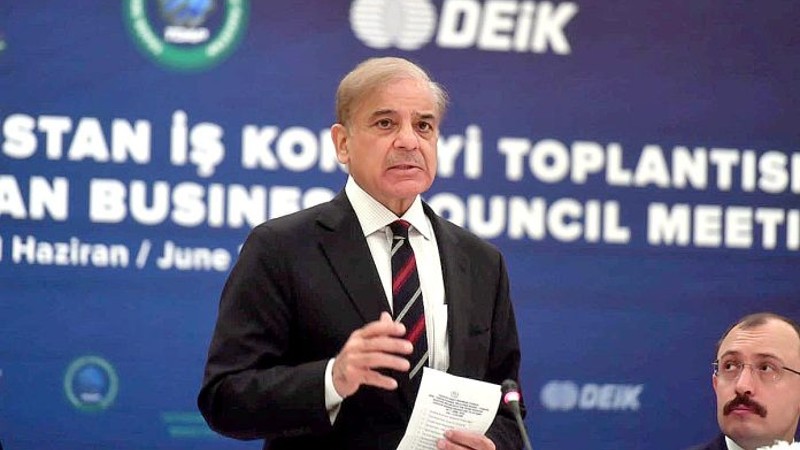
ISLAMABAD: Pakistan’s prime minister accused Afghanistan on Tuesday of refusing to rein in terrorists operating from its soil, saying the Taliban-led government left his country no choice but to shut down all cross-border trade in a standoff that’s hurting ordinary people on both sides.
The border has stayed closed to trucks and goods since fighting broke out in mid-October 2025. Efforts to talk things out, with help from Turkey and Qatar, went nowhere. No agreement came on how to handle the terrorism threat. “We have a total blockade on trade between Pakistan and Afghanistan,” Sharif told a gathering at a security workshop in the capital. “It shouldn’t be this way, but they left us no option.”
He put the question bluntly: Does Afghanistan want peace or not? “They are our brothers and sisters,” Sharif said. “If the people running things in Kabul don’t care about getting along with us, at least they should think about their own citizens and stop making life harder for them.” Sharif promised Pakistan would keep pushing for a fix. “We’ll do everything we can,” he said.
The shutdown has hammered Afghanistan’s economy much harder than Pakistan’s, according to trade figures. Still, Pakistani businesses and exporters are hurting and complaining about the hit they’re taking. “It’s our neighbor — we’re stuck with each other forever,” Sharif said. “What’s good for them helps us, and the other way around.”
He said it was a shame that governments in Kabul, past and present, never appreciated what Pakistan did for them. The country took in four million Afghan refugees and got some outside help, but also spent its own money to keep them going. “We weren’t doing them a favor — we were just doing what was right,” Sharif said. “But how they’re treating us now is really disappointing.”
Sharif brought up the 2020 peace deal signed in Doha, which made it clear Afghanistan had to stop terrorists from working out of the country. “The Doha agreement laid it out plain as day,” he said. Pakistan’s ministers met with Afghan officials time and again, but nothing stuck. “They ignored every suggestion we made.” Sharif went back to the October border fights and the failed negotiations that followed. “We got nothing out of it,” the prime minister said. “Our one ask was simple: Promise to shut down all the terrorist groups and their backers, like the TTP or BLA, including whatever help they’re getting from India.” “They never got serious about it,” he added.
Sharif spent a good part of his talk on Khyber Pakhtunkhwa, the province hit hard by the return of terrorism. He called it a stunning part of the country, full of people ready to die for Pakistan. “You all know what spilled over from the war in Afghanistan,” Sharif said. Pakistan opened its doors to refugees and treated them like kin. “But what did we get back?” he asked. Thousands of Pakistanis died in attacks, he said, and even politicians tied to the province gave up a lot.
By 2018, the military and government had wiped out terrorism through huge efforts. After the 2014 school massacre in Peshawar, leaders decided no more picking favorites among militants. “No good Taliban or bad Taliban,” Sharif said. “That’s still the rule.” So why did it all come roaring back after 2018? “We know why,” Sharif said. Terrorists got let out of places like Swat, and thousands more came over from Afghanistan to settle here. “That’s what kicked it off again.” Now terrorism is stalling progress everywhere, especially in Balochistan and Khyber Pakhtunkhwa. “Something happens every day,” Sharif said.
He praised the troops for their ultimate sacrifice but slammed the poison spread online against them. “People are trying to trash our heroes,” he said. “They’re echoing enemies from the other side of the border.” Pakistan won’t stop until terrorism is gone for good, Sharif vowed. Sharif pushed back on talk of bad blood between Islamabad and the provincial leaders. “That’s not true,” he said. The prime minister called the chief minister, Sohail Afridi, right after his win to congratulate him and offer full backing for the province. “He said thanks, but that was it — no follow-up,” Sharif said.
Later, in a speech up in Chitral, he invited cooperation again. The government is working with the youth, he said, through tech training programs and more. “Pakistan moves forward only if every province pulls its weight,” Sharif said. Without getting into politics, he suggested looking at how Khyber Pakhtunkhwa stacked up against Punjab, Sindh or Balochistan over the last decade. The truth would show, he said. Money flows to the provinces through a national formula, but in some spots like Khyber Pakhtunkhwa, the results don’t match. “Why is that? It’s a tough question we need to face,” Sharif said.
He made clear the government is dead set on ending terrorism and that peace in Khyber Pakhtunkhwa can’t wait. Steps are in place to fix security there. Sharif called the province key to the country and said its people paid a heavy price in the fight against militants. Keeping the nation safe comes first, he said. The plan covers threats from inside and out, and he thanked the forces for what they’ve given. “We all have to stick together to beat this,” Sharif said.
He reminded everyone that Khyber Pakhtunkhwa’s people chose Pakistan in a vote long ago. Other provinces chipped in Rs800 billion of their own money to help fight terrorism there.”Why is terrorism back after we had it under control?” Sharif asked. On Afghanistan, he repeated that Pakistan sheltered four million people. Now Kabul has to choose peace. Sharif said Pakistan’s security push, Azm-e-Istehkam, keeps going to clear out terrorism backed from abroad.
Attacks from across the border jumped since the Taliban took over Afghanistan in 2021. Khyber Pakhtunkhwa and Balochistan feel it most. In a January 6 update, military spokesman Lt. Gen. Ahmed Sharif Chaudhry said forces ran 75,175 operations last year. That broke down to 14,658 in Khyber Pakhtunkhwa, 58,778 in Balochistan and 1,739 elsewhere. They counted 5,397 attacks nationwide: 3,811 in Khyber Pakhtunkhwa, 1,557 in Balochistan and 29 in other areas. Operations took out 2,597 militants. In the 10 biggest attacks, civilians got hit on purpose, and Afghan fighters were behind every one.
Copyright © 2021 Independent Pakistan | All rights reserved