By Staff Reporter
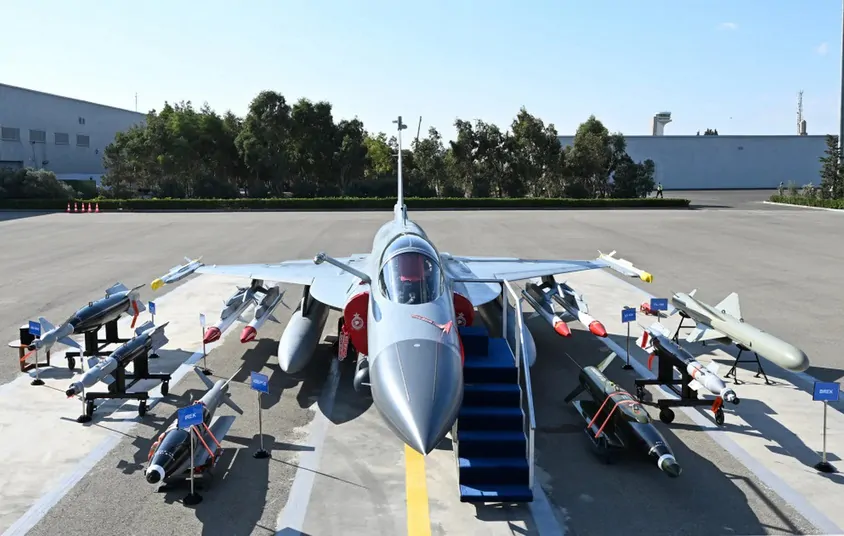
ISLAMABAD: Pakistan’s defence industry is booming, with its fighter jets, drones and missiles gaining fresh appeal among foreign buyers after proving their mettle in a high-stakes clash with India last year, Reuters reported on Tuesday.
Officials in Islamabad have opened negotiations with 13 countries, including half a dozen where discussions have progressed significantly, over sales of the JF-17 fighter jets co-produced with China, along with training aircraft, unmanned aerial vehicles and other weapons systems, according to three Pakistani sources familiar with the defence trade.
The Pakistani military and defense ministry declined to offer specifics on any agreements, but the country’s defence production minister acknowledged that multiple nations have shown keen interest in the jets and related gear. China’s defence ministry did not reply to a request for comment.
Defence experts say the uptick in inquiries stems from global supply chain upheavals triggered by Russia’s war in Ukraine and escalating violence in the Middle East, prompting nations to seek alternatives. Pakistan’s arsenal emerged as a credible option following a major aerial confrontation with India in May, when Pakistani squadrons deployed JF-17s in tandem with sophisticated Chinese J-10 fighters.
In reporting this story, Reuters consulted six sources with direct knowledge of the defence negotiations, three retired air force officers and a dozen analysts who shed light on the expansion of Pakistan’s arms sector, including previously undisclosed aspects of the talks. While some voiced doubts about Islamabad’s ability to manage international diplomatic strains and ramp up manufacturing, there was broad agreement that demand for Pakistani hardware has spiked. Still, most experts warned that preliminary discussions often fail to yield firm contracts. “These talks are taking place (but) they can fall through due to international pressures,” Defense Production Minister Raza Hayat Harraj said in an interview, describing the negotiations as “guarded secrets.” “There are a lot of queries but we are negotiating,” he added, noting expressions of interest in air force equipment, ammunition and training programs.
Harraj highlighted the stark cost gap between Pakistani offerings and those from the United States and Europe. Even if Western systems boast superior technology, they can run more than three times the price of a JF-17, which ranges from about $30 million to $40 million. The roster of prospective buyers includes Sudan, Saudi Arabia, Indonesia, Morocco, Ethiopia and Nigeria, as well as the eastern Libyan administration under Khalifa Haftar, Reuters reported.
Pakistan’s armed forces have publicly confirmed talks with Bangladesh and Iraq involving JF-17s and other arms, though few details have surfaced. Nearly all the interested parties are majority-Muslim countries, mirroring Pakistan’s own demographics. Many hail from the Middle East, a region where Pakistan has long played a role in security arrangements.
Asim Suleiman, a retired air marshal who continues to receive updates on defence sales, said “there are also three African countries lined up” beyond the previously reported deals with the Libyan National Army and Sudan. Among the most advanced negotiations is a comprehensive package with Bangladesh encompassing arms sales, defence collaboration and intelligence sharing, according to three defence sources. Bangladesh, which broke away from Pakistan amid the 1971 civil war, is eyeing JF-17 Block III multirole fighters, MFI-17 Mushshak trainers, Shahpar reconnaissance and strike drones, air defense setups and Mohafiz mine-resistant armored vehicles, two of the sources detailed.
A major challenge lies in scaling up output of the JF-17, the linchpin of Pakistan’s defence manufacturing, alongside sought-after trainers and drones. Suleiman projected that by late 2027, the production pace at the primary facility could double from the current annual rate of around 20 aircraft, thanks to facility upgrades and expansions.
Analysts see limited barriers to boosting overall defence production, especially with support from Beijing, which should help surmount most obstacles. Pakistan “is becoming more relevant as a flexible, mid-tier provider of defence capacity,” Andreas Krieg, a security studies lecturer at King’s College London, told Reuters. “It can train forces, provide advisers, run joint exercises, support maritime operations, and offer a menu of cost-effective platforms. For fragile African partners, that combination can be attractive: it is faster than Western capacity-building, less politically encumbered, and often cheaper.”
Tie-ups with an emerging private defence industry, especially in drones, are expected to accelerate the sector’s momentum. At Sysverve Aerospace in Rawalpindi, home to the Pakistani army’s headquarters, employees assemble hundreds of kamikaze and surveillance drones each year, mostly for domestic military use. “The trend in the army is naturally moving toward engaging the private sector,” said Saad Mir, the company’s director. Yet questions linger over China’s role. Siemon Wezeman, a senior researcher on arms transfers at the Stockholm International Peace Research Institute, noted uncertainty about how many of the reported JF-17 discussions will culminate in actual sales, and suggested Beijing might veto deals with certain buyers. Though Pakistan serves as a logical conduit for China to promote the jet in the Middle East and Africa, “it’s the ones to Sudan and Libya that are really problematic,” Wezeman said. Both Libya and Sudan’s Darfur region remain under UN arms embargoes.
Beyond coordinating with China, Pakistan must thread the needle of Middle Eastern rivalries, particularly between its allies Saudi Arabia and the United Arab Emirates. Islamabad has inked a mutual defence agreement with Riyadh and is in talks for another pact involving Saudi Arabia and Turkey, though specifics remain undisclosed. “On the ideological side, Islamabad is more aligned with Saudis on overall narrative,” said Emadeddin Badi, an analyst with the Global Initiative Against Transnational Organized Crime. “But where things get murkier is on the business, ports, mineral sides, all those supply chains are very much dominated by UAE, that’s where the battle is playing out and Saudis have to play catch-up.”
Copyright © 2021 Independent Pakistan | All rights reserved