By Staff Reporter
ISLAMABAD: Pakistan believes the United States and Iran are edging towards an agreement capable of defusing the confrontation that has kept global energy markets on edge for months, even as Washington and Tehran continued on Tuesday to trade incompatible demands over compensation and control of the Strait of Hormuz.
“Things are shaping up again in favour of a peace arrangement or a deal,” defence minister Khawaja Asif told Bloomberg News in Islamabad. “The signals in the last two, three days are that we are close to some sort of an arrangement.”
His comments briefly rattled oil markets. Brent crude had jumped as much as 2.5 percent overnight, edging towards $90 a barrel, before paring those gains once Asif spoke; it was trading close to $88 a barrel by mid-morning. US benchmark West Texas Intermediate moved in step, hovering just above $82.
Pakistan has positioned itself as the chief mediator in the conflict, which erupted on 28 February when American and Israeli strikes killed Iran’s supreme leader, Ayatollah Ali Khamenei, and a string of senior military commanders on the first day of fighting, prompting retaliatory missile and drone strikes by Tehran against US positions and infrastructure across the Gulf. Islamabad’s efforts have drawn backing from China, Saudi Arabia, Turkey, Egypt and the United Nations, and produced a brief truce in April before Pakistan brokered the Islamabad Memorandum of Understanding in June — a framework that has since come under considerable strain.
That strain was on full display in the latest exchange between Washington and Tehran, in which both sides hardened rather than softened their positions.
Trump raises the stakes on compensation
Iran laid out its conditions for reopening the strait over the weekend, telling Washington it would not agree to any deal without compensation for the damage inflicted during the five-month war, an end to what it calls unlawful sanctions and military threats, the lifting of the US naval blockade, and the release of frozen Iranian assets.
President Donald Trump responded on Monday not by conceding ground but by turning the demand back on Tehran. In a Truth Social post, he wrote that he was “likewise demanding compensation from Iran, for all of the people that they have killed and gravely wounded with their roadside bombs and many conflicts”, singling out the late Quds Force commander Qasem Soleimani and invoking the 17 US sailors killed in the 2000 bombing of the USS Cole in Aden — an attack that has been attributed to al-Qaeda rather than Iran.
In a follow-up post shortly afterwards, the president widened the claim further, writing that “Iran should be responsible for the damages and death caused to the people of Lebanon, Syria, Yemen, and Gaza.”
He also revived a disputed casualty figure from Iran’s crackdown on protests that accompanied the war, claiming Tehran had killed 52,000 demonstrators — a figure well beyond independent estimates. The US-based Human Rights Activists News Agency put the toll in February at around 7,000 deaths, including roughly 6,500 protesters.
Speaking to reporters at the White House, the president declined to spell out his next move but made clear that military options remained under consideration. Asked whether a “massive escalation” against Iran was still on the table, he replied: “Well, we have that certain ability if we want to do that.” Pressed on what would follow the latest round of negotiations, which he has previously cast as Iran’s “last chance” before further military action, he offered only: “You’ll find out.”
He also repeated his contention that the strait itself was no longer a problem. “We’ve mine swept the entire strait,” he said, adding: “We control the strait 100 percent. Now, can they make trouble? Yeah, they can make trouble, but they’re broke. They have no money.” He described the US presence as “a blockade that’s been infallible… a steel wall”, insisting vessels bound for Iran were being turned away while other traffic moved freely.
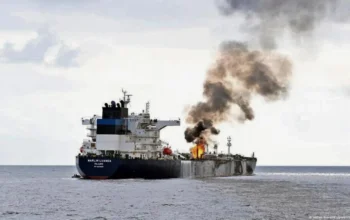
Tehran disputes that account entirely. Foreign minister Abbas Araghchi has said Iran will not agree to fully reopen the waterway unless Washington first lifts the naval blockade it reimposed in July — a move Iran regards as a breach of the June ceasefire — and meets its other conditions. Roughly a fifth of the world’s daily oil and liquefied natural gas supply passed through the strait before the war; traffic has been severely disrupted ever since.
Not everyone in Washington is convinced the tougher rhetoric reflects genuine strength. Democratic congressman Bill Keating, appearing on CNN, read the shifting White House position differently. “What you’re seeing here is the beginning of a capitulation,” he said. “This is reality. It’s sinking in.” Trump is under pressure at home to bring the conflict to a close ahead of November’s midterm elections, with high fuel prices weighing on rural areas that have previously backed him.
Progress reported with Oman on a shipping route
Away from the standoff over reparations, technical talks between Iran and Oman on arrangements to allow shipping through the strait appear to be advancing. Qatar’s foreign ministry said the negotiations had reached “an advanced stage” and were at “a critical juncture”, with spokesman Majed al-Ansari telling reporters that Doha, acting as a mediator, wanted to see the waterway reopened “as soon as possible”.
Iranian foreign ministry spokesman Esmaeil Baghaei described the talks with Oman as “progressing smoothly and constructively”, saying a map of the shipping route had been agreed even as some technical questions remained outstanding, including arrangements for paid services such as navigation assistance, environmental protection and maritime security. US officials have said they will not accept any deal that allows Iran to charge fees for access to the strait. Tehran maintains, in any case, that an agreement with Oman on navigation would fall short of a full reopening, which it says depends on Washington meeting its broader demands first.
Pakistan deepens its regional diplomacy
Pakistan’s own diplomatic activity intensified on multiple fronts on Tuesday. Interior minister Mohsin Naqvi flew to Tehran for talks with Iranian officials, meeting foreign minister Abbas Araghchi as well as his own counterpart, interior minister Eskandar Momeni, according to Iranian state media. Iran’s IRNA news agency said the visit was intended to cover bilateral ties and issues of mutual interest.
The visit came days after Pakistan signed a new trilateral defence pact with Saudi Arabia and Turkey. Under the Makkah Joint Defence Agreement, signed on Friday by prime minister Shehbaz Sharif, Saudi Crown Prince Mohammed bin Salman and Turkish president Recep Tayyip Erdoğan, an armed attack on any one of the three states would be treated as an attack on all three.
Foreign minister Ishaq Dar has since been working the phones with regional counterparts. Bahrain’s foreign minister, Abdullatif bin Rashid Al Zayani, called Dar on Monday night to congratulate him on the agreement and signalled his intention to visit Pakistan before long, according to a foreign office statement, which said Dar “reiterated Pakistan’s firm commitment to promoting dialogue and diplomacy to achieve peace and stability in the region and beyond.” Dar also spoke separately on Monday with Saudi foreign minister Prince Faisal bin Farhan, focusing on continued coordination between the two countries, and with Mr Araghchi, in a call centred on the new pact.
Pakistani officials have stressed that the Makkah agreement is defensive in character, names no adversary, and does not supersede the extensive bilateral and multilateral commitments each of the three states holds elsewhere — a significant caveat given Turkey’s Nato membership and the close security ties all three maintain with Washington. It builds on a bilateral defence pact Pakistan signed with Saudi Arabia last September, agreed on similar terms.
Copyright © 2021 Independent Pakistan | All rights reserved