By Staff Reporter
ISLAMABAD: Pakistan will keep working to bring the United States and Iran back to the negotiating table, its foreign minister said on Tuesday, warning that sharper great-power rivalry and the erosion of international rules were leaving every country less secure.
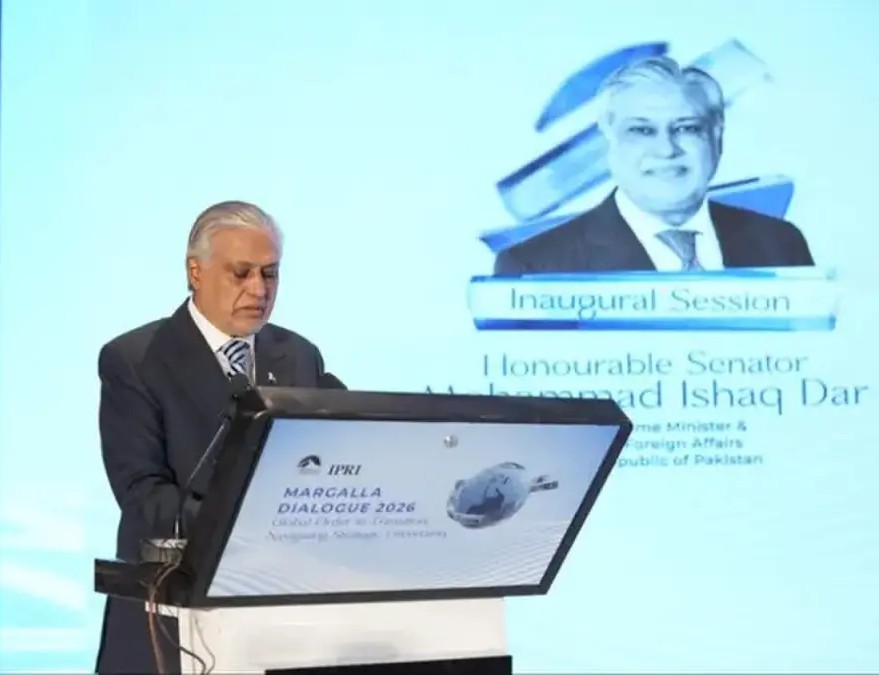
Ishaq Dar, who is also deputy prime minister, told the opening session of the Margalla Dialogue in Islamabad that contact between adversaries must never be allowed to lapse.
“Our experience reinforces a simple conviction. Even amid serious confrontation, channels of communication must remain open,” he said. “Closing them makes the next crisis harder to manage and peace harder to achieve.”
Pakistan and Qatar have led mediation efforts in a war that began on 28 February, when the US and Israel launched strikes across Iran, closing the Strait of Hormuz and driving up oil and gas prices. Islamabad hosted the first high-level talks in April, when a US delegation led by Vice President JD Vance met an Iranian team headed by parliament speaker Mohammad Bagher Ghalibaf. The meeting ended without a formal agreement.
Dar described the memorandum of understanding signed on 18 June as a foundation for further negotiations. The memorandum allowed a brief ceasefire and peace talks but later broke down, and by late July Dar was urging de-escalation in a call with his Iranian counterpart, Abbas Araghchi, as fighting between the two countries intensified.
Diplomacy is still moving, unevenly. Qatari mediators have been passing messages between the two sides and travelled to Tehran last week to discuss a draft deal. Donald Trump told CNN on Sunday that further strikes were highly unlikely if Iran agreed to a strong deal, and went further on Monday after meeting Qatar’s prime minister, saying he saw no need for more military action for now. Yet he confirmed on 7 November that US forces had carried out what he called minor strikes, and Iran’s military said four oil tankers caught fire after hitting mines in the Strait of Hormuz. The two sides also remain far apart on sequencing. Tehran says its talks with Washington rest on a seven-step plan that begins with the US lifting its blockade of Iranian ports and Iran reopening the strait, with other issues to follow, while Trump has linked an end to strikes to progress on Iran’s nuclear programme and on reopening Hormuz.
“Pakistan continues to pursue all diplomatic efforts with regional partners and parties involved to sustain engagement, restore dialogue and facilitate a return to the negotiating table,” Dar said.
He said he had stayed in contact with Saudi Arabia, Turkey and Egypt through a regional grouping known as the R4, as well as with Qatar. The R4 held a joint meeting on 23 October with the E4, made up of Britain, France, Germany and Italy. He also pointed to a five-point initiative issued jointly with China in Beijing on 31 March, which called for dialogue to restore peace in the Gulf and Middle East and for vessels to move through maritime routes without restrictions, permits or charges. Prime Minister Shehbaz Sharif, Field Marshal Syed Asim Munir, the chief of defence forces, and the Foreign Office had all stayed closely involved, Dar added.
Defence pact
Dar used the speech to defend the Makkah Joint Defence Agreement between Pakistan, Saudi Arabia and Turkey, describing it as a defensive arrangement that was “directed against no country” and “intended to contribute to regional peace and stability”. He said it reflected Pakistan’s commitment to collective security and credible deterrence.
The three countries signed the agreement in Makkah on 7 August, and it treats an armed attack on one member as an attack on all. The Turkish parliament approved it last week by 279 votes to 119, which clears the way for Ankara to send military support to Riyadh amid attacks by Yemen’s Iran-backed Houthi militants. The Associated Press has reported that Syria has decided to join.
Dar named three developments that he said demanded attention: pressure on the international security architecture, the growing overlap between geopolitics and economics, and rapid technological change. Prolonged conflicts and the weakening of arms control agreements were raising the risk of miscalculation, he said, while political divisions were hampering the United Nations.
“Selective application of international law further weakens confidence in the institutions established to uphold the same,” he said. “When agreed principles are applied inconsistently, their authority suffers and every country becomes less secure.”
Pakistan supported a more representative multipolar order, Dar said, but a wider spread of power would not by itself bring fairness or stability without effective multilateralism and respect for agreed rules. He said instability in the Gulf and the Red Sea showed how quickly regional crises could disrupt trade and energy supplies.
“A security crisis can become an economic shock,” he said. “That shock can raise food and fuel prices we are witnessing currently, threaten livelihoods and place public services under further pressure.”
He said artificial intelligence, cyber capabilities, biotechnology and space technologies were changing how states competed and how wars were fought, raising difficult questions about accountability and the rules governing their use.
On Gaza, Dar said the idea that might is right was gaining ground as force displaced international law, and pointed to the suffering there, the continued occupation and the expansion of illegal settlements as evidence of the cost of impunity. He said Pakistan had used its 2025-26 seat on the UN Security Council to promote the peaceful settlement of disputes. The council unanimously adopted Resolution 2788 during Pakistan’s presidency in July 2025, and agreed by consensus on 5 November to a Pakistan-initiated presidential statement stressing diplomacy and mediation even during active hostilities.
South Asia and Afghanistan
On India, Dar said unresolved disputes, military asymmetries and unilateral actions were undermining strategic stability, and that uncertainty must not become a justification for adventurism.
“Pakistan’s decisive and calibrated response to India’s unprovoked aggression in May 2025 through Operation Bunyanun-Marsoos demonstrated a resolve and capability to defend our sovereignty,” he said. India says its strikes that month were a response to the Pahalgam attack in April 2025, after which it placed the Indus Waters Treaty in abeyance.
“Regional stability also depends on respect for treaty obligations,” Dar said. “Pakistan will firmly safeguard its legitimate rights under the IWT and oppose any attempt to weaponise water. Where millions depend on the shared resource, honouring agreements is essential to both human security and confidence between the states.” He also restated Pakistan’s position on Kashmir.
Terrorism emanating from Afghan territory remained a security challenge, he said, adding that Pakistan would continue to protect its people while supporting a peaceful, stable and economically integrated Afghanistan. Progress required effective action to ensure Afghan soil was not used against other countries, particularly Pakistan.
The seventh Margalla Dialogue, launched in 2019, runs for two days under the theme “Global Order in Transition: Navigating Strategic Uncertainty”. Sessions cover power realignment, connectivity between South and West Asia, technology, national resilience and non-traditional security threats.
Copyright © 2021 Independent Pakistan | All rights reserved