By Staff Reporter
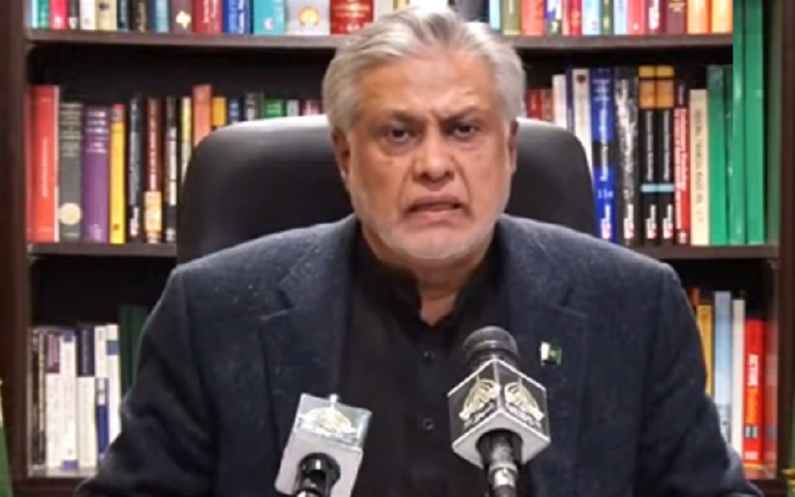
ISLAMABAD: Deputy Prime Minister and Foreign Minister Ishaq Dar warned on Tuesday that India may soon declare occupied Jammu a separate state, a step he said would violate international conventions and United Nations Security Council resolutions.
Speaking at a rally in Islamabad’s D-Chowk to mark six years since India altered the status of Kashmir, Dar condemned the potential move as part of a broader effort by New Delhi to tighten its grip on the disputed region.
On August 5, 2019, India revoked the special autonomy of Jammu and Kashmir, enshrined under Article 370 of its constitution, and split the region into two union territories: Jammu and Kashmir, and Ladakh. The decision, enacted through the Jammu and Kashmir Reorganisation Bill, stripped the region of its unique privileges and placed it under greater control of the central government in New Delhi, administered by a lieutenant governor. The move, upheld by India’s Supreme Court in 2023, has remained a flashpoint in the decades-long dispute between India and Pakistan over Kashmir.
Addressing the crowd, Dar pointed to reports in Indian media suggesting that Jammu could soon be granted statehood while occupied Kashmir remains a union territory.
“On August 5, 2019, Jammu and Kashmir and Ladakh were declared as union territory, but now it’s being said that Jammu will be given a statehood,” Dar said. He warned that such a decision could come “in the next few hours or days,” calling it “condemnable, unacceptable and provocative.”
Speculation about India’s next steps has intensified following recent meetings between the Indian president, Prime Minister Narendra Modi, and Home Minister Amit Shah. The Hindustan Times reported that these discussions among top government officials have stoked expectations of an impending announcement on restoring statehood to Jammu and Kashmir.
A senior leader of the ruling Bharatiya Janata Party (BJP) told the newspaper that statehood was “a promise that the government has already made… and it will be done when the time is right,” though he declined to confirm if a decision was imminent. Adding to the anticipation, India’s Supreme Court is set to hear an application on Friday seeking a directive to restore Jammu and Kashmir’s statehood, a development that has further fueled debate.
In Srinagar, Jammu and Kashmir Chief Minister Omar Abdullah dismissed the swirling rumors. In a post on X, he wrote: “I’ve heard every possible permutation & combination about what to expect in J&K tomorrow so let me stick my neck out and say nothing will happen tomorrow, fortunately nothing bad will happen but unfortunately nothing positive will happen either.”
Dar, however, painted a stark picture of India’s actions since 2019, accusing New Delhi of attempting to “usurp Kashmir” and reshape its demographics.
The minister cited changes to local laws, an expansion of the lieutenant governor’s authority, and a redrawing of the region’s legislative assembly boundaries to “influence the representation of Muslims in Kashmir.”
Dar also noted that non-Kashmiris have been permitted to obtain domicile status, purchase property, and join the voter rolls, steps designed to “make Kashmir a separate state and form a government in Srinagar which is subservient to New Delhi.” “This is unacceptable to Pakistan and its people,” he said.
The foreign minister said India’s moves are a violation of Kashmir’s status as an internationally recognised dispute. The United Nations Security Council, through resolutions like Resolution 47 in 1948, has called for a plebiscite to allow Kashmiris to determine their future, a vote that has never taken place. Pakistan contends that India’s unilateral actions contravene these resolutions and international law, a position Dar reiterated in his remarks.
The Kashmir conflict, dating back to the 1947 partition of India and Pakistan, remains a persistent source of tension. Both nations claim the region in full but control only parts of it, with India occupying Jammu, Kashmir, and Ladakh, and Pakistan holding Azad Kashmir and Gilgit-Baltistan. Any move to grant statehood to Jammu alone, as Dar fears, could deepen the rift and heighten friction in a region already marked by decades of unrest and has seen multiple wars.
Copyright © 2021 Independent Pakistan | All rights reserved