By Staff Reporter
ISLAMABAD: Pakistan has warned India that any aggression will be met with a “forceful response”, rejecting as “provocative” a threat by the Indian defence minister, Rajnath Singh, of a strike bigger than last year’s.
Singh told a defence conference in New Delhi on Thursday that any fresh terrorist activity originating from Pakistan would bring a response even larger than India’s last, saying New Delhi’s commitment to peace should not be mistaken for weakness. The reference was to Operation Sindoor, India’s military action in May 2025 following the Pahalgam attack in Indian occupied Kashmir that killed 26 civilians.
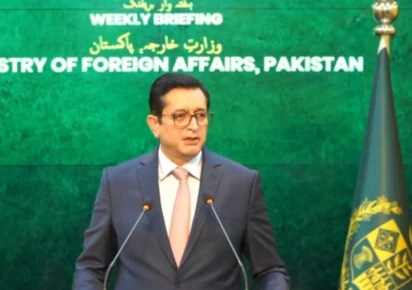
Responding at the Foreign Office’s weekly press briefing in Islamabad on Friday, spokesperson Sajjad Haider Khan used strikingly similar language.
“Restraint and commitment to peace must never be mistaken for weakness. Any aggression will be met with a forceful response,” he said.
Khan said the remarks reflected India’s “hegemonistic mindset” and the risk its “belligerent posture” posed to peace and stability in South Asia.
“Pakistan rejects and condemns the Indian defence minister’s provocative remarks entailing a threat of Indian aggression against Pakistan.”
He reminded India of the “consequences of its military aggression in May last year”, the brief conflict between the two countries, when he said Pakistan had demonstrated its capability and resolve to defend its sovereignty and territorial integrity and had given a “befitting response”.
“Let there be no ambiguity. Pakistan remains fully prepared to safeguard its sovereignty and territorial integrity against any ill-advised aggression,” Khan said.
He urged India to “draw an appropriate lesson from last year’s experience”, abandon its dangerous rhetoric and act responsibly for lasting peace in the region.
Asked about China’s objection to India’s decision to standardise the names of 28 places and geographical features in Ladakh, Khan returned to Kashmir. India announced the list on 2 October, and Beijing called the move illegal and invalid.
The spokesperson said India’s actions of 5 August 2019, which revoked the special autonomy of Indian-administered Kashmir and divided it into parts, were “illegal and void”. He said they could not alter the fact that Jammu and Kashmir was an internationally recognised disputed territory whose final status must be determined under relevant UN Security Council resolutions and the wishes of the Kashmiri people.
Afghanistan and terrorism
Khan said Deputy Prime Minister and Foreign Minister Ishaq Dar had addressed a conference on Pakistan’s counterterrorism landscape, organised by the Institute of Strategic Studies Islamabad on 12 October. It covered the Tehreek-e-Taliban Pakistan (TTP), cross-border threats and regional security.
According to the spokesperson, Dar called on Afghan authorities to take “concrete, verifiable and irreversible action against groups operating from Afghan soil” against Pakistan. He also spoke of the threat from “Indian-sponsored terrorist groups”, including those operating from Afghan territory, a claim India has repeatedly denied.
Dar listed Pakistan’s counterterrorism measures, including the National Action Plan, Operation Azm-e-Istehkam and improved intelligence coordination, and paid tribute to the armed forces and law enforcement agencies for their sacrifices, Khan said.
Pakistan was among 18 countries whose foreign ministers on Friday condemned Colombia’s opening of an embassy in Jerusalem on Wednesday. The others were Algeria, Djibouti, Egypt, Indonesia, Jordan, Kuwait, Lebanon, Libya, Malaysia, Oman, Palestine, Qatar, Saudi Arabia, Somalia, Syria, Sudan and Turkey.
Their joint statement said the move contravened UN Security Council resolutions and undermined efforts to achieve a “just and lasting peace based on the two-state solution”. It cited Security Council resolutions 476 and 478 of 1980, which reject attempts to change Jerusalem’s status. The ministers urged Bogotá to “reconsider and reverse this decision”.
Most countries keep their embassies in Tel Aviv, arguing that Jerusalem’s status should be settled in a final peace agreement. Colombia joins a small group that includes the United States, which moved its embassy during Donald Trump’s first term. Fiji, Guatemala, Honduras, Papua New Guinea, Paraguay and Nauru have also followed. In May, Pakistan and 13 other countries condemned Somaliland’s opening of what it called an embassy in Jerusalem.
On the occupied West Bank, Mr Khan said Pakistan regarded the forced displacement of Palestinians, and attempts to stop them returning, as serious violations of international law. He was responding to reports that displaced residents of the Tulkarm refugee camp would not be allowed back. He called on the UN Security Council to act to halt unlawful evictions and hold the occupying power accountable.
The Foreign Office also condemned the latest Houthi attack on King Khalid International Airport in Riyadh, reaffirming support for Saudi Arabia’s sovereignty and security. Khan said attacks on civilian populations and critical infrastructure were “unacceptable”. He said Pakistan, Saudi Arabia, Egypt and Turkey issued a joint statement on 11 October under the R4 Group Framework calling for an immediate and unconditional end to the attacks.
Khan said Oman’s foreign minister, Sayyid Badr bin Hamad bin Hamoud Al-Busaidy, visited Islamabad on 13 and 14 October. He and Mr Dar co-chaired the eighth session of the Pakistan-Oman Joint Ministerial Commission. They agreed to expand cooperation in trade, investment, energy, maritime connectivity, information technology and workforce mobility, and signed five agreements and memorandums of understanding.
Dar also met Russia’s interior minister, Vladimir Kolokoltsev, on 14 October. They discussed trade, investment, culture and tourism, and the importance of coordination in forums including the Shanghai Cooperation Organisation.
The deputy prime minister held calls on 15 October with Egypt’s foreign minister, Badr Abdelatty, and Turkey’s, Hakan Fidan. The talks with Mr Fidan covered Gaza and preparations for the Organisation of Islamic Cooperation foreign ministers’ meeting in Iraq. On 10 October he spoke to Maldives foreign minister Ertugrul Hisham Adem about President Mohamed Muizzu’s forthcoming visit to Pakistan.
Dar met the EU’s migration commissioner, Magnus Brunner, in Islamabad on 13 October. He argued that Pakistan’s efforts against irregular migration, smuggling and trafficking should be matched by more legal routes for skilled Pakistani workers.
Khan said EU figures showed irregular migration from Pakistan to Europe had fallen by about 64 per cent over the past 18 months. “In Europe, they are short of labour, and in Pakistan we have sufficient labour workforce,” he said, adding that the Migration and Mobility Dialogue launched in November 2022 was a “win-win template”.
The spokesperson announced that the International Atomic Energy Agency’s International Physical Protection Advisory Service mission, the first of its kind in Pakistan, concluded on 9 October. It reviewed the country’s legal and regulatory framework for nuclear security, and the IAEA team praised Pakistan’s cooperation, transparency and professionalism.
Khan also said the Foreign Office, the Higher Education Commission and the Inter-Boards Coordination Commission had signed an agreement to integrate their databases and speed up the attestation of educational documents. Asked about an inquiry into alleged irregularities in attestation services and reports of officials being taken into custody, he said the committee was formed from outside the ministry and would announce its findings once its work was complete.
Copyright © 2021 Independent Pakistan | All rights reserved